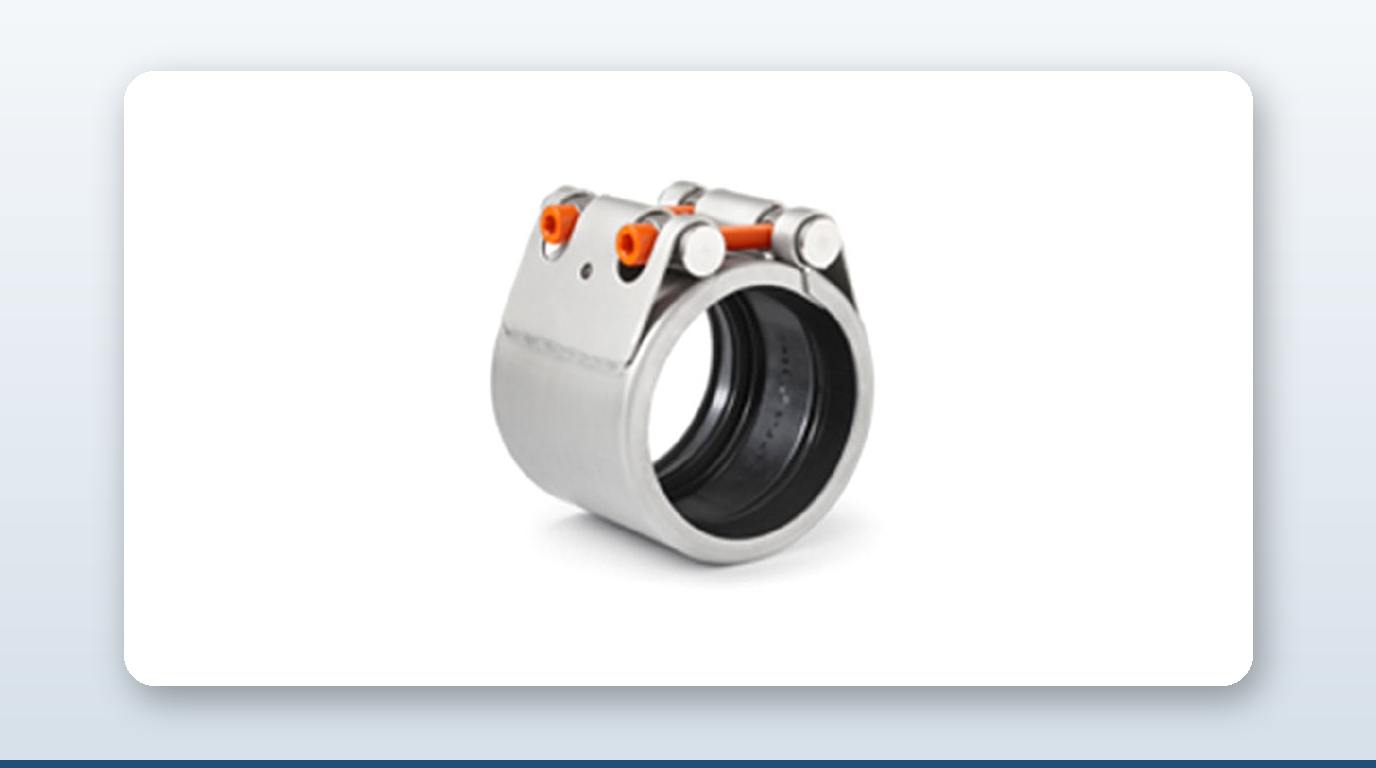
The short answer is no — not the coupling already on your shelf.
This question comes up constantly on water-main and industrial jobs in Singapore and across the region, and it usually arrives the same way: a contractor has a PE100 main to tie into an existing ductile-iron line, has a box of mechanical couplings in the van, and wants to know whether the DN100 coupling will do the job on the DN100 PE pipe.
It will not. And the reason it will not is not a preference or a warranty technicality. It is two separate physical facts, either of which is enough on its own to make the joint fail.
This article explains both, then covers what you actually need to order for a mechanical joint on HDPE — and, just as importantly, when you should not be using a mechanical joint on HDPE at all.
Fact One: HDPE Runs on Its Own Outside-Diameter Series
Mechanical couplings grip the outside of the pipe. That makes the pipe’s outside diameter the only dimension the coupling actually cares about — not the nominal bore, not the material, not the pressure class.
For carbon steel and stainless steel, OD is fixed by ANSI/ASME B36.10M and B36.19M. DN100 steel pipe is 114.3 mm OD, whatever the wall schedule. Ductile iron follows its own series again. Polyethylene follows a third series entirely — ISO 161 and ISO 4427 in metric markets, IPS/AWWA sizing in North American practice.
The consequence is blunt: a “DN100” PE pipe and a “DN100” steel pipe are not the same size on the outside. A coupling whose housing and gasket compression range were designed around 114.3 mm has been handed a pipe that is a different diameter. Depending on the direction of the mismatch, you get one of two outcomes, and both are bad:
- – Coupling too large — the gasket never reaches proper compression. The joint weeps immediately or under first pressure test.
- – Coupling too small — it will not go on, or it goes on and over-compresses the gasket, which sets hard and leaks in a year.
There is a further wrinkle specific to PE. PE pipe is specified by SDR (Standard Dimension Ratio), which fixes the ratio of OD to wall thickness. Changing SDR — SDR11 for roughly PN16, SDR17 for roughly PN10 — keeps the OD constant and changes the wall. So SDR affects how much the pipe can resist being squeezed, even when the OD the coupling grips is identical. This matters for the second fact.
Fact Two: HDPE Needs a Stainless Internal Stiffener
Steel does not care that a coupling is squeezing it. Polyethylene does.
PE is a thermoplastic. It is flexible by design — that flexibility is a large part of why it is chosen for buried mains in the first place. But under the radial clamping load of a mechanical coupling, and especially under end-load (the pull-out force from internal pressure on an unanchored buried joint), a PE pipe end will deform inward and pull out of the coupling.
The fix is a close-fit stainless-steel internal support liner, also called a stiffening insert. It slides inside the pipe end and gives the coupling something rigid to compress against. Viking Johnson makes this mandatory on all PE and thin-wall PVC connections. Romac sells a dedicated HDPE pipe stiffener as a separate line item across a 4″–36″ range for exactly this purpose.
Two things follow from that, and both get missed on site:
1. The liner is a separate part number. It does not arrive in the coupling box. If it was not ordered, it is not on the truck, and the joint is not compliant. 2. The liner must match the pipe’s SDR, not just its OD. A thicker-walled SDR11 pipe has a smaller bore than an SDR17 pipe of the same OD. The wrong liner is loose, and a loose liner does nothing.
A mechanical joint on PE without the internal stiffener is not a marginal joint. It is a joint that will pull out.
So What Should You Actually Order?
Once both facts are respected, mechanical joining of HDPE is entirely standard practice. You need one of two product families.
Transition couplings — where PE meets metal
This is the most common HDPE mechanical joint by a wide margin, because a fused PE system is monolithic right up until it meets something that is not PE. It always does: every gate and butterfly valve, every air valve and washout, every hydrant, meter, pump flange and DI chamber, and every tie-in to the existing cast-iron or ductile-iron network.
At those boundaries the joint is mechanical by physics. There is no fusion option. What you want is either:
- – A dedicated PE-to-metal transition coupling — sized to grip PE on one side and metal on the other.
- – A wide-tolerance universal coupling — one fitting with a compression range broad enough to span PE, DI, steel, PVC, CI, AC and GRP. These earn their keep on renewal work where you genuinely do not know what is in the ground until the trench is open.
For buried, unanchored joints, add one more requirement: end-load resistance. The coupling must grip against pull-out, not merely seal. An unrestrained transition coupling on a pressurised buried PE main is a joint waiting to separate.
Repair clamps and couplings — on live PE mains
Third-party excavation damage is the number-one cause of water-main failure, and when a live PE main is struck, in-situ fusion repair is usually impossible. The line is pressurised and wet, the trench is confined, there is frequently no power on site, and draining a live main is not an acceptable answer.
A mechanical repair clamp rated for HDPE is the only field option in that situation. Several manufacturers publish explicit HDPE ratings on their stainless full-circle clamps — some ranges are designed exclusively for HDPE repair, typically with a minimum SDR limit stated on the datasheet. Check for that stated rating rather than assuming a clamp that handles DI will handle PE.
When You Should Not Use a Mechanical Joint on PE
It is worth being straight about this, because the honest answer sells better than the convenient one.
On a long, straight, buried PE run — with power on site and clean, dry pipe — electrofusion or butt-fusion is the better engineering answer, and it is not close. A fused joint is monolithic. There is no leak path and no elastomeric seal to maintain, and it is rated for the pipe’s full 50–100 year design life. A mechanical coupling on that same run introduces a gasket, which is a maintained leak path measured in decades.
Where mechanical joining genuinely wins is everywhere fusion cannot go:
| Constraint | Fusion | Mechanical coupling |
|---|---|---|
| Power on site | Required | None needed |
| Pipe condition | Must be clean, dry, scraped | Wet-tolerant |
| Live / in-service work | Not possible | Yes — under pressure |
| Confined or congested trench | Difficult | Straightforward |
| Dissimilar materials (PE to metal) | Impossible | This is its job |
| Time to pressurise | Timed cooling and cure hold | Immediate |
| Certified operator | Required | Fitter, no fusion cert |
| Demountable later | No — cut it out | Yes |
Read that table as a routing rule rather than a scorecard. Straight buried run with power and dry pipe: fuse it. Boundary, repair, live line, confined space, or dissimilar material: mechanical, with the correct PE-OD coupling and the stainless liner.
The Ordering Checklist
Before a mechanical coupling goes onto HDPE, five things need to be on the purchase order:
1. The pipe’s actual OD in millimetres — measured, not inferred from the DN label. 2. The pipe’s SDR — this sets the liner bore and the pipe’s resistance to radial compression. 3. A coupling with a stated PE-OD rating, or a wide-tolerance coupling whose published range covers the measured OD. 4. The stainless internal stiffening insert, matched to OD *and* SDR, ordered as a separate line. 5. End-load resistance, if the joint is buried and unanchored.
Miss item 3 and it will not seal. Miss item 4 and it will pull out.
Getting the Right Part the First Time
The reason this article exists is that the failure mode here is expensive and entirely avoidable. A wrong-OD coupling and a missing liner are both caught in ten seconds at the quotation stage, and both are caught at the worst possible moment if they are caught in an open trench with a live main.
David Phee Enterprise supplies mechanical couplings, transition couplings and repair clamps across Singapore, Malaysia and Indonesia from our Kaki Bukit HQ, with same-day delivery on stocked lines. If you are joining PE to metal — or repairing a live PE main — send us the measured OD and the SDR rather than the nominal size, and we will confirm the correct coupling and liner combination against the manufacturer’s published PE range before anything ships.
For technical enquiries and quotations, visit www.davidphee.com.
*This article covers general engineering principles for mechanical joints on polyethylene pipe. Always confirm PE-OD ratings, SDR limits and liner requirements against the specific manufacturer’s current datasheet for the product being installed, and follow the project specification where it is more restrictive.*