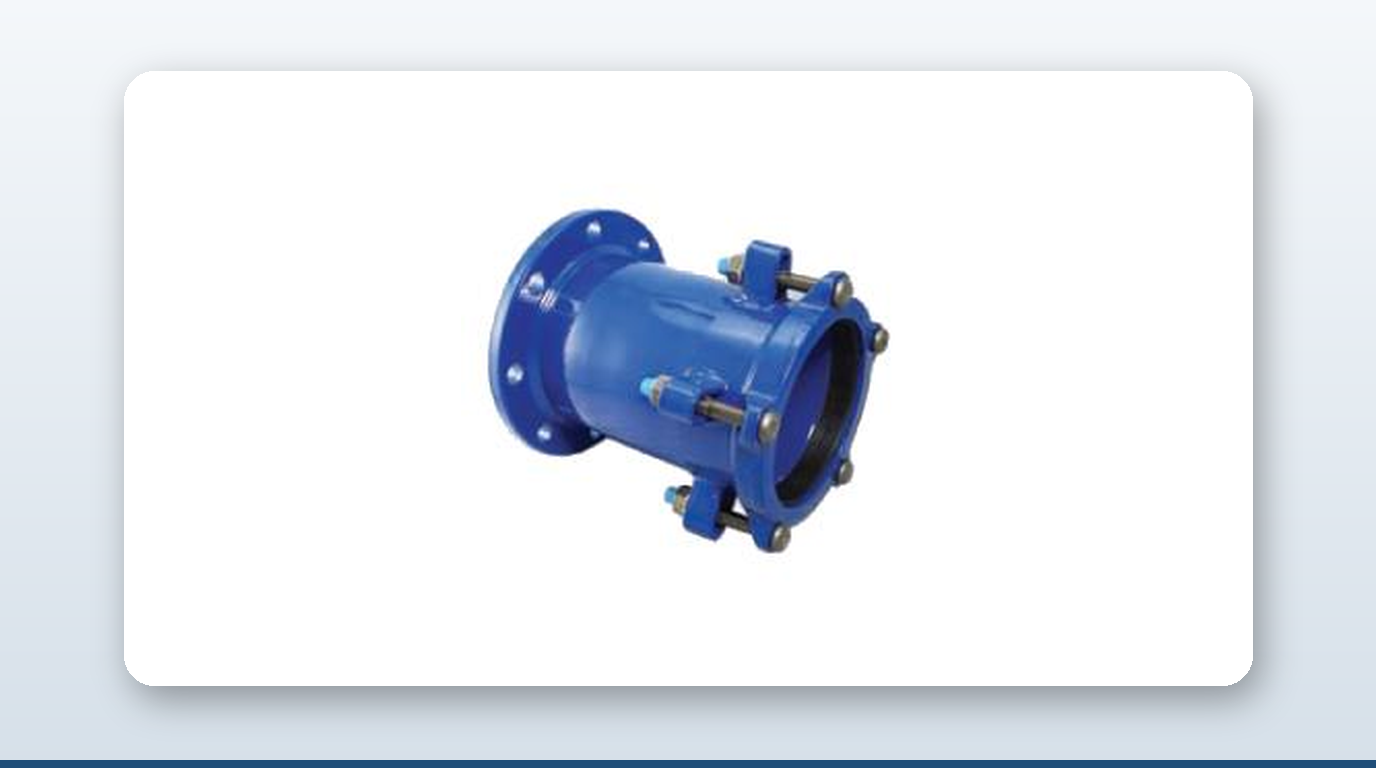
There is no single right material for a seawater coupling.
That is not a hedge. It is the actual engineering answer, and treating it as one is what keeps seawater joints in service. The correct material is set by service, velocity, temperature, design life and classification society — and a specification that names a material without naming those five things is incomplete.
The honest short version, before the detail:
> Ductile iron for cost. Stainless for general marine. Copper-nickel for fire main and high-velocity seawater.
This article explains why that ordering exists, what the numbers behind it are, and where each lane runs out.
Why Seawater Is Harder Than It Looks
Seawater attacks piping through several mechanisms at once, and they do not all respond to the same defence:
- – Chloride pitting — localised breakdown of a passive film. The dominant failure mode for stainless steels.
- – Crevice corrosion — under gaskets, deposits and biofouling, where oxygen is depleted and chlorides concentrate. Mechanical couplings create crevices by design, which is why this matters more here than on welded pipe.
- – Erosion-corrosion — the protective film stripped by flow above a threshold velocity. This is what sets the velocity limits below.
- – Galvanic corrosion — dissimilar metals in an electrolyte. A coupling joining two materials is a galvanic cell unless it is designed not to be.
- – Sulphide attack — in stagnant or polluted seawater, particularly harbour water.
Note that two of these — crevice and galvanic — are specific to the joint rather than the pipe. A material that performs well as pipe does not automatically perform well as a coupling in the same water.
Lane 1: Copper-Nickel — The Gold Standard
Why it works
Cu-Ni forms a protective oxide film (a Cu₂O·NiO complex) on exposure to seawater. The film does three useful things: it acts as a barrier against chloride pitting, it is self-healing — scratch it and it reforms — and copper ion release gives it genuine antifouling behaviour.
That self-healing property is the real differentiator. Stainless relies on a passive film that, once broken locally, tends to keep corroding at that point. Cu-Ni repairs itself.
The velocity limits — the practical spec gate
This is the number that decides the material, and it is routinely missed:
| Alloy | Maximum design seawater velocity |
|---|---|
| 90-10 Cu-Ni | 3.5 m/s |
| 70-30 Cu-Ni | 4.0 m/s |
These are the BS MA18 figures for pipes of 100 mm diameter and above.
Above the breakaway velocity — around 3.5 m/s for 90-10 — corrosion rates climb sharply. If the system design puts velocity above that, the answer is either velocity-reduction measures (larger diameter at pump discharge, orifice plates, bypass loops) or stepping up to the 70-30 alloy. It is not “it will probably be fine.”
Life and corrosion rate
General corrosion rate in seawater runs 0.025 to 0.0025 mm/yr, the range covering variation in turbulence, temperature and dissolved oxygen. With velocity properly controlled, expect 30+ years in fire-main service.
Why mechanical couplings matter on Cu-Ni
Cu-Ni is hard to weld. It needs a compatible filler metal, low heat input and a controlled atmosphere. That makes welding expensive and slow in the field.
Consequently mechanical jointing is the routine field choice on Cu-Ni piping — flanged, grooved, or plain-end mechanical couplings. This is not a compromise on Cu-Ni systems; it is standard practice.
Where Cu-Ni is effectively mandatory
- – Marine fire main, naval and commercial — 70/30 is the naval standard
- – High-velocity seawater cooling, above roughly 2 m/s with excursions
- – FPSO topside seawater where enhanced-corrosion class notations apply
- – Naval and submarine service — non-magnetic, shock-tested, fire-resistant
The canonical fire-water build
A typical fire-water mechanical coupling specification for shipyard service — the material stack that recurs on this duty — looks like:
- – Middle ring and follower: Cu-Ni 90/10
- – Bolts, nuts, washers: SUS316L
- – Gasket / packing: FKM (Viton)
That combination is worth recognising, because it shows the principle in miniature: the wetted body in Cu-Ni, the bolting in a stainless grade that will not become the sacrificial anode, and an elastomer chosen for the temperature and service rather than for the water alone.
Lane 2: Stainless Steel — The Workhorse
Stainless covers the largest volume of general marine work, and its limits are well defined by one number.
The PREN ladder
Pitting Resistance Equivalent Number predicts resistance to chloride pitting. It is the fastest way to know whether a grade belongs in seawater at all:
| Grade | PREN | Seawater verdict |
|---|---|---|
| SUS304 | ≈ 19 | Not for seawater |
| SUS316 | ≈ 25 | Marginal — continuous flow only |
| 22Cr duplex | ≈ 35 | Acceptable for seawater |
| 25Cr super duplex | ≈ 41 | Proper seawater material |
| 6Mo super austenitic | ≈ 43 | Top-tier non-Cu-Ni option |
The single most common specification error in this space is treating 316 as a seawater material. It is not, quite. At PREN ≈ 25 it is acceptable in continuous-flow seawater and fragile under intermittent or stagnant conditions — which describes a great many real systems, including anything that sits idle in port.
Where stainless wins
- – Cooling water — continuous flowing seawater at design velocity of 2 m/s or below
- – General industrial marine utility — fresh water, condensate, low-pressure steam, drains
- – Engine-room piping away from direct seawater contact
Where stainless fails
- – Stagnant or low-flow seawater — chloride pitting
- – Under gaskets, deposits and biofouling — crevice corrosion, which a coupling geometry actively encourages
Design life expectation
| Grade and service | Expected life |
|---|---|
| SUS304/316 in fresh water | 25+ years |
| SUS316L in continuous-flow seawater | 10–15 years |
| Super duplex / 6Mo in seawater | 25+ years |
| Cu-Ni 90/10 in controlled-velocity seawater | 30+ years |
The 316L line is the one to internalise. Ten to fifteen years is a real service life and often entirely acceptable — but it is roughly half of Cu-Ni’s, and a design assuming a 30-year life on 316L in seawater is a design that will need an unplanned replacement.
Cost, indicatively
Relative to 90-10 Cu-Ni as a baseline: 70-30 Cu-Ni carries a further 20–30% premium; 316L sits roughly 20–30% below 90-10 upfront; coated ductile iron is cheapest upfront and shortest-lived under aggressive seawater.
Note “upfront.” On a 30-year asset, the upfront ordering does not survive a life-cycle comparison.
Lane 3: Ductile Iron — Cost-Led
Ductile iron with a suitable coating and an NBR or EPDM gasket is the cost-led lane, and it has a legitimate place — typically in less demanding marine classifications and in systems where the design life expectation is shorter or replacement is straightforward.
It is the shortest-lived option under aggressive seawater, and the honest boundary is this: do not put cost-led ductile iron into fire-main service. That is not the duty for it.
The Two Rules That Cut Across All Three Lanes
The gasket is selected separately, and it decides leaks
The body material determines how long the coupling survives. The gasket determines whether it seals.
For seawater, EPDM is the marine default and performs well across seawater, fresh-water cooling and fire main. Two cautions:
- – EPDM is destroyed by petroleum oils — so a seawater default is not a universal default. Any line that may see hydrocarbon contamination needs a different compound.
- – Where the seawater is chemically treated — electrochlorinated ballast water, hypochlorite dosing — most common elastomers degrade. That service needs a compound chosen for the chemistry, typically AFLAS.
Specify the compound, the cure system and the hardness in writing. Never order “rubber.”
Watch the galvanic couple
A coupling that joins two different metals, or whose body is a different metal from the pipe, forms a galvanic cell in seawater. This is why the fire-water build above uses SUS316L bolting with a Cu-Ni body — the bolting has to not become the anode.
Where dissimilar metals are unavoidable, the joint needs to be designed for it: appropriate material pairing, gasket isolation, and in some cases an insulating kit. Treat the coupling as a designed galvanic interface, not an incidental one.
Choosing, in Practice
Five questions, in order:
1. What service? Fire main, seawater cooling, ballast, general utility. 2. What velocity? Above 3.5 m/s takes you out of 90-10 and into 70-30 or a redesign. 3. Continuous flow or intermittent/stagnant? Intermittent rules out 316. 4. What design life? 10–15 years and 30+ years are different materials. 5. What class society and notation? This can override everything above.
Answer those and the material chooses itself. Skip them and the choice is a guess with a 10-year settlement period.
Specifying With Us
David Phee Enterprise supplies mechanical couplings, repair clamps and expansion joints for marine and industrial seawater service across Singapore, Malaysia and Indonesia, from our Kaki Bukit HQ, with same-day delivery on stocked lines. We hold stainless plain-end couplings and repair clamps in common marine sizes; copper-nickel fire-main builds are project-specific and are quoted to the specification rather than taken from stock.
When you send an enquiry, the five questions above are what we will ask. Sending the answers up front — service, velocity, flow regime, design life, class — gets a correct quotation back considerably faster than a nominal size alone.
For technical enquiries and quotations, visit www.davidphee.com.
*Velocity limits cited are the BS MA18 figures for pipes 100 mm diameter and above. PREN values are nominal and vary with actual composition. Corrosion rates and design lives are general engineering expectations, not guarantees — confirm against the project specification, the classification society’s material rules and the manufacturer’s current datasheet for the specific product.*