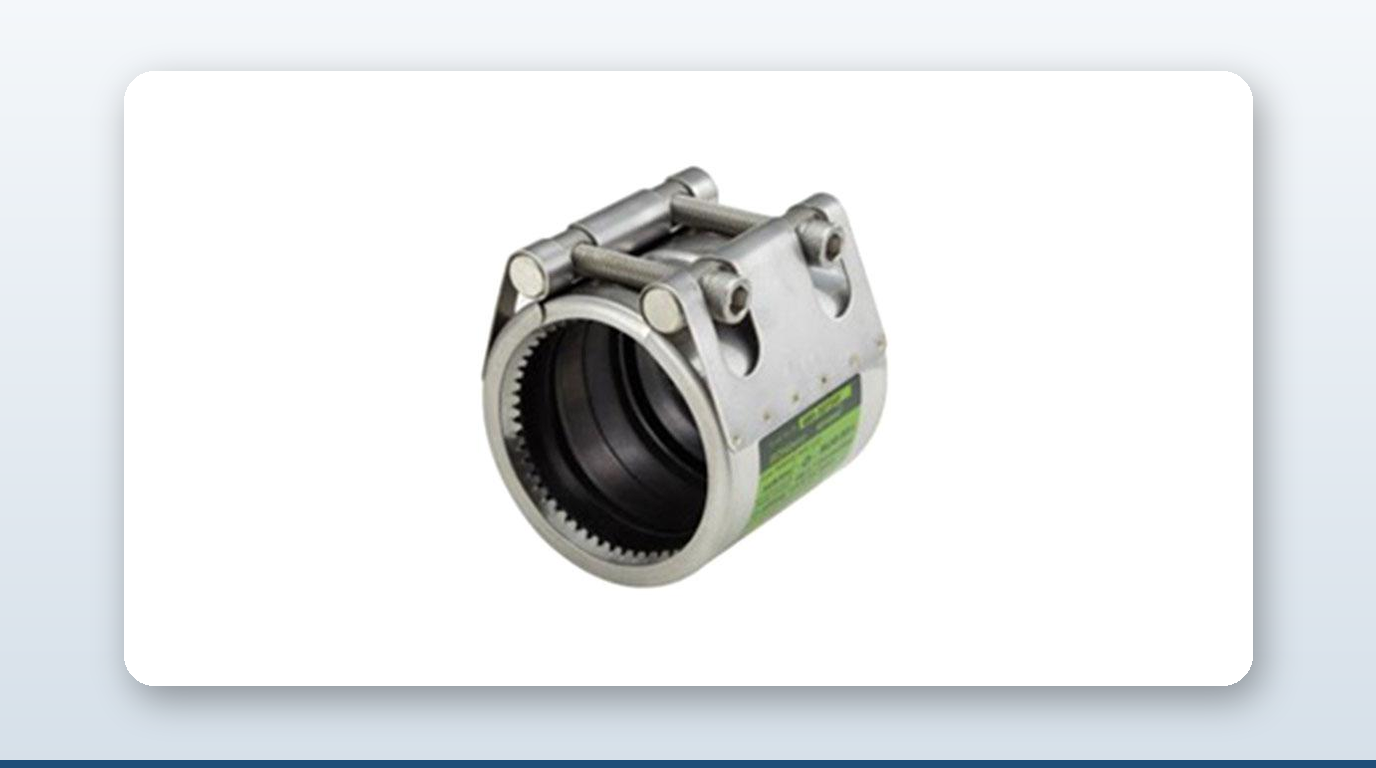
Two couplings sit on a counter. Same nominal size, same material description, same general shape. One costs meaningfully more than the other. A buyer reasonably asks what the difference is.
The answer is almost never the steel. Both are probably made from a broadly similar grade, in a broadly similar way. What separates them is the documentation chain, control over the gasket compound, dimensional consistency, and who is liable when it leaks.
Sometimes those things are worth paying for. Sometimes they are genuinely not, and a buyer who pays for them on every line item is wasting money. This guide is about telling the two situations apart.
First, the Vocabulary
The terms get used loosely, which is part of the problem.
OEM part. The component specified by the original equipment manufacturer for a specific piece of equipment — the coupling that a pump skid, a BWTS package or a piping system was originally supplied with, usually carrying that maker’s part number.
Branded coupling. A product from a named coupling manufacturer, sold under that manufacturer’s own model designation, with published datasheets, dimensional standards and — where applicable — third-party certification.
Generic or unbranded. A dimensionally similar product without a traceable manufacturer identity, published datasheet or certification trail. It may be perfectly well made. You have no documented way to know.
The important distinction is not really OEM versus branded. Those two are usually the same thing wearing different labels. The meaningful line is between a product with a traceable documentation chain and one without.
What You Are Actually Paying For
1. The documentation chain
A branded coupling comes with a stated pressure rating, a stated OD range, a material specification, and — where relevant — a third-party certificate. That paperwork does two jobs. It tells you whether the part is suitable, and it gives you something to point at when a surveyor, a client’s QA, or an insurer asks.
An unbranded coupling gives you a dimension and a promise. On a job that never gets inspected, that may be sufficient. On a job that does, the absence of paperwork is the problem, regardless of how good the part is.
2. Control over the gasket compound
This is the difference that actually causes failures, and it is invisible at the counter.
The housing is easy to copy. The gasket is not, because the gasket’s performance lives in the compound and cure system, not in its shape. Two black rubber rings with identical dimensions can be:
- – EPDM, peroxide-cured — good for roughly 25–30 °C more continuous service temperature than the alternative, far better compression set over years, appropriate for hot water and steam; or
- – EPDM, sulphur-cured, high filler loading — visually identical, materially cheaper, and prone to hardening and leaking within months in continuous hot-water duty.
Both are honestly describable as “EPDM.” There is no way to tell them apart by eye.
When you buy a branded coupling, the compound and cure system are controlled and stated. When you buy an unbranded one, you are buying an unspecified elastomer and finding out its cure system in service.
3. Dimensional consistency across a batch
A one-off replacement is forgiving. Fifty couplings across a system are not. Batch-to-batch variation in housing dimensions and gasket section shows up as a handful of joints that need extra torque, then a handful that weep.
4. Recourse
If a branded coupling fails inside its stated envelope, there is a manufacturer, a distributor and a warranty conversation. If an unbranded coupling fails, there is a supplier who may or may not still stock the same item, and no published envelope to have failed against.
For a low-consequence joint that is a shrug. For a joint whose failure means a vessel off-hire or a plant shutdown, it is the whole point.
The Rule That Removes the Choice Entirely
On classed marine work, this decides it before any commercial discussion:
> Classification-society type approval attaches to the coupling and gasket as a combination — not to the coupling alone.
An approved housing fitted with a different gasket compound is not an approved joint. It does not matter that the gasket seals. At survey, the certificate covers a specific combination, and a substituted gasket falls outside it.
This is why a sheet-cut aftermarket gasket at a fraction of the price is a false economy on classed service. It may work perfectly for years. It has also voided the certificate, and that will surface at the least convenient possible moment.
The same principle applies to potable water in Singapore. Approvals under SS 375 or BS 6920 attach to specific cured compounds. A generic “EPDM” gasket has no approval, and the joint it sits in cannot be signed off for potable service.
Where certification is required, certificate and part are inseparable. There is no version of this where the cheaper unbranded route is compliant.
When Generic Is Genuinely Fine
Being straight about this matters, because a guide that concludes “always buy branded” is a sales page, not advice.
Unbranded or lower-cost product is a reasonable choice when all of the following hold:
- – The line is not classed, not potable, and not fire-critical. No certificate is required by anyone.
- – The consequence of failure is low. A weep into a bund or a drain, not a flooded machinery space.
- – The joint is accessible. You can get to it and fix it without a shutdown, a scaffold or a diver.
- – The service is benign. Ambient temperature, clean water, moderate pressure, no aggressive chemistry.
- – It is a one-off, not part of a batch where consistency matters.
- – Nobody will audit it. No client QA, no insurer, no surveyor.
Plenty of real work meets that description — non-critical plant service lines, drainage, temporary installations, workshop rigs. Paying a certification premium there buys nothing.
When It Definitively Is Not
Reverse the list, and any single one of these is enough:
- – Classed vessel piping. Type approval, combination rule, no exceptions.
- – Potable water. SS 375 or BS 6920 contact approval is a legal gate, not a preference.
- – Fire main and fire-critical lines. Fire-test evidence to ISO 19921/19922 where required.
- – Buried and unanchored joints. Failure means excavation; end-load resistance must be a rated property, not an assumption.
- – Seawater service. Material selection is doing real work here — PREN, velocity limits, galvanic pairing. An unspecified “stainless” is not an answer.
- – High consequence of failure. Off-hire, shutdown, flooding, environmental release.
- – Anything that will be audited.
The Cost Nobody Prices In
Mixed inventory.
A store holding four different unbranded couplings that all say “DN100” is a store where nobody can confidently pick a replacement gasket, because the gasket section depends on the housing that nobody recorded. The saving on the original purchase gets spent several times over in the years afterward — in wrong parts ordered, in joints rebuilt twice, and in the hour someone spends with a calliper trying to work out what is actually installed.
Standardising on a small number of known brands is worth real money over an asset’s life, and it is worth more the larger the installed base.
Practical Red Flags
When evaluating any coupling offer:
- – No stated OD range — only a nominal size. The nominal size is a label; the OD is what the coupling grips.
- – No stated pressure rating, or a rating with no reference standard behind it.
- – “Rubber gasket” with no polymer, no cure system and no hardness.
- – ISO 9001 offered as the product credential. ISO 9001 certifies the factory’s quality-management system. It says nothing about whether this part meets any dimensional or pressure requirement.
- – A certificate that names a different model than the one being quoted.
- – No body marking on a product being sold for certified service.
- – “Equivalent to” without saying equivalent in what respect — dimension, pressure, material, or approval. These are four different claims.
How to Decide, Quickly
One question, asked first: does this joint need a certificate?
- – Yes → the choice is made. Branded, certified, with the approved gasket. There is no compliant alternative.
- – No → then it is a genuine commercial decision, and it turns on consequence of failure and accessibility. Low consequence and easy access: buy on price. High consequence or hard access: buy the documentation, because you are buying predictability rather than a certificate.
Our Position, Stated Plainly
David Phee Enterprise stocks branded mechanical couplings, repair clamps and expansion joints, so we have an obvious commercial interest in this question. Our actual advice is the version above rather than the simpler one.
Where a line is classed, potable or fire-critical, we will quote the certified product with the approved gasket combination and will not offer a dimensional substitute, because a substitute is not compliant. Where a line is none of those things, we will say so, and the decision is a straightforward commercial one that you are better placed to make than we are.
If you are unsure which category a given joint falls into, tell us the service, the pressure, the temperature and whether the vessel or system is classed. That question is usually settled in one exchange.
For technical enquiries and quotations, visit www.davidphee.com.
*Certification requirements vary by flag state, classification society, project specification and local authority. This guide describes general practice; always confirm the applicable requirement against your project specification and the relevant authority before deciding on a substitution.*