A chiller plant room on the third basement level of a 1980s office tower doesn’t get the luxury of a shutdown window. The building above is fully tenanted, the chilled-water loop feeds live air-handling units on every floor, and the facilities team usually discovers a weeping joint on a condenser-water header only because someone notices a damp patch on the plant room floor. Fixing it — replacing the joint, or the length of pipe around it — has to happen without cutting cooling to the building, without disturbing the fire protection risers running through the same shaft, and almost always inside the narrow after-hours access window the facilities management (FM) contract allows.
This is the day-to-day reality behind what looks, from the outside, like a routine MEP retrofit. Singapore’s facilities management market was estimated at USD 3.69 billion in 2025, growing toward USD 4.19 billion by 2030, and hard services — the mechanical and electrical maintenance work that includes plant-room pipework — account for more than half of that spend. A meaningful share of it is aging-infrastructure repair: chilled-water (CHW) and condenser-water (CW) pipework in commercial buildings dating from the 1970s through the 1990s is now well past the point where corrosion pitting, joint fatigue, and coupling failure are routine maintenance events rather than exceptions.
The Occupied-Building Constraint
Unlike a new-build installation, a retrofit inside an occupied building carries three constraints layered on top of the mechanical work itself: continuity of service, limited access windows, and proximity to systems that can’t be touched without triggering a separate compliance process. CHW and CW loops typically can’t be fully isolated for more than a few hours without affecting tenant comfort or, in buildings with server rooms or specialist tenants, process cooling. Plant rooms and riser shafts frequently sit next to or share space with fire protection pipework, which sits under a stricter, separate certification regime (covered below). And most of the physical work — moving pipe sections, staging tools, running a temporary bypass — has to happen during evening or weekend maintenance windows negotiated with the building’s FM team.
This is why mechanical coupling technology, rather than welding or full pipe-section replacement, dominates this kind of retrofit work. A flexible mechanical coupling or an in-service repair clamp can be fitted around an existing pipe section — in many cases without fully draining or isolating it — without the hot work, ventilation permits, and extended shutdown that welded repair requires. That difference is the entire reason mechanical couplings exist as a distinct product category for building services work, separate from new-construction piping.
Where Coupling Failures Show Up First
Not every pipe run in a commercial building carries the same retrofit profile. The table below sets out where coupling-based retrofit work concentrates, and roughly how often it recurs.
| System | Location | Pipe content | Typical coupling type | Service / replacement cycle |
|---|---|---|---|---|
| CHW supply/return mains | Basement or roof plant room | Chilled water, 6–12°C, up to ~10 bar | Flexible or grip coupling; expansion joint | Full replacement every 15–25 years; repair clamps as-needed in between |
| Condenser water (CW) circuit | Cooling tower deck / plant room | Warm treated water, 28–35°C | Flexible coupling; pump-bay expansion joint | Same cycle as CHW |
| Cooling tower water headers | Rooftop / plant room | Treated water | Flexible coupling; repair clamp | Access driven by the NEA cooling-tower maintenance cycle (see below) |
| Non-potable flush / irrigation water | Risers, pump rooms | Recycled water / NEWater | Grip or flexible coupling | Lower frequency; fewer certification constraints |
| Pump-room expansion joints / vibration isolators | Plant room — chiller, CHW, CW, condenser pumps | Chilled or condenser water | Metal-bellows or rubber expansion joint | Every 10–15 years, or at pump overhaul |
| Emergency leak repair | Anywhere in the affected system | Any non-potable water | In-service mechanical repair clamp | Continuous, event-driven |
Matching Coupling Type to the System
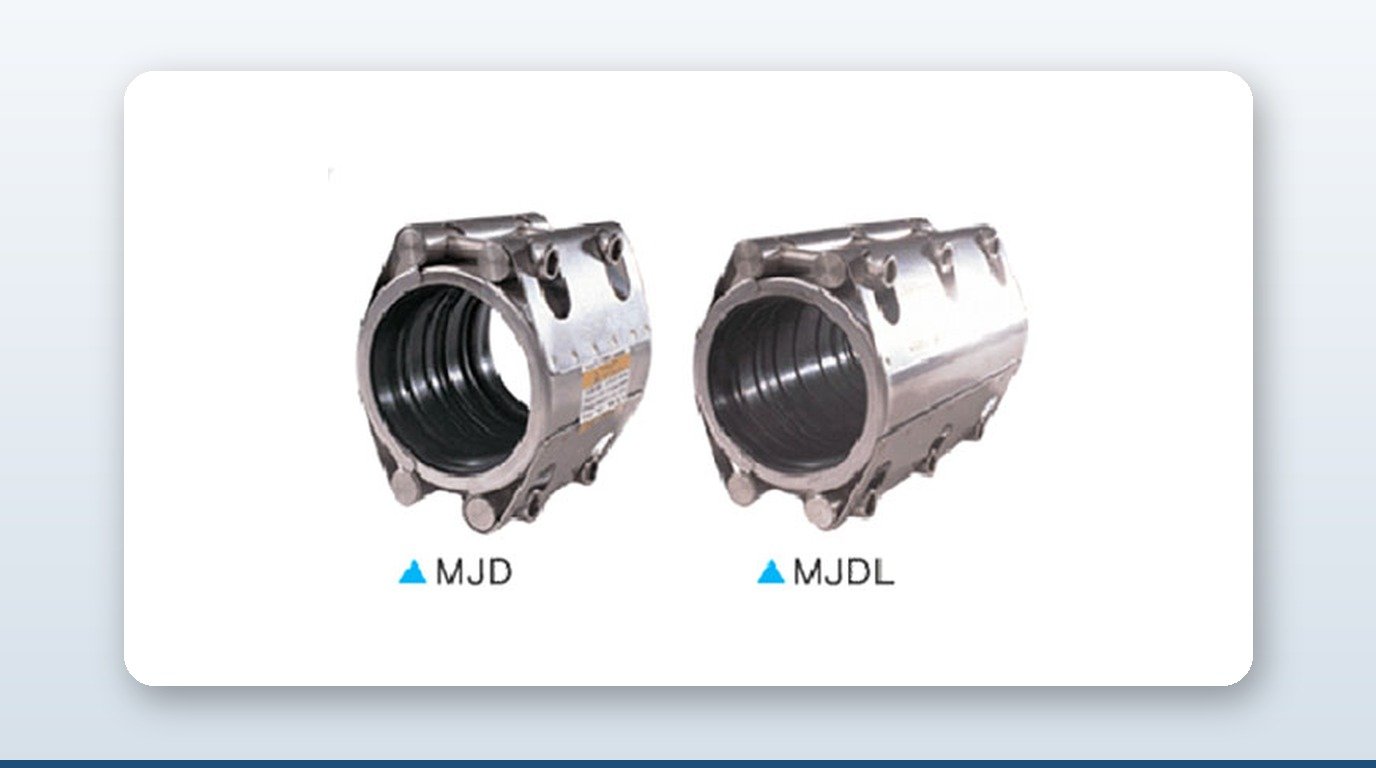
Two variables drive coupling selection on a retrofit: whether the section can be fully isolated, and what the pipe is carrying. A planned CHW header replacement, scheduled during a shutdown window, can use a standard flexible or grip coupling sized to the existing pipe outer diameter — the same product class used in new plant-room installation, including the CHW/CW coupling series supplied in Singapore by JWC, DPE’s exclusive local distribution partner. An unplanned leak discovered mid-operation is a different problem: it calls for an in-service mechanical repair clamp that can be fitted around a live or partially live pipe section to stop the leak immediately, with the permanent pipe or joint replacement scheduled for the next available isolation window.
Pump-bay expansion joints and vibration isolators are a related but distinct category. Metal-bellows or rubber expansion joints absorb the thermal movement and vibration transmitted from centrifugal chillers and ring-main pumps, rather than joining two pipe ends. These typically run on a longer replacement cycle — 10 to 15 years, or whenever the pump itself is overhauled — and are sized and specified separately from the pipe-run couplings around them.
Two Systems That Sit Outside Standard Coupling Retrofit
Two building systems that look, on the surface, like more of the same pipework actually sit under separate and stricter certification regimes, and a retrofit plan needs to treat them as distinct scopes from the outset.
Fire protection piping — sprinkler mains, wet risers, and hose reel systems — falls under SCDF’s Fire Code, which requires listed components for these systems. That is a different, additional certification pathway from the general mechanical coupling used on chilled or condenser water, and it should be planned and sourced as its own scope, with its own supplier and documentation trail, rather than folded into a general CHW/CW retrofit.
Potable and domestic cold-water risers sit under a separate regime again: PUB requires water fittings used in potable-water service installations to meet its Standards & Requirements for Water Fittings, a different certification gate from fire-system listing. Not every mechanical coupling on the market carries current, Singapore-relevant test documentation for potable-water contact. Buyers retrofitting a domestic cold-water riser should confirm current test and approval documentation with their supplier for the specific standard their project requires, rather than assuming that a coupling approved for CHW or CW service automatically qualifies. PUB’s specific technical requirements for pipe couplings in potable water networks are involved enough — a layered stack rather than a single certificate — that they are worth understanding in detail before specifying anything for that scope.
Scheduling Around the Regulatory Calendar
The retrofit isn’t only a mechanical exercise — it’s also bounded by Singapore’s inspection and maintenance calendar, which creates most of the access windows and procurement triggers for this kind of work.
| Requirement | Frequency | System | Who acts |
|---|---|---|---|
| NEA Cooling Tower Legionella Code of Practice | Monthly water quality testing + quarterly disinfection; annual inspection | Cooling towers, condenser water | Building owner / FM contractor |
| NEA AGS notification & registration | On new cooling tower installation; periodic renewal | Cooling towers | Building owner |
| SCDF Fire Code periodic fire-system inspection | Annual (commissioner) + 5-yearly (QP) | Wet riser, sprinkler, hose reel | Fire safety manager + fire-system maintenance contractor |
| BCA Green Mark reassessment | Every 3 years (Gold and above) | Whole-building MEP efficiency | Building owner / FM |
| BCA periodic safety inspection | Typically annual for major equipment | Chiller plant, ACMV, lift | Accredited inspection agency + FM |
| PUB Licensed Water Service Plumber inspection | On repair or modification of potable-water systems | Domestic water risers | Licensed water service plumber |
In practice, these cadences give an FM contractor recurring, scheduled access to plant rooms and cooling-tower decks. The monthly-to-quarterly cooling-tower maintenance visit is often the point at which coupling condition on the CW circuit gets assessed, while the annual SCDF fire-system inspection surfaces wet-riser and sprinkler component replacement needs on its own, separate track.
A Practical Sequence for Occupied-Building Retrofit
1. Assess and classify. Walk the plant room and riser routes, and sort every section needing attention into three buckets: planned replacement (can wait for a shutdown window), unplanned or emergency (needs an in-service repair clamp now), and out-of-scope (fire protection or potable water, which require their own certification trail). 2. Confirm the certification path before selecting product. For CHW, CW, cooling-tower, and non-potable scope, a standard mechanical coupling sized to pipe OD and rated to system pressure is normally sufficient. For fire protection or potable-water risers, confirm listing or approval documentation with the supplier before committing to a product — don’t assume a coupling correct for CHW/CW automatically qualifies for either of those two systems. 3. Sequence the work around existing access windows. Coordinate isolation timing with the FM contractor’s maintenance calendar and, where the retrofit touches cooling towers, the NEA inspection cycle, so the work piggybacks on an already-scheduled access window rather than requiring a separate shutdown negotiation. 4. Stage repair clamps for continuity of service. Where full isolation isn’t available on the discovery date, an in-service repair clamp buys time to complete the permanent pipe or joint replacement at the next planned window, without an unplanned interruption to tenants. 5. Document as you go. Record the coupling model, pipe OD, pressure rating, and — for cooling-tower and fire-adjacent work — the relevant inspection date, so the next FM cycle starts from a maintenance record instead of a fresh assessment.
Key Takeaways
- – Building services retrofit in occupied structures is constrained by continuity of service, limited access windows, and adjacency to fire and potable-water systems under separate certification regimes — not just by the mechanical work itself.
- – CHW, CW, cooling-tower, and non-potable water pipework are where standard mechanical couplings and repair clamps do most of the retrofit work; full replacement typically runs on a 15–25-year cycle, with repair clamps bridging emergency leaks in between.
- – Fire protection piping and potable/domestic cold-water risers sit under separate certification regimes from general CHW/CW coupling work and should be planned, sourced, and documented as distinct scopes.
- – Singapore’s NEA, SCDF, and BCA inspection cadences create the recurring access windows that retrofit work should be scheduled around, rather than requiring standalone shutdown negotiations.
- – Confirm current test and approval documentation with your supplier for the specific standard your project requires, rather than assuming a coupling approved for one building system automatically qualifies for another.
About David Phee Enterprise
David Phee Enterprise (DPE) is a Singapore-based industrial pipe coupling trading company, established in 1990 and headquartered in Kaki Bukit, supplying flexible and grip couplings, expansion joints, and repair clamps for chilled-water, condenser-water, and general M&E plant-room applications across Singapore, Malaysia, and Indonesia. DPE is the exclusive Singapore distributor for JWC (Jeong Woo Coupling) and offers same-day delivery from its Singapore HQ — a relevant factor when a coupling failure surfaces mid-shift and a facilities team needs product on site before the next access window closes. For product specifications or availability on a specific retrofit scope, see davidphee.com or get in touch.