Victaulic is the name most procurement officers recognise first. It pioneered the grooved coupling system and carries decades of global installations. JWC (Jeong Woo Coupling) is less familiar to buyers outside Asia — but when evaluating JWC coupling vs Victaulic Singapore, the numbers tell a different story. JWC has become the preferred choice across Singapore, Malaysia, and Indonesia, particularly in maritime, shipyard, and water infrastructure projects.
If you are sourcing grooved couplings in Singapore, this comparison covers the five differences that actually affect procurement decisions: materials, product range, certifications, availability, and cost.
What Is the Grooved Coupling System?
Grooved couplings connect two pipes at a pre-cut groove near each pipe end. A housing — two halves bolted together — clamps over a rubber gasket seated in the groove, creating a leak-proof, pressure-rated joint without welding or flanges. The system is faster to install than flanges, easier to disassemble for maintenance, and capable of absorbing vibration when a flexible housing type is used.
Both JWC and Victaulic operate on this same principle and are dimensionally compatible with standard grooved pipe ends to ASME B16.25, BS EN 10255, or JIS B 2301 standards. The housings, gaskets, and pipe end preparation follow the same geometry. For buyers in Singapore comparing JWC coupling vs Victaulic Singapore, the fundamental engineering is equivalent — which means the real decision comes down to what actually differs between the two brands.
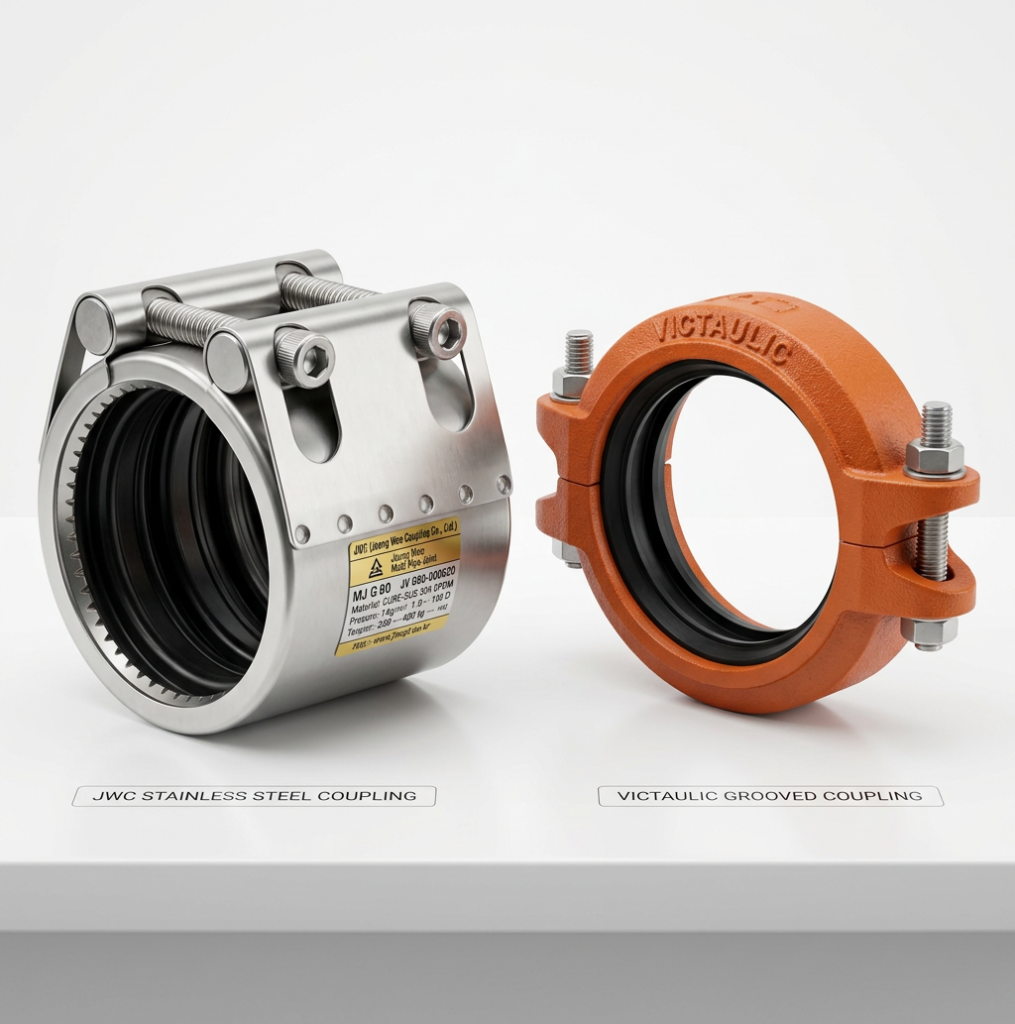
Specification Comparison at a Glance
| Parameter | JWC (MP Joint Series) | Victaulic (Style 107 / 77 Series) |
|---|---|---|
| Size range | DN15–DN600 (15A–600A) | DN20–DN2400 |
| Body material | Ductile iron (standard); SUS 304/316 available | Ductile iron (standard); stainless available |
| Grip ring material | SUS 301H stainless steel | Carbon steel (standard) |
| Gasket options | EPDM, NBR, Silicone, FKM, Viton | EPDM, NBR, Silicone, VLGE, Nitrile |
| Max working pressure | Up to 32 bar (size-dependent) | Up to 41 bar (size-dependent) |
| Bolt/nut material | SUS 304 (standard on most models) | Carbon steel with hex bolts and nuts |
| Certifications | JIS, ISO; ABS Type Approved (A-Ju expansion joints) | UL Listed, FM Approved, CE Marked |
| Regional availability (SG) | Stock held locally; same-day supply via DPE | Import lead time; no dedicated local stock |
The two brands cover overlapping ground for the most common pipeline applications in Singapore (DN25–DN200). Where they diverge most visibly is hardware specification, product range, certification scope, and price.
Difference 1 — Materials and Hardware Standards
The most operationally significant difference when comparing JWC coupling vs Victaulic Singapore is the bolt and nut specification.
JWC ships with SUS 304 stainless steel hardware as standard. Every bolt and nut on a JWC coupling is stainless steel out of the box. For ship chandlers, marine engineers, and anyone operating in humid or salt-air environments — which describes most industrial work in Singapore — this matters. Carbon steel hardware corrodes over time, requiring either regular replacement or costly upgrades at the point of order.
Victaulic ships most standard couplings with carbon steel hardware. In dry, climate-controlled environments, this is not a problem. But for maritime applications, engine room piping, offshore installations, and outdoor pipework along Singapore’s waterfront industrial belt, specifying standard Victaulic couplings typically means a follow-up hardware upgrade. That upgrade adds cost and delays the procurement process.
Grip ring material follows the same pattern. JWC’s MJG series uses a SUS 301H stainless steel grip ring, which bites into the pipe on installation to resist axial pull-out. Victaulic’s carbon steel grip teeth in equivalent configurations are functional but require more attention in corrosive environments.
For body material, both brands default to ductile iron for the coupling housing. Stainless steel housing variants are available from both JWC and Victaulic at premium pricing — used in chemical processing, pharmaceutical, and food-grade applications.
Gasket options are broadly comparable. EPDM covers most water, air, and ambient temperature services. NBR suits oil-adjacent environments. Viton/FKM handles aggressive chemicals and high process temperatures. Both brands offer comparable gasket variety, and the selection criteria are the same regardless of brand.
Difference 2 — Product Range and Unique Models
Both brands offer flexible and rigid grooved coupling variants, but JWC has two product categories with no direct Victaulic equivalent in the standard grooved range.
Flexible Couplings: JWC MJS vs Victaulic Style 77
The JWC MJS (and MJSL for lighter-wall pipe) provides genuine angular deflection — typically 1° to 3° per coupling depending on size — and vibration absorption. This makes it the default choice for shipyard piping, engine room installations, and any system where thermal expansion or mechanical vibration is a concern.
Victaulic’s Style 77 is the equivalent flexible coupling and performs similarly. Both handle the same service conditions. The functional difference is price: at Singapore market rates, JWC MJS is significantly less expensive per unit than the Victaulic Style 77 at comparable sizes.
Rigid Couplings: JWC MJD vs Victaulic Style 107
For rigid, zero-deflection installations — structural pipework, compressed air, or systems where precise alignment must be maintained — the JWC MJD and Victaulic Style 107 are functional equivalents. Both clamp tightly to the pipe groove with no rotational or angular movement.
Grip Ring Couplings: JWC MJG (No Victaulic Equivalent)
The JWC MJG adds a stainless steel grip ring inside the housing. On final torquing, the ring bites into the pipe wall, creating mechanical resistance to axial pull-out. This addresses a limitation of standard grooved couplings — that the housing can theoretically slide along the pipe if the groove dimensions are marginal or if the system experiences sustained end-load forces.
Victaulic handles this scenario through a different product family (their “Advanced Groove System” or through dedicated restrained couplings), but there is no direct MJG equivalent in the standard Victaulic grooved range available in Singapore.
For projects where engineers would traditionally spec a flanged or welded connection due to pull-out concerns, the MJG provides a grooved-coupling alternative without the installation complexity of flanges.
Hinge Repair Clamps: JWC MJH
The JWC MJH is a two-part repair clamp that installs over an existing pipe section — even without a pre-cut groove — for emergency or scheduled in-situ repair. It is particularly useful in operating plants where taking a pipe out of service for groove-cutting is not feasible.
Victaulic does not manufacture a direct equivalent hinge-type repair clamp. Their repair solutions typically require the pipe to be grooved or replaced at the coupling section.
For maintenance-heavy environments — refineries, shipyards, water treatment plants — having a local supply of MJH clamps provides an emergency repair option that Victaulic cannot match at comparable cost or speed.
Difference 3 — Certifications and Approvals
Certifications determine whether a product can legally be installed on a specific project. When comparing JWC coupling vs Victaulic Singapore, certification scope is where a clear boundary exists.
UL Listed and FM Approved (Fire Protection)
Victaulic holds UL Listing and FM Approval. These are mandatory certifications for fire protection sprinkler systems governed by NFPA 13 and accepted by Singapore’s SCDF (Singapore Civil Defence Force) for code-compliant fire suppression installations. If a project specification requires UL/FM-approved couplings, Victaulic is the compliant product.
JWC does not hold UL or FM approvals. For fire sprinkler applications, JWC is not a compliant substitute where those certifications are required. This is not a quality statement — it is a scope statement. JWC is designed for industrial and marine applications, not fire protection systems.
ABS Type Approval (Maritime)
For vessel piping, the relevant certification is ABS (American Bureau of Shipping) Type Approval. DPE’s A-Ju expansion joint range carries ABS Type Approval, valid until March 2029. JWC couplings are routinely supplied to shipyards and ship chandlers across the region; class approval for individual fittings on a vessel applies to the vessel’s classification survey as a whole, not individual components in most cases.
JIS and ISO Standards
JWC couplings are manufactured to JIS (Japanese Industrial Standard) and ISO dimensional standards — the dominant standards in the Singapore, Malaysia, and Indonesia markets. All DPE-supplied JWC products include mill certificates on request.
For projects specifying “grooved coupling to JIS B 2301” or “to ISO standards,” JWC qualifies without further justification.
Difference 4 — Availability in Singapore
In maritime and shipyard procurement, vessel turnaround time is often measured in hours. A coupling that requires 2–4 weeks for delivery is not a coupling that works for that context.
Victaulic operates through regional distributors in Southeast Asia. In Singapore, lead times for standard sizes vary by distributor and stock position — for common sizes like DN50 and DN100, same-week supply may be possible, but full-range local stock is not maintained. Non-standard sizes, stainless variants, or specialist configurations typically run 2–4 weeks.
JWC couplings are stocked locally by David Phee Enterprise, the exclusive Singapore distributor. DPE holds inventory across DN15–DN300 in the most common configurations — EPDM gasket, ductile iron housing — at its warehouse in Empire Technocentre, Kaki Bukit. Same-day delivery is standard.
This availability difference is why JWC has become the dominant grooved coupling brand for ship chandlers and shipyard procurement teams in Singapore. When a vessel’s chief engineer needs couplings within four hours, the brand that stocks locally wins regardless of what is specified on the original project drawing.
For a full pipe size and OD reference for JWC couplings, see the pipe coupling size chart.
Difference 5 — Cost at Volume
On a unit-by-unit comparison at equivalent specifications, JWC is consistently 30–50% less expensive than Victaulic in the Singapore market.
For a 100-unit order of DN50 flexible couplings in ductile iron with EPDM gasket, the landed cost from JWC via DPE is typically 30–50% below equivalent Victaulic pricing. The gap widens when comparing stainless hardware — because JWC includes stainless hardware as standard, while Victaulic’s stainless hardware upgrade adds cost on top of an already higher base price.
For high-volume procurement — infrastructure projects, new builds, bulk orders from ship chandlers — this price delta is significant. A regional water infrastructure project specifying 5,000 couplings at DN100 can generate procurement savings in the six-figure range by qualifying JWC as a compliant equivalent.
When Victaulic is specified by name on project drawings, substitution requires a formal engineering equivalency submission and approval. This process adds time and administrative cost. Where the specification reads “grooved coupling to BS or JIS standard” without naming a brand, JWC qualifies as a compliant alternative immediately.
When to Choose JWC vs Victaulic Singapore
Understanding the JWC coupling vs Victaulic Singapore decision comes down to three questions: What does the project specification require? What is the operating environment? And what are the lead time constraints?
Choose JWC when:
- The project is in Singapore, Malaysia, or Indonesia and delivery speed matters
- Budget is a factor in medium- to high-volume orders
- Marine, shipyard, or corrosive environments require stainless hardware as standard
- The specification allows equivalent compliance (JIS/ISO standard, no UL/FM requirement)
- Pull-out resistance is needed — the MJG grip ring coupling has no direct Victaulic equivalent
- Emergency repair capability is required — the MJH hinge repair clamp is a JWC-only product
- You need same-day stock for urgent works
Choose Victaulic when:
- The project specification explicitly requires UL Listed or FM Approved couplings (fire protection systems)
- The engineer or main contractor is locked to Victaulic by brand specification
- Extended sizes beyond DN600 are needed — JWC’s standard range caps at DN600
- Full Victaulic project engineering and technical support services are required
- The installation system was originally installed with Victaulic and maintenance continuity requires the same brand
Frequently Asked Questions
Are JWC and Victaulic couplings interchangeable?
Yes, dimensionally. Both brands follow the same grooved coupling geometry (ASME/JIS/ISO standard), so a JWC coupling will fit the same pipe groove as a Victaulic coupling of the same size. Gaskets are also broadly interchangeable by material type. Where they are not interchangeable is on certified systems — if a fire sprinkler system has UL/FM approval built around Victaulic products, substituting JWC may affect compliance.
Does JWC meet Singapore standards for industrial piping?
Yes. JWC couplings are manufactured to JIS and ISO standards, which are the applicable standards for industrial piping in Singapore. For maritime applications, JWC is routinely used in class-approved vessel piping systems. For fire protection, UL/FM certification (not JIS/ISO) determines compliance — JWC does not hold UL/FM approvals.
Can JWC be substituted for Victaulic on a live project?
It depends on how the specification is written. If the spec names Victaulic as the product, a formal engineering submission is required. If the spec says “grooved coupling to BS EN or JIS standard,” JWC qualifies without additional justification. DPE can provide product data sheets, mill certificates, and material certifications to support equivalency submissions.
What sizes are available from local stock in Singapore?
DPE stocks JWC couplings from DN15 to DN300 in standard configurations. DN350 to DN600 are available on short order. For sizes beyond DN300, contact DPE directly for lead time confirmation.
What is the JWC MJG grip ring coupling used for?
The MJG is used where standard grooved couplings might be subject to axial pull-out forces — for example, at changes of direction under sustained pressure, at pump connections, or in systems with high thermal cycling. It eliminates the need for welded or flanged connections in those locations while retaining the speed and reversibility of a grooved system.
Key Takeaways
- JWC and Victaulic operate on the same grooved coupling principle and are dimensionally compatible with standard grooved pipe ends
- JWC ships with SUS 304 stainless hardware as standard; Victaulic requires an upgrade for marine or corrosive environments, adding cost
- Victaulic is the required choice where UL/FM fire-system approvals are specified; JWC does not hold these certifications and is not a compliant substitute on UL/FM-governed systems
- For Singapore, Malaysia, and Indonesia procurement, JWC is available with same-day local stock via DPE; Victaulic typically requires import lead time for the full range
- JWC is 30–50% lower cost at comparable specifications for volume orders
- The MJG grip ring coupling and MJH hinge repair clamp have no direct Victaulic equivalents in the standard grooved range
David Phee Enterprise holds Singapore’s exclusive JWC distribution rights and carries same-day stock at Empire Technocentre, Kaki Bukit. For quotations and technical specifications, visit davidphee.com.
2 thoughts on “JWC vs Victaulic Couplings: 5 Key Differences for Singapore”