Bilge, sewage and greywater are the three “drain” systems on a vessel — the lines that move dirty fluid off the ship rather than around it. It’s tempting to quote them as one line item, but they sit under different MARPOL annexes, run through different pipe materials, and — critically for a coupling supplier — favour completely different joint families. Getting that distinction right is the difference between winning the steel headers and wasting a quote on a network you can’t actually supply.
This guide maps what each sub-system carries, the regulatory envelope each one sits under, where biogenic corrosion attacks the joint, and exactly where DPE’s product range applies versus where it doesn’t.
Three systems, three different jobs
All three share the same basic engineering profile: low operating pressure (gravity-flow or low-head pump, typically ≤4 bar), large bore relative to flow since they’re sized for solids passage rather than pressure drop, and aggressive contents. Where they diverge is regulation and construction.
| Sub-system | Carries | Typical pressure | Typical pipe material | Typical bore | Dominant joint family |
|---|---|---|---|---|---|
| Bilge | Oily water from machinery-space bilge wells, through a 15 ppm separator before overboard discharge | Suction ~−0.5 bar, discharge 2–4 bar | Carbon steel (galvanised or epoxy-lined) in the machinery space | DN 65 main suctions on small ships, DN 100–150 on cargo ships, DN 200+ on cruise/RoPax | Flanged + slip-on / grip-type mechanical couplings; welded inside Cat-A |
| Sewage (black water) | Toilet discharge | Vacuum collection −30 to −50 kPa, or gravity | Cast iron DWV / PVC-U / PP / GRE inside accommodation; steel for overboard discharge | DN 50–80 branches, DN 100–150 collection mains, DN 150–250 overboard | Shielded no-hub inside; flanged + slip-on at the STP and overboard penetration |
| Greywater | Showers, basins, laundry, galley | Gravity drain, some pumped lift stations | PP / PVC-U / GRE / DWV cast iron | DN 40–80 branches, DN 100–150 collection mains | Shielded no-hub + push-fit; flanged at tank/overboard |
Bilge is regulated under MARPOL Annex I (oil pollution). Sewage sits under MARPOL Annex IV (discharge distance and treatment thresholds). Greywater is, for now, largely unregulated under MARPOL itself, though HELCOM Baltic ports, US Alaska state rules and a growing list of EU port-state controls treat it as functionally regulated.
Bilge: the 15 ppm rule and the sampling tee
Every ship 400 GT and above must carry an oily water separator with a 15 ppm bilge filter (MARPOL Annex I Regulation 14). Legal discharge requires the ship underway, effluent through the approved filter, oil content at or below 15 ppm, and — a detail that trips up new installations — the sampling tee installed in a vertical section of the discharge line close to the separator outlet. A horizontal sampling point lets oil float to the top of the bore and distorts the reading.
Pipe sizing follows US 46 CFR 56.50-50, broadly aligned with IACS: no main bilge suction under 2.5″ (DN 65) internal diameter on vessels 150 GT and above, branch lines at least 2″ (DN 50), flow velocity kept above roughly 2 m/s to keep solids in suspension. Bilge piping is Class III under IACS UR P2 — below 16 bar and 200°C — which means no fire-test gate on the bilge line itself, unless it runs adjacent to fuel or lube oil piping inside a Cat-A machinery space and the surveyor extends the scrutiny.
The overboard non-return valve on the bilge discharge is a regulatory fixture (46 CFR 56.50-95 plus SOLAS): an automatic non-return valve plus a means of closing it from above the freeboard deck. That joint sees chloride, oil and sediment plus repeated thermal cycling, which makes the gasket spec there worth getting right rather than defaulting to standard stock.
Sewage: biogenic sulphide corrosion eats the joint from the inside
Sewage is the most chemically aggressive routine piping service on a vessel outside crude cargo lines, and the mechanism is worth understanding because it drives the gasket and bolt spec directly:
- Anaerobic biofilm in low-flow or pooled sections of the gravity main hosts sulphate-reducing bacteria, which metabolise organic load and sulphate into H2S gas.
- The H2S desorbs into the pipe headspace above the waterline.
- At the pipe crown, sulphur-oxidising bacteria convert that H2S into sulphuric acid in the presence of moisture and oxygen.
- The acid attacks the pipe wall from the inside-top, eating cast iron, concrete and even some elastomers.
This is biogenic sulphide corrosion, and it’s the dominant in-service failure mode for marine sewage piping. The practical implications for coupling selection:
- Gasket: standard EPDM water-grade gasket degrades under sustained H2S exposure. Specify NBR as the baseline upgrade for sewage service, and HNBR for aggressive sour service such as high-H2S blackwater holding tanks.
- Housing: carbon-steel housings rust through faster than the pipe itself in this environment — specify 316 stainless steel housings.
- Bolts: zinc-plated carbon steel bolts fail within months under H2S attack. Specify A4-80 316L stainless steel.
- Gasket geometry: any gasket lip that protrudes into the bore becomes a biofilm anchor point and a slow-blockage risk that won’t show on a flow meter until the line stops completely — flush-to-bore geometry is the safer spec.
Regulation compounds the corrosion problem. MARPOL Annex IV applies to ships of 400 GT or more, or carrying 15 or more persons, on international voyages, with three compliance routes and discharge conditions that scale with treatment level:
| Treatment state | Minimum distance from land | Speed condition |
|---|---|---|
| Treated by an approved sewage treatment plant | 3 nm or more | 4 knots or more, no visible solids |
| Comminuted and disinfected | 3 nm or more | 4 knots or more, no visible solids |
| Untreated | 12 nm or more | 4 knots or more, moderate rate |
In the Baltic special area, passenger ships cannot discharge sewage at all unless the treatment plant meets the tightened IMO MEPC.227(64) standard — total nitrogen at or below 20 mg/L (or a 70% reduction) and total phosphorus at or below 1.0 mg/L (or an 80% reduction), tightening further to 10 mg/L nitrogen for Baltic-only passenger plants. Every ship subject to Annex IV must also carry an International Shore Connection — a standard flange with a 138 mm bolt circle, 210 mm flange OD and four M16 bolts — where the ship hands off sewage to shore reception facilities. The gasket there needs the same NBR-or-better spec as the rest of the sewage line, not a generic water-grade gasket.
Joint selection by location
| System | Engine-room steel header | Below-deck distribution | Toilet / fixture branch | Overboard penetration |
|---|---|---|---|---|
| Bilge | Grip-type or slip-on mechanical coupling plus repair-clamp option; Class III, no fire gate unless adjacent to a fuel line | Same as engine room | Not applicable | Flanged plus check valve; gasket must handle chloride and oil emulsion |
| Sewage | Grip-type slip-on with NBR or sulphide-rated EPDM; fire-resistant cover if inside Cat-A footprint | Shielded no-hub coupling on cast iron DWV, push-fit on PVC/GRE | Same as distribution | Flanged plus non-return valve; International Shore Connection per Annex IV Reg. 10 |
| Greywater | Grip-type or slip-on for the steel header section | Shielded no-hub / push-fit on PVC or DWV | Same as distribution | Flanged plus check valve; less aggressive service than sewage |
The pattern that matters commercially: DPE’s product range is a strong fit for every steel-to-steel joint — engine-room headers, below-deck steel sections, the overboard penetration — and a poor fit for the inboard plastic DWV network, which runs almost exclusively on shielded no-hub couplings that DPE doesn’t carry.
Where DPE’s range actually applies
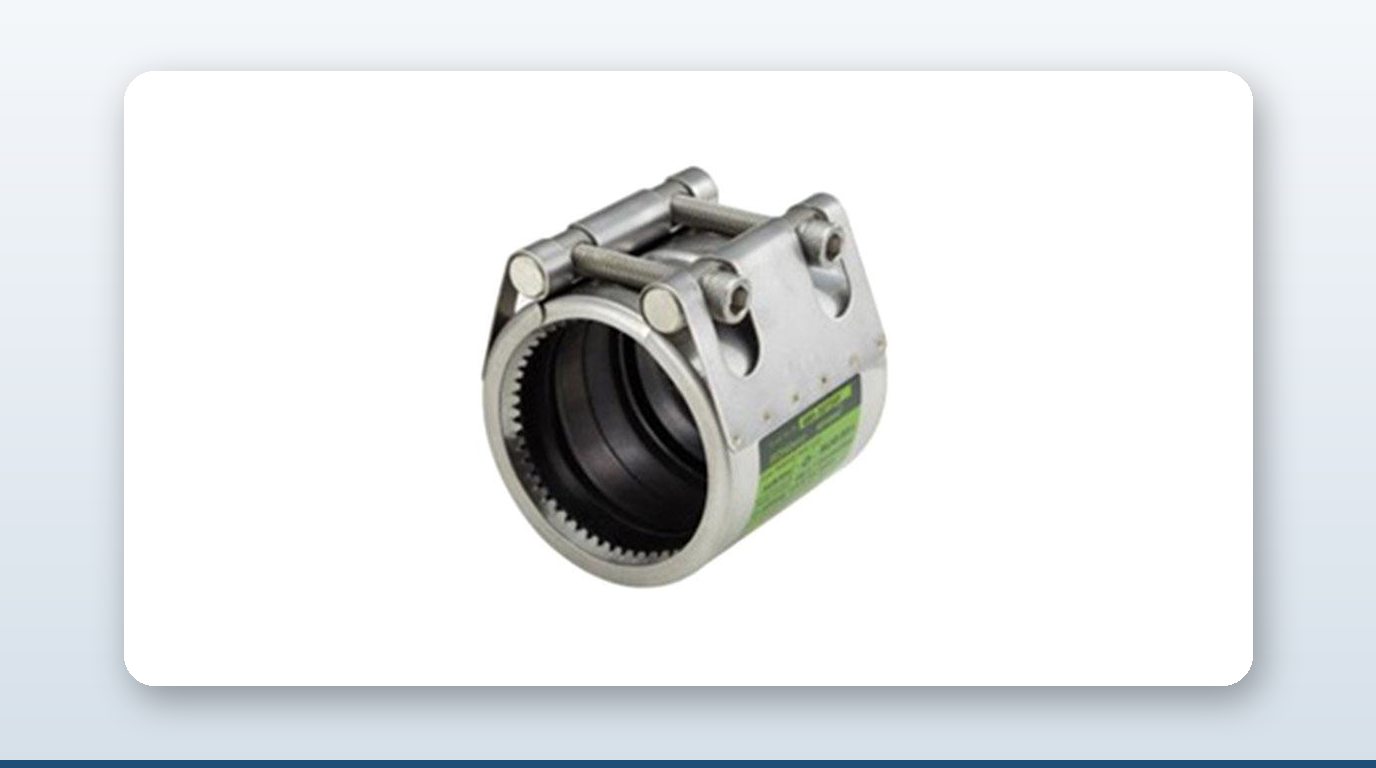
JWC (hero brand). JWC MJS and MJG slip-on and grip couplings fit the bilge main header, the sewage overboard discharge, and the greywater steel sections — the default call for steel-on-steel joints in the machinery space and below-deck runs. Where the line passes through a Cat-A machinery space and the surveyor reads the fire-rating gate strictly, JWC’s Fire Resistant Cover carries the same 800°C ± 50°C, 30-minute IACS/ISO 19921-19922 certification as premium alternatives at a lower price point. Standard EPDM is fine for greywater and bilge service; for sewage, specify NBR as the upgrade, or HNBR for sour service. The honest limit: JWC doesn’t make no-hub couplings, so the toilet-to-tank and galley-to-greywater-tank plastic network isn’t DPE territory — that scope belongs to the no-hub coupling suppliers.
Romacon. Romacon’s stainless-steel repair clamps — RS-1, RSO, RSC — are explicitly designed for above-ground pipe repair on board ships, and work across cast iron, steel, PVC and GRP. Romacon’s internal repair clamp is purpose-built for waste-water piping and is a genuine differentiator: no equivalent exists in JWC, Smith-Blair or Helden’s ranges. The Snap clamp handles fast repair up to DN 300 at 10 bar and is a reasonable standing emergency-stock item. One caveat worth flagging on every plastic-pipe quote: Romacon asks for consultation before its clamps go on plastic pipe.
Smith-Blair. The 411 steel coupling is a bolted sleeve-type for steel-to-steel joints at matching diameter, rated around 150 psi (roughly 10 bar) — comfortably above all three sub-systems’ operating pressure. Its Nitrile (Buna-N) gasket is meaningfully more H2S-resistant than a standard EPDM default, which makes it a relevant option on the sewage header specifically. Smith-Blair reads as a water-and-oilfield brand first rather than marine-first, so it’s the better call when a spec explicitly asks for AWWA-compliant hardware or a US-owner preference, not a default choice.
Helden. Helden’s wide-tolerance couplings and flange adaptors, spanning 40 mm to 8000 mm, suit the overboard discharge penetration and any large-diameter transition from steel inboard to GRE through the hull. GRE pipe needs axial restraint at its couplings — slip-type joints can walk off GRE under thermal cycling because the pipe’s ovality and surface finish differ from steel — so a grip-type or restrained-tolerance joint is the correct spec wherever steel meets GRE under load.
Key Takeaways
- Bilge, sewage and greywater run under different regulations (MARPOL Annex I, Annex IV, and largely unregulated respectively) and favour different joint families — don’t quote them as a single line item.
- Bilge’s 15 ppm oily-water rule requires the sampling tee in a vertical section of the discharge line, not horizontal.
- Sewage piping suffers biogenic sulphide corrosion — sulphate-reducing bacteria convert organic load to H2S, which oxidises to sulphuric acid at the pipe crown. Specify NBR or HNBR gaskets and 316L stainless bolts and housings, not standard EPDM and zinc-plated carbon steel.
- Every ship under MARPOL Annex IV needs an International Shore Connection flange (138 mm bolt circle, 210 mm OD, four M16 bolts) with a sewage-rated gasket.
- DPE’s range fits the steel headers, below-deck steel runs and overboard penetrations across all three systems; the inboard plastic DWV network (toilet-to-tank, galley-to-greywater-tank) runs on no-hub couplings DPE doesn’t carry.
About David Phee Enterprise
David Phee Enterprise is the exclusive Singapore distributor for JWC pipe couplings, stocked at Empire Technocentre, Kaki Bukit for same-day delivery, alongside Romacon repair clamps, Smith-Blair couplings and Helden wide-tolerance fittings for the steel sections of bilge, sewage and greywater systems. For coupling specs or certification documentation on any of these ranges, contact DPE or browse the full catalogue at davidphee.com. Related reading: fuel oil system piping coupling requirements and Class I, II and III marine piping.