For most industrial and maritime piping projects in Singapore, the choice between a grooved coupling and a flanged joint comes down to four factors: installation time, system flexibility, maintenance access, and cost. Both methods create a secure, leak-free pipe connection — but they suit different applications, and choosing the wrong one adds unnecessary cost or creates maintenance headaches later.
How Each Connection Works
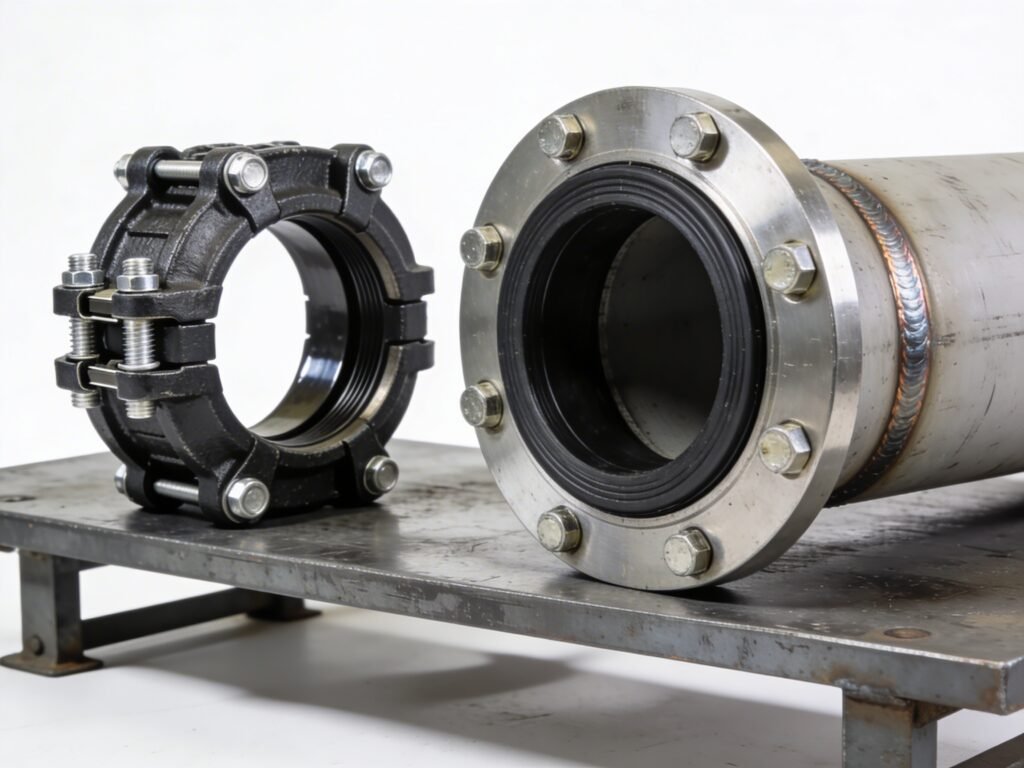
Flanged joint: Two flanges — one welded or threaded to each pipe end — are bolted together with a gasket between them. The connection is rigid and depends on the precision of the flange faces and the torque applied to the bolts. Widely used in high-pressure, high-temperature systems and where the piping code specifies flanged connections.
Grooved coupling: A groove is cut or rolled near each pipe end. A gasket seats inside the groove, and a housing clamps over it. No welding required. The coupling can be assembled with basic hand tools in minutes. Flexible and rigid variants are available.
Specification Comparison
| Parameter | Grooved Coupling (e.g. JWC MJS) | Flanged Joint (e.g. ANSI 150# RF) |
|---|---|---|
| Installation method | Clamp over groove; no welding | Bolt-up with gasket; may require welded flange |
| Installation time (DN100) | ~10 minutes per joint | 30–60 minutes per joint (plus weld cure time if applicable) |
| Skilled labour required | Fitter or general labour | Qualified welder (if welded flanges) |
| Angular deflection | Yes (flexible type) — 0.5°–3° depending on size | None |
| Axial movement | Limited (flexible type) | None |
| Vibration absorption | Yes (flexible type) | None — rigid connection |
| Disassembly for maintenance | Quick — remove housing bolts | Remove all flange bolts; may require breaking gasket face |
| Pressure rating | Up to 32 bar (size-dependent) | PN16 (16 bar), PN25, PN40 depending on flange class |
| Cost per joint (DN100, approx.) | Lower unit cost; no weld prep | Higher — flange procurement + welding labour |
| System footprint | Compact | Larger — flange OD significantly wider than pipe OD |
Pressure and Temperature Limits
Flanged joints at PN16 or ANSI 150# cover the majority of utility and process piping in Singapore’s industrial sector. For systems requiring PN25, PN40, or Class 300 and above — high-pressure steam, process lines — flanged connections remain the standard.
Grooved couplings are rated to handle most utility piping pressure ranges. JWC’s MJS flexible couplings cover up to 32 bar at smaller diameters (DN15–DN50), with pressure ratings decreasing at larger pipe sizes (e.g., 4.2 bar at DN600). Always verify the coupling’s pressure rating against the system’s design pressure and check the manufacturer’s data sheet for the specific size.
For fire-protection sprinkler systems, grooved couplings are common. In Singapore, this typically covers commercial buildings and industrial facilities following SCDF guidelines or NFPA 13.
Installation: The Real Cost Difference
The total installed cost of a flanged joint includes:
- Flanges (two per joint, welded or slip-on)
- Gasket
- Bolts and nuts (8–16 per joint depending on size)
- Welding labour (if welded flanges) — typically 30–60 minutes per weld
- Weld inspection and pressure test
For a grooved coupling:
- Coupling housing (includes bolts)
- Gasket (included in most coupling assemblies)
- Groove preparation — roll groove on-site or specify factory-grooved pipe
On a 50-joint DN100 piping run, the installation time difference is significant. Grooved systems reduce skilled welding hours, reduce shutdown time for modifications, and can be assembled in confined spaces where welding is impractical or prohibited.
Maintenance and Future Modifications
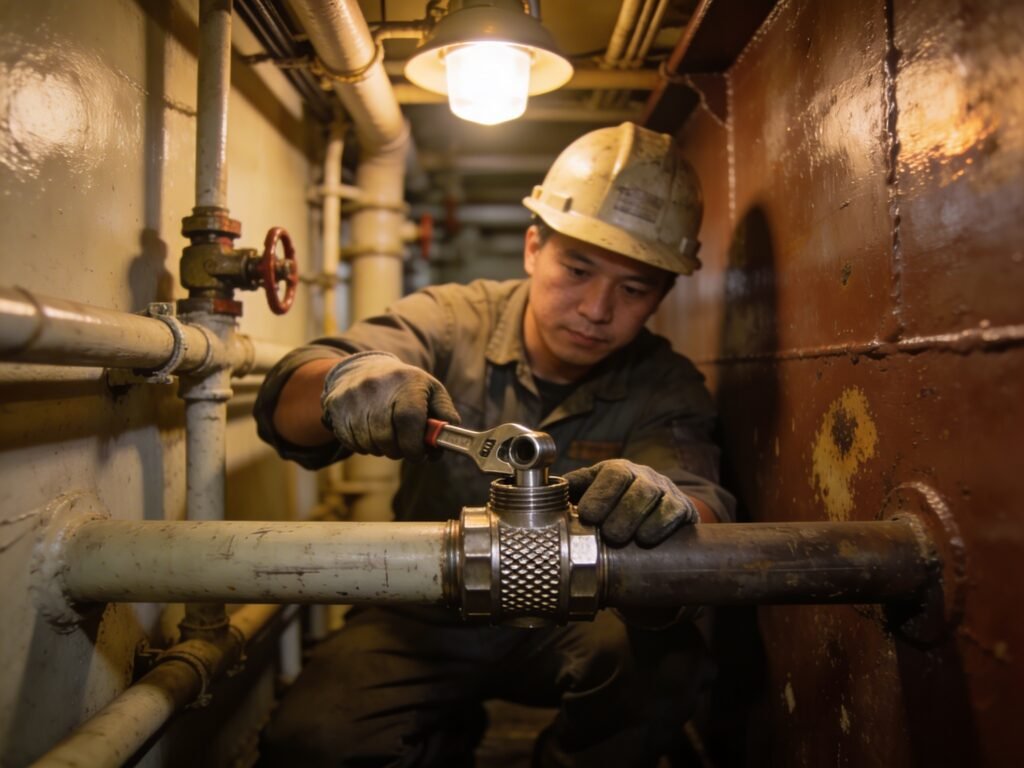
Both systems allow disassembly, but grooved couplings are faster to open and reclose. In shipyard and marine contexts — where access is restricted, vessels have limited port time, and pipe replacement happens under time pressure — this matters.
For systems that will be modified, extended, or rerouted over their operational life, grooved couplings reduce the cost of change. Adding a branch or a new section means cutting a groove, not welding a new flange stub.
Flanged joints are preferable where:
- The joint will never need to be broken in normal operation
- The system requires visual inspection of flange face condition at scheduled maintenance
- The specification mandates flanged connections (process piping, certain valve connections)
Vibration and Movement
Flexible grooved couplings absorb vibration and accommodate slight pipe movement or misalignment. This is particularly relevant in:
- Marine engine rooms, where hull flex and engine vibration transmit through pipework
- HVAC systems on mechanical floors
- Pump connections, where vibration isolation between the pump and pipework is required
Flanged joints transmit vibration directly. Where vibration isolation is needed, a separate flexible connector or expansion joint must be added to the system. For a breakdown of which coupling brands are available locally and what to expect on pricing and lead time, see JWC vs Victaulic: what Singapore buyers should know.
When to Choose Each
Use grooved couplings when:
- Installation time and labour cost are priorities
- The system requires vibration absorption or angular deflection (engine rooms, pump connections)
- Future modifications or maintenance access are likely
- Working in confined or restricted-access spaces where welding is impractical
- Pressure requirements are within the coupling’s rated range
Use flanged joints when:
- The system design pressure exceeds grooved coupling ratings for the given size
- The piping specification or engineering drawing mandates flanged connections
- High-temperature or aggressive process fluids require a full-face or ring-type-joint flange
- Long-term permanent connections with no planned disassembly
Key Takeaways
- Grooved couplings are faster to install, require no welding, and suit confined spaces; flanged joints are the standard for high-pressure and high-temperature applications
- For DN100 utility piping, a grooved system typically costs less in total installed cost due to reduced welding labour
- Flexible grooved couplings absorb vibration and pipe movement; flanged joints do not
- Flanged joints remain the required choice for process piping at PN25 and above, and wherever the specification mandates flanged connections
- Grooved couplings are the preferred method for systems that will be modified or maintained over their operational life
David Phee Enterprise stocks JWC grooved couplings — including flexible (MJS), grip ring (MJG), and repair clamp (MJH) variants — in Singapore with same-day delivery. Visit davidphee.com for specifications and quotations.
1 thought on “Grooved Coupling vs Flanged Joint: Which Should You Use?”