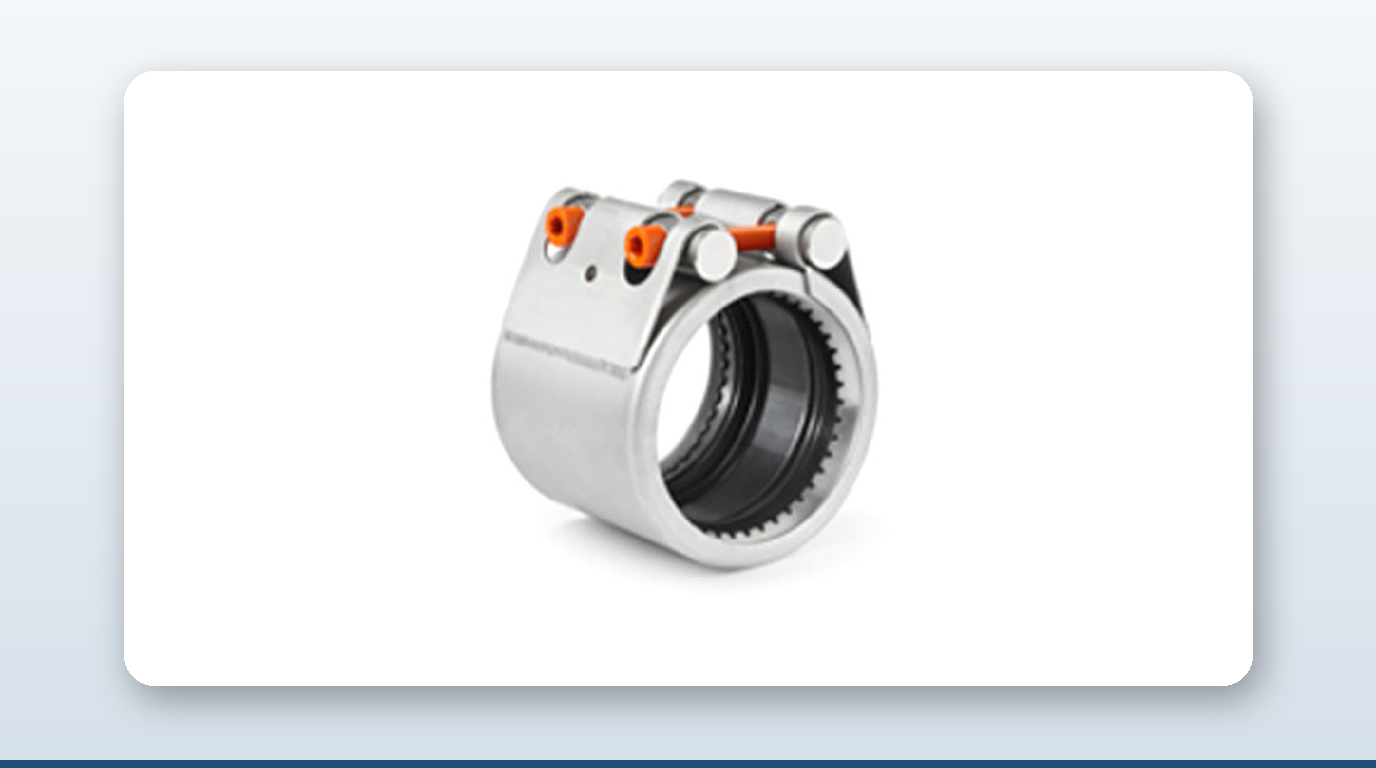
The gasket is the smallest and cheapest component in a mechanical pipe coupling. It is also the one that decides whether the joint leaks.
The housing and the bolting are structural. They hold the assembly together and carry the load. But the gasket is the element in continuous contact with the fluid, the temperature and the chemistry, and it is the single most common cause of an in-service leak. When a coupling that has worked for years starts weeping, the housing is almost never the problem.
This guide covers how to select a replacement gasket, how to fit it, and — most importantly — the two mistakes that turn a routine replacement into a repeat failure or a voided certificate.
First: Is the Gasket Actually the Problem?
Worth thirty seconds before ordering anything, because three different faults present as “the coupling is leaking”:
- – Gasket failure — the seal has hardened, taken a permanent set, cracked, swelled, or been chemically attacked. The classic signs are a gasket that has gone glassy and lost its rebound, or one that has swollen and extruded past the follower ring.
- – Loss of bolt preload — the gasket is fine, the bolts have relaxed. Common after thermal cycling. Check torque before condemning the seal.
- – Pipe-end damage — corrosion pitting, scoring or ovality on the pipe surface the gasket seals against. A new gasket on a pitted pipe end leaks again quickly. This one needs a repair clamp or a pipe repair, not a gasket.
If the pipe surface under the gasket is pitted or grooved, stop and reassess the repair strategy. That is the failure mode most often mistaken for a gasket problem.
Selecting the Replacement: Four Things That Must Match
1. The compound — set by the fluid, not by habit
This is where most repeat failures originate. The two most common marine and industrial compounds are near-opposites in chemical resistance, and they look identical:
- – EPDM is the default for water, seawater, fresh-water cooling, fire main, chilled water and steam. It is destroyed by petroleum oils.
- – NBR (nitrile) is the default for fuel oil, lube oil and hydraulic oil. It is destroyed by ozone, and it is poor against the oxidants in chemically treated ballast water.
Fit EPDM on a fuel line or NBR on a treated seawater line and the joint will pass its pressure test and fail later.
A working selection guide for the common services:
| Service | First choice | Notes |
|---|---|---|
| Seawater (ambient) | EPDM | HNBR and FKM also suitable |
| Fresh water / closed-loop cooling | EPDM | Broadest compatibility of any service |
| Fire main | EPDM | Check fire-test requirements separately |
| Saturated low-pressure steam | EPDM | Peroxide-cured; NBR is unsuitable |
| Fuel oil — MGO | NBR | FKM where temperature is higher |
| Fuel oil — heated MDO/HFO | HNBR or FKM | Plain NBR runs out of temperature |
| Lube oil — main engine | NBR | FKM for hot lube above ~120 °C |
| Hydraulic — mineral oil | NBR | |
| Hydraulic — phosphate ester | EPDM | NBR and FKM both fail here |
| Chlorinated seawater / hypochlorite | AFLAS (FEPM) | FKM is only marginal; EPDM and NBR fail |
Two traps in that table worth naming. Phosphate-ester hydraulic fluid takes EPDM, not NBR — the opposite of every other hydraulic service, and a genuine catch. And chlorinated seawater from ballast-water treatment attacks nearly everything; if there is electrochlorination upstream, the compound needs to be chosen for that, not for “seawater.”
2. The cure system — the specification most people omit
Two gaskets can both be genuinely EPDM and behave completely differently, because the polymer is only half the specification. The other half is the cure system.
Peroxide-cured EPDM gives roughly 25–30 °C more continuous service temperature, materially better steam and hot-water resistance, and dramatically better long-term compression set than sulphur-cured EPDM. The price difference is on the order of 15–20%. In continuous hot-water duty the service-life difference is far larger than that.
The cheap “EPDM” gaskets that look identical and fail at six months are typically sulphur-cured with high carbon-black filler loading. There is no way to tell by looking.
So: never order a “rubber gasket.” Specify the polymer, the cure system and the hardness in writing. A correct line reads:
> EPDM, peroxide-cured, Shore A 70 ± 5
Add the approval where one is required — for example *BS 6920 / SS 375 approved* for potable water.
3. Hardness — and why it is not a free choice
Shore A hardness governs how the gasket compresses and how it resists extrusion. Too soft and it extrudes past the follower under pressure. Too hard and it will not conform to the pipe surface, particularly on a pipe with mill scale, light corrosion or slight ovality.
Match the OEM hardness. If the original specification is unknown, this is a question for the coupling manufacturer rather than a judgement call in the workshop.
4. Dimensions — the gasket is not selected independently of its joint
The gasket has to match the coupling model, the pipe outside diameter, and the sealing geometry. A gasket is a component of a specific joint, not a generic consumable. Confirm inside diameter, outside diameter, section thickness and profile against the coupling model — not against the nominal pipe size.
The Rule That Voids Certificates
On any classed vessel, this is the one that costs real money:
> Classification-society type approval attaches to the coupling and gasket as a combination — not to the coupling alone.
A stainless housing fitted with the approved gasket carries the ABS, DNV, Lloyd’s Register, BV, KR, ClassNK or RINA type approval. The same housing fitted with a different gasket compound has no approval and cannot be used on a classed pipe.
The practical consequence: an aftermarket gasket cut from sheet at 60% of the price is the warranty call that voids the certificate. It may seal perfectly. It is still not an approved joint, and at survey that is the only fact that matters.
For classed service, order the OEM gasket. Certificate and part are inseparable.
The same logic applies on the potable-water side in Singapore. Approvals under SS 375 or BS 6920 attach to specific cured compounds, not to a polymer family. “EPDM” is not an approval; a named, approved, cured compound is.
The Replacement Procedure
Standard practice for a bolted sleeve-type coupling. Always follow the manufacturer’s published instructions where they differ.
1. Isolate and depressurise. Confirm zero pressure at the joint, not just at the valve. Drain and vent. Follow the vessel’s or plant’s permit system.
2. Mark the position. Before loosening anything, mark the coupling’s axial position on both pipes. It has to go back to the same place, particularly where the coupling is accommodating a gap or a slight misalignment.
3. Slacken bolts evenly. Work in a diagonal or star pattern, in stages. Do not fully release one bolt at a time.
4. Dismantle and inspect. Separate the follower rings and remove the old gaskets. Then inspect properly:
- – Pipe surface under the gasket — pitting, scoring, ovality, heavy scale. This decides whether a gasket alone will fix it.
- – Housing and follower rings — corrosion, distortion, damaged edges.
- – Bolts and nuts — corrosion, thread damage, stretch. On marine work, replace bolting rather than reuse it; it is cheap relative to the consequences and it is usually the corroded component.
5. Clean the sealing surfaces. Remove scale, old gasket residue and corrosion product from the band of pipe the gasket seals against. The surface must be clean and smooth. Do not gouge it.
6. Fit the new gaskets. Check orientation — many coupling gaskets have a defined direction, with a tapered or lipped profile that must face the correct way. Use only the lubricant the manufacturer specifies. Do not use a petroleum-based lubricant on EPDM — it will attack the gasket during installation, before the joint ever sees service.
7. Reassemble and torque in sequence. Diagonal pattern, in progressive stages, to the manufacturer’s specified torque. Even preload around the circumference is what makes the seal; uneven preload is a slow leak.
8. Re-torque after settling. Elastomers relax. Re-check torque after the joint has been pressurised and, where the service is hot, after a thermal cycle.
9. Pressure test and document. Record the compound, cure system, hardness and torque used. On classed work, keep the certificate with the job record.
Common Mistakes, Collected
- – Ordering “the same rubber one” without recording the compound or cure system.
- – Substituting a sheet-cut gasket on a classed joint and voiding the type approval.
- – Fitting a new gasket over a corroded, pitted pipe surface.
- – Petroleum lubricant on EPDM during assembly.
- – Uneven bolt tightening — the most common cause of a slow weep on an otherwise correct rebuild.
- – Never re-torquing after the first thermal cycle.
- – Reusing corroded bolting because the gasket was the only part ordered.
Ordering Replacement Gaskets
David Phee Enterprise supplies coupling gaskets, bolts and nuts alongside our mechanical coupling, repair clamp and expansion joint range, from our Kaki Bukit HQ in Singapore, with same-day delivery on stocked lines.
For a replacement gasket, the fastest route to the right part is: the coupling brand and model, the pipe outside diameter, the service and temperature, and whether the line is classed or potable. If the coupling model is unknown, a photograph of the housing marking plus the measured OD is usually enough to identify it.
Where the joint is classed, we will supply the OEM gasket for the approved combination rather than a dimensional equivalent — and say so plainly if the approved part is not the cheapest option on the table.
For enquiries and quotations, visit www.davidphee.com.
*This guide covers general practice for bolted sleeve-type mechanical couplings. Always follow the coupling manufacturer’s published installation instructions, torque figures and gasket specifications, and your site or vessel’s isolation and permit procedures. Compound selection guidance here is general; confirm compatibility against a compound datasheet for the actual fluid, concentration and temperature.*