Search “pipe flange dimensions DN15 to DN600” and you’ll find plenty of single-table charts promising every size in one place. Treat those with caution. A flange’s dimensions — bolt circle diameter, number of bolts, bolt hole size, outside diameter — are not fixed by nominal size alone. They’re fixed by nominal size plus the standard it’s drilled to, plus the pressure class or PN rating, plus the facing. Two flanges labelled the same “size” from different standards frequently look almost identical and will not bolt together.
This guide explains what actually determines a flange’s dimensions, why a single universal chart is misleading, and how to get the exact figures for your job without guessing.
What Actually Fixes a Flange’s Dimensions
A flange dimension is determined by four things together, not one:
- The standard. ASME B16.5 (½”–24″) and B16.47 (26″–60″) for imperial/ANSI work; EN 1092-1 for European/metric work; JIS B2220 or KS for Korean/Japanese-origin equipment. These are different families with different logic, not regional dialects of the same table.
- The pressure class or PN rating. ASME uses Class (150, 300, 400, 600, 900, 1500, 2500). EN/JIS/KS use PN (PN10, PN16, PN25…) or a K-rating (5K, 10K, 16K, 20K). The class or PN changes the bolt circle and bolt count even at the same nominal size.
- The facing. Raised Face (RF) is the refinery/petrochem/power default. Flat Face (FF) is used against cast-iron equipment. Ring-Type Joint (RTJ) is reserved for high-pressure, high-temperature, or critical service. Facing affects gasket seating and, in some standards, overall flange thickness.
- The flange type. Weld neck, slip-on, blind, threaded, socket weld, or lap joint — this affects how the flange attaches to the pipe but not the bolt circle itself, which is governed by points 1–3.
Miss any one of these on an RFQ and the dimensional answer is incomplete, even if the DN or NPS is correct.
Why Standards Don’t Interchange — Two Real Examples
The most common site failure with flanges is two parts that look the same but were drilled to different standards. Two documented comparisons illustrate the scale of the mismatch:
- NPS 20 / DN 500: ASME B16.5 uses roughly a 635mm bolt circle with 32mm bolt holes. EN 1092-1 at the equivalent size uses roughly a 620mm bolt circle with 26mm bolt holes. Visually similar. Will not bolt up.
- 4″ / DN100: ASME NPS 4 Class 150 uses roughly a 190.5mm bolt circle. EN 1092-1 DN100 PN16 uses roughly a 180mm bolt circle. A 10mm difference across the full circle is enough to make every bolt hole miss.
JIS 10K flanges have the same problem against ASME Class 150 at nominally equivalent sizes — different bolt circle, different bolt count. And within the metric family itself, revisions differ: DIN PN16 at DN65 uses 4 bolt holes where EN 1092-1 PN16 at the same size uses 8.
These figures are illustrative comparisons, not a substitute for a controlled dimensional table. Confirm exact bolt circle, hole count, and hole diameter against the current edition of the specified standard, or against a verified manufacturer cut sheet, before fabricating or ordering.
Where Each Standard Actually Applies
Which standard governs depends on the sector and the pipe’s origin — not on the buyer’s preference:
| Sector | Dominant standard | Notes |
|---|---|---|
| Oil & gas, petrochemical, refining (Jurong Island and regional EPC work) | ASME B16.5 / B16.47 | International EPC norm; RF default, RTJ on high-pressure lines |
| Power generation | ASME B16.5 / B16.47 on process lines | Utility lines (cooling water, fire main) often use couplings instead of flanges |
| Water infrastructure (PUB and municipal waterworks in Singapore) | BS EN 1092-1, AWWA | PUB’s Stipulation of Standards governs fittings; EN/PN drilling is the norm here, not ASME |
| Building services / MEP | BS / EN 1092 (PN6/10/16) | Chilled water, condenser water, fire protection risers |
| Korea/Japan-origin equipment (pumps, valves, heat exchangers) | KS / JIS B2220 (5K/10K/16K/20K) | Common even on an otherwise-ASME plant, at the imported equipment’s nozzle |
A Singapore oil & gas job and a Singapore water infrastructure job sitting a few kilometres apart can call up entirely different flange families. Always confirm against the project spec, not assumption.
The Practical Answer: Flange-Adaptor Couplings
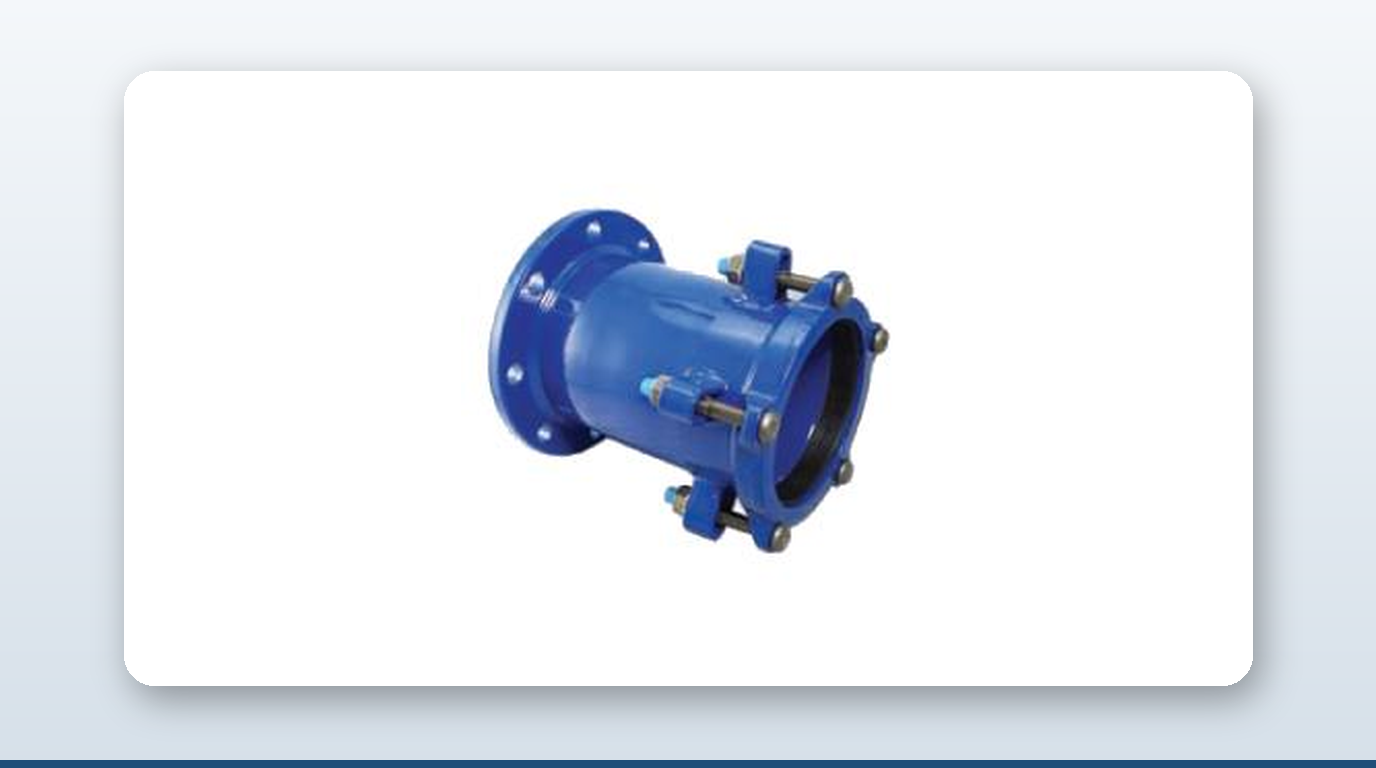
Where DPE’s product range intersects this question directly is the flange-adaptor coupling — a fitting with a flange on one end (bolts to a flanged pump, valve, or vessel) and a coupling grip on the other (grabs plain-end pipe). It replaces a fabricated welded spool piece that would otherwise be needed to connect plain pipe to flanged equipment.
The flange end of this fitting has to match the equipment flange exactly on all four dimensions above. Because DPE’s primary brands — JWC and Aju — are Korea-origin, their natural default drilling is KS or JIS, which is the right match for Korean or Japanese-origin pump and valve nozzles but the wrong match for an ASME B16.5-specified Singapore oil & gas job unless the ASME-drilled variant is specifically confirmed and ordered. Getting this wrong doesn’t produce a slightly-off part — it produces a flange that physically cannot bolt to the equipment.
For couplings that avoid the flange question entirely — plain pipe to plain pipe, no flange on either end — see Mechanical Coupling vs Flange for where a coupling replaces a flanged joint outright on utility and low-pressure runs. For the coupling-body size chart (a related but separate reference — this covers flange bolt patterns, not coupling OD/ID sizing), see Complete Pipe Coupling Size Chart: DN15 to DN300.
How to Get the Exact Numbers for Your Job
- Confirm the governing standard from the project spec — don’t infer it from the pipe’s country of origin alone.
- Confirm the pressure class or PN rating, and the facing (RF/FF/RTJ).
- For B16.47 large-diameter work (26″+), confirm Series A or Series B — these are not interchangeable even within the same standard.
- Pull the exact bolt circle, bolt count, and hole diameter from the current edition of the standard or a verified manufacturer cut sheet — never from a generic online chart that doesn’t state its source standard.
- If you’re specifying a flange-adaptor coupling, confirm with the supplier in writing which drilling standard the flange end is made to before the order goes to the factory.
FAQ
Is there one universal flange dimensions chart that covers DN15 to DN600?
No. Dimensions depend on the governing standard (ASME, EN, JIS/KS), the pressure class or PN, and the facing — not on nominal size alone. A chart that doesn’t specify which standard it’s drawn from should be treated as unreliable for ordering.
Will a JIS flange bolt onto an ASME B16.5 flange of the same nominal size?
No. JIS and ASME flanges at nominally equivalent sizes have different bolt circle diameters and bolt counts. They will not mate without a transition piece or re-drilling.
What’s the difference between ASME B16.5 and B16.47?
B16.5 covers NPS ½ through 24. B16.47 picks up NPS 26 through 60, and exists in two non-interchangeable series (Series A and Series B) with different outside diameters and bolt patterns at the same nominal size and class.
Which flange standard does PUB (Singapore’s water agency) require?
PUB’s Stipulation of Standards governs fittings for Singapore’s water infrastructure, and the norm is BS EN 1092-1 / PN drilling rather than ASME — confirm the specific requirement against the current PUB stipulation for your project.
Key Takeaways
- A flange’s dimensions are fixed by standard, pressure class/PN, and facing together — nominal size alone is not enough to order by
- ASME, EN 1092-1, and JIS/KS flanges at “the same” nominal size are not interchangeable and will not bolt together
- Which standard applies depends on the sector: ASME for oil & gas and power, EN/PN for Singapore water infrastructure and building services, JIS/KS for Korean and Japanese-origin equipment
- For DPE’s flange-adaptor couplings, always confirm the flange-end drilling standard in writing before ordering — JWC and Aju default to KS/JIS unless ASME or EN drilling is specifically requested
- Pull exact bolt circle and hole dimensions from the controlled standard or a verified cut sheet, not a generic chart
About David Phee Enterprise
David Phee Enterprise is the exclusive Singapore distributor for Jeong Woo Coupling (JWC) and a long-standing supplier of Aju, Smith-Blair, and Romacon pipe couplings, flange-adaptor fittings, and expansion joints. Operating from Empire Technocentre in Kaki Bukit, DPE supplies industrial contractors, shipyards, and infrastructure projects across Singapore, Malaysia, and Indonesia with same-day delivery on stocked items. Visit davidphee.com for quotations and drilling-standard confirmation.