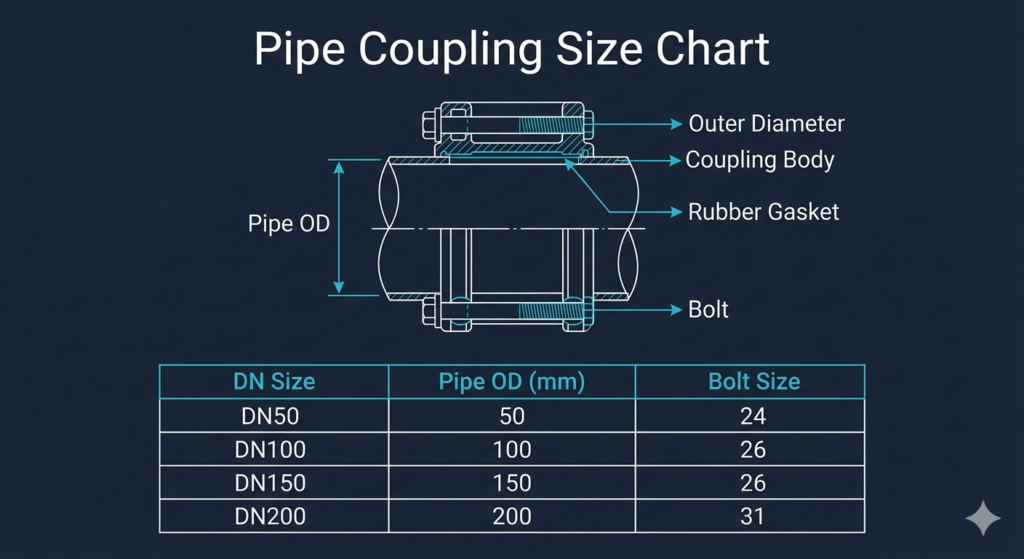
This pipe coupling size chart covers DN15 to DN300 — giving you OD ranges, bolt specs, pressure ratings, and gasket selection for mechanical pipe couplings in one complete reference.
Choosing the right coupling starts with one number: the actual outside diameter (OD) of your pipe. Not the nominal bore. Not the DN size. The OD. Whether you are sourcing for a shipyard, a water infrastructure project, or an oil and gas facility, this essential pipe coupling size chart will save you from the most common and costly sizing mistakes.
Why OD — Not DN — Determines Your Coupling Size
Nominal bore (DN or NB) is a label, not a measurement. Two pipes stamped DN150 can have completely different outside diameters depending on which standard they were manufactured to — JIS, DIN, ANSI, or BS.
Here is how much OD can vary at the same DN:
| DN / NB | JIS OD (mm) | DIN OD (mm) | ANSI OD (mm) |
|---|---|---|---|
| DN25 (1″) | 34.0 | 33.7 | 33.4 |
| DN50 (2″) | 60.5 | 60.3 | 60.3 |
| DN80 (3″) | 89.1 | 88.9 | 88.9 |
| DN100 (4″) | 114.3 | 114.3 | 114.3 |
| DN150 (6″) | 165.2 | 168.3 | 168.3 |
| DN200 (8″) | 216.3 | 219.1 | 219.1 |
The DN150 difference is the one that catches people out most often. A JIS pipe at 165.2mm OD will not seal correctly inside a coupling sized for a 168.3mm DIN pipe. This pipe coupling size chart accounts for both — always confirm the pipe standard before ordering.
How to measure: Use a vernier calliper across the outside of the pipe. If you do not have one, a wrap-around pipe OD tape works for larger diameters. Never estimate from the bore.
Which Pipe Standard Is Most Common in Singapore and Southeast Asia?
This is a question that comes up frequently for procurement teams using this pipe coupling size chart to source in the region.
JIS (Japanese Industrial Standard) dominates Singapore and most of Southeast Asia. The majority of pipes installed in Singapore’s industrial, marine, and water infrastructure sectors follow JIS dimensions. This is a legacy of decades of Japanese equipment and engineering influence across the region. If you are buying pipe locally in Singapore, Malaysia, or Indonesia, there is a high probability it is JIS.
DIN (German / European Standard) appears in European-supplied equipment and process plants. You will encounter DIN pipes in refineries, petrochemical plants, and facilities that sourced their process equipment from European manufacturers. At smaller sizes (DN50 to DN100) the OD difference from JIS is small enough to share a coupling range — but at DN150 and above the difference becomes critical.
ANSI (American Standard) is common in oil and gas facilities that follow American engineering specifications, particularly those with ties to US-based EPC contractors. ANSI ODs largely match DIN from DN50 upward, but diverge at smaller sizes.
Practical rule for Singapore: Default to JIS OD when reading any pipe coupling size chart unless you have documentation stating otherwise. When in doubt, measure.
Complete Pipe Coupling Size Chart: DN15 to DN300
The table below is your primary pipe coupling size chart for standard JWC mechanical couplings (MJG series). Bolt counts and sizes reflect the standard factory configuration. Always verify against the manufacturer datasheet for your specific model.
| DN | Pipe OD (mm) | Coupling OD Range (mm) | No. of Bolts | Bolt Size | Pressure Rating |
|---|---|---|---|---|---|
| DN15 | 21.3 | 19.0 – 21.3 | 2 | M8 × 55 | PN16 |
| DN20 | 26.9 | 24.0 – 27.2 | 2 | M8 × 55 | PN16 |
| DN25 | 33.7 / 34.0 | 31.0 – 35.0 | 2 | M8 × 65 | PN16 |
| DN32 | 42.4 | 40.0 – 43.0 | 2 | M8 × 65 | PN16 |
| DN40 | 48.3 | 45.0 – 49.0 | 2 | M8 × 65 | PN16 |
| DN50 | 60.3 / 60.5 | 57.5 – 61.0 | 2 | M10 × 70 | PN16 |
| DN65 | 76.1 | 73.0 – 77.5 | 2 | M10 × 75 | PN16 |
| DN80 | 88.9 / 89.1 | 85.5 – 91.0 | 2 | M10 × 80 | PN16 |
| DN100 | 114.3 | 110.0 – 115.5 | 2 | M12 × 85 | PN16 |
| DN125 | 139.7 | 135.0 – 141.5 | 2 | M12 × 90 | PN16 |
| DN150 | 165.2 / 168.3 | 162.0 – 170.0 | 2 | M12 × 95 | PN16 |
| DN200 | 216.3 / 219.1 | 212.0 – 221.0 | 4 | M16 × 100 | PN16 |
| DN250 | 267.4 / 273.1 | 263.0 – 276.0 | 4 | M16 × 110 | PN16 |
| DN300 | 318.5 / 323.9 | 314.0 – 327.0 | 4 | M16 × 120 | PN16 |
From DN200 upward, couplings switch from 2 bolts to 4. Factor this into installation time and hardware kitting.
Which JWC Coupling Model Do You Need?
Once you have confirmed the size using this pipe coupling size chart, the next question is which series fits your application. JWC produces several types under the MP Joint brand, each designed for a specific installation scenario:
| Model | Type | Best For |
|---|---|---|
| MJS / MJL | Flexible | Absorbs vibration, expansion, angular movement. Ideal for new pipe runs. |
| MJG / MJGL | Grip Ring | Anti-pull-out grip. Replaces flanges and unions — no pipe end processing required. |
| MJSG / MJSGL | Flex-Grip | Combines flexible absorption with grip-ring security. Best of both. |
| MJH / MJHL | Hinge Repair Clamp | Opens like a hinge — for repairing leaks on straight pipe in-situ. |
| MJER | Elbow Repair Clamp | Split two-part design for damaged elbows and welded sections. |
| MGLP | Low Pressure | Economy option for low-pressure connections up to 10 bar (small sizes). |
For high-pressure variants, add “F” to the model code (e.g. MJGF, MJSF) — these are the Force Type series rated for higher working pressures.
MJS vs MJG — which to choose? MJS absorbs movement. MJG grips the pipe and resists pull-out. If your pipe system experiences vibration or thermal expansion, go with MJS. If you need a secure, no-weld joint that will not pull apart under pressure, go with MJG. The MJSG series gives you both — grip on one end, flex on the other.
Gasket Material Selection Guide
The gasket determines what fluid and temperature your coupling can handle. Standard JWC couplings ship with either NBR or EPDM — specify when ordering if you need something different.
| Gasket | Temperature Range | Best For |
|---|---|---|
| NBR (Nitrile) | -20°C to +80°C | Water, oil, general service |
| EPDM | -30°C to +120°C | Hot water, seawater, outdoor/UV exposure |
| Viton (FKM) | -20°C to +200°C | Fuels, aggressive chemicals, high-temperature service |
| Silicone | -50°C to +180°C | Food-grade, clean service |
For maritime and shipyard applications, EPDM is the standard choice — it handles UV, saltwater, and heat cycling without degrading. For oil and gas service, Viton is the correct specification. NBR is the workhorse for general industrial water and utility service.
One thing worth noting: the gasket cross-section on JWC couplings is a triangular or wedge profile. When replacing gaskets, make sure the tapered face is oriented inward — reversed installation is a common cause of persistent leaks that are mistakenly attributed to incorrect pipe coupling sizing.
Pipe Coupling Applications by Industry
Maritime and Shipyards
Ships operate in the harshest environment for pipe systems: constant vibration from engines, saltwater exposure, tight spaces, and the need for fast in-situ repairs. Referencing a reliable pipe coupling size chart before placing orders is essential here — the wrong size on a vessel can mean a full system shutdown.
- New pipe runs: MJS flexible couplings absorb engine vibration and reduce noise transmission by over 60% compared to welded joints.
- Emergency repairs: MJH hinge repair clamps and Romacon snap clamps can be fitted without shutting down the system in most cases.
- Marine expansion joints: For Class II and III piping systems, ABS-approved A-Ju expansion joints are the correct specification.
Key customers in this sector include ship chandlers supplying vessels at anchor or berthed in Singapore port, as well as shipyards like Seatrium (formerly Sembcorp Marine).
Water Infrastructure
Singapore’s PUB water network and regional water treatment plants operate predominantly on JIS-dimensioned pipe. DN100 and DN150 are the most commonly specified sizes for distribution mains, and DN200 to DN300 for trunk mains.
For water applications, EPDM gaskets are standard. Romacon RS-1 repair clamps are commonly used for in-service leak repair on water mains — they are certified to ACS (France) and WRAS (UK) standards and can be installed under live pressure.
Oil and Gas
Refineries and petrochemical facilities in Indonesia (Pertamina) and across Southeast Asia use pipe couplings in utility piping, cooling water, and non-process systems. The key differences here are:
- Higher working pressure requirements — specify MJGF or MJSF Force Type couplings.
- Viton gaskets are mandatory for any service involving hydrocarbons.
- Stainless steel bolts (A4-80) are preferred for corrosive environments.
For OGA trade show procurement and Indonesia supply enquiries, DPE supplies to the region from its Singapore hub with standard documentation for cross-border shipments.
Common Pipe Coupling Sizing Mistakes
These are the errors that generate the most return requests and re-orders — most of which come down to not using an accurate pipe coupling size chart at the point of ordering:
1. Ordering by DN without confirming OD
The most common mistake. A buyer orders a “DN150 coupling” without specifying JIS or DIN. The wrong one arrives. Always state the OD and the pipe standard on the RFQ.
2. Assuming the same coupling fits both JIS and DIN at DN150
It does not. A coupling with a 162–170mm OD range can technically accommodate both 165.2mm (JIS) and 168.3mm (DIN) at DN150 — but not all coupling models have this range. Confirm with your supplier before ordering a single part number for mixed-standard pipe.
3. Ignoring the service fluid when selecting gasket material
A coupling ordered for water service and subsequently redeployed to oil service without changing the gasket will fail. NBR will swell and degrade in contact with certain hydrocarbons. Always re-specify the gasket when the service changes.
4. Over-torquing the bolts
More torque does not mean a better seal. Excessive bolt force crushes and deforms the gasket, creating a leak path rather than preventing one. Use a torque wrench and follow the manufacturer’s values.
5. Using the wrong coupling on plastic or lined pipe
Grip ring couplings (MJG) rely on their grip rings biting into the pipe surface. On PVC, HDPE, or internally lined pipe, this can cause damage. Use flexible couplings (MJS) on softer pipe materials, or consult your supplier for the correct specification.
Bolt Specifications and Torque Guide
Standard JWC coupling bolts are carbon steel Grade 8.8, hot-dip galvanised. If your installation is in a seawater or corrosive environment, specify stainless steel bolts (A2-70 or A4-80) when ordering. Stainless bolts require slightly lower torque to avoid galling.
| Bolt Size | Galvanised Steel — Torque | Stainless Steel — Torque |
|---|---|---|
| M8 | 15 – 20 Nm | 12 – 16 Nm |
| M10 | 25 – 35 Nm | 20 – 28 Nm |
| M12 | 40 – 55 Nm | 32 – 44 Nm |
| M16 | 80 – 110 Nm | 64 – 88 Nm |
Torque values shown are indicative. Always refer to the manufacturer’s installation guide for the specific coupling model, as values vary between MJS, MJG, and repair clamp series.
How to Order the Right Coupling
Once you have identified your size using the pipe coupling size chart above, confirm these five details before sending your RFQ:
- Pipe OD — measured with a calliper, not estimated from the nominal bore
- Pipe standard — JIS, DIN, ANSI, or BS (affects OD even at the same DN)
- Service fluid and temperature — determines gasket material
- Coupling model — MJG, MJS, MJSG, MJH, or repair type
- Bolt material — galvanised carbon steel (default) or stainless steel for corrosive environments
Providing all five on your RFQ eliminates back-and-forth and gets you a faster, more accurate quote.
For same-day availability of JWC couplings in Singapore across the full DN15 to DN300 range, contact David Phee Enterprise. As the exclusive JWC distributor in Singapore, DPE stocks all standard sizes and gasket materials — with same-day delivery as standard.
Frequently Asked Questions
What is the difference between DN and NB?
DN (Diameter Nominal) and NB (Nominal Bore) refer to the same thing — the nominal pipe size designation. Neither is a physical measurement. The actual pipe OD must be confirmed separately, as it varies by pipe standard (JIS, DIN, ANSI). Always cross-reference with a pipe coupling size chart that shows actual OD values.
Can I use the same coupling for JIS and DIN pipe at DN150?
Only if the coupling’s OD range covers both 165.2mm (JIS) and 168.3mm (DIN). Some JWC coupling models at DN150 have a range of 162–170mm, which accommodates both. Confirm this with your supplier before ordering.
What does PN16 mean?
PN stands for Pressure Nominal. PN16 means the fitting is rated for a nominal working pressure of 16 bar. Standard JWC couplings across the DN15 to DN300 range are rated PN16, which covers the majority of industrial and marine utility piping applications.
How do I know if I need a flexible (MJS) or grip ring (MJG) coupling?
If the primary concern is vibration, noise, or thermal expansion — use MJS. If the primary concern is a secure, pull-out-resistant joint that replaces a flange or union — use MJG. For both, use MJSG.
Can I install a pipe coupling on a live pipe?
Repair clamps (MJH hinge type, Romacon snap clamp) can often be installed under live pressure for emergency repairs. Standard MJG and MJS couplings require the system to be depressurised for installation.
What is the maximum pressure for JWC couplings?
Standard MJG couplings are rated to 16 bar (PN16) for industry use and 7–16 bar for marine (ship) use depending on size. For higher pressure requirements, specify the Force Type variants (MJGF, MJSF), which are rated up to 32 bar.
Do JWC couplings need special tools to install?
No. Standard JWC couplings require only a torque wrench and basic hand tools. No pipe end grooving, threading, or welding is required. This is one of the key advantages over grooved couplings and flanged joints.
Key Takeaways
- Use this pipe coupling size chart to confirm OD range before placing any order — never order by DN alone.
- JIS, DIN, and ANSI pipes of the same DN often have different ODs — especially at DN150 and above.
- In Singapore and Southeast Asia, JIS dimensions are the default. Confirm the pipe standard before ordering.
- DN200 and larger use 4 bolts instead of 2 — account for this in installation.
- Match gasket material to your service fluid: NBR for general service, EPDM for water and marine, Viton for oil and chemicals.
- Never over-torque — follow manufacturer torque specs to protect the gasket.
- Specify stainless steel bolts for seawater or corrosive environments.
- When in doubt about sizing, measure the OD with a calliper and state the pipe standard on your RFQ.
- Jurong Island Piping Maintenance: What Petrochemical Operators Specify
- Pharmaceutical Plant Pipework in Tuas: Coupling and Fitting Selection
- Semiconductor Fab Piping: Coupling Requirements for Cleanroom Utilities
- District Cooling Pipework: How Couplings Handle Singapore’s Network Loads
- Data Centre Chilled Water Piping: Coupling Selection for Singapore Facilities
1 thought on “Complete Pipe Coupling Size Chart: DN15 to DN300”