Ask a supplier whether a coupling is “certified” and you will almost always get a yes. The word does a lot of work and explains very little.
The problem is that pipe coupling standards are not one list. They are two separate layers that answer two different questions, and a product can pass one layer completely while failing the other entirely. Most specification disputes on Singapore projects come down to somebody accepting a certificate from the first layer as if it settled the second.
This article explains the two layers, then walks through what ISO, JIS, BS/EN, AWWA and Singapore SS numbers actually cover — and what to ask for when a specification says only “to relevant international standards.”
The Two-Layer Rule
Layer one is structural. Does the joint hold pressure? Are the materials and dimensions sound? Will the housing, gasket and bolting survive the mechanical duty? This is what most coupling standards address.
Layer two is service and contact. Is this coupling permitted in *this* service — touching drinking water, in a fire-risk zone, on a classed vessel? This is a separate certification with separate testing.
The consequence is the sentence worth remembering:
> A coupling can be fully compliant with a structural coupling standard and still be legally blocked from potable water service.
The structural standard proves the joint holds. It says nothing about whether the elastomer leaches into drinking water, or whether the joint survives a hydrocarbon fire. Those are tested separately, certified separately, and gated separately.
Keep the two layers apart in your head and the rest of this article is straightforward.
ISO — The International Layer
ISO standards relevant to couplings split into three quite different jobs, and they are frequently confused with one another.
ISO 9001 — a quality-management standard, not a product standard
This is the one most often waved as a product credential, and it is not one. ISO 9001 certifies the manufacturer’s quality-management system — that the factory has documented, repeatable processes. It says nothing whatsoever about whether a specific coupling meets a specific dimensional or pressure requirement.
An ISO 9001 certificate is a reasonable signal that a manufacturer is organised. It is not evidence that the part in your hand is fit for your service. Treat it as supporting information, never as the answer.
ISO 19921 and ISO 19922 — the fire-test gate
ISO 19921:2005 is the fire-test method for pipe components. ISO 19922:2005 sets out the test bench requirements and the acceptance framing. Read them as a pair — a certificate citing one without the other is incomplete.
These matter enormously in marine and fire-critical work. Where a line runs through a fire-risk zone, a standard utility-coupling approval is not sufficient; the component needs to have been fire-tested to this method. Classification-society rules and IACS requirements point at these numbers.
If your line is fire-critical, this is the specific question to ask: *has this coupling been fire-tested to ISO 19921, and can I see the certificate?*
ISO 161 and ISO 4427 — dimensional series for plastics
These fix the outside-diameter series for thermoplastic pipe, including polyethylene. They matter because PE runs on its own OD series, distinct from steel and ductile iron — which is why a metal-pipe coupling does not fit a PE pipe of the same nominal size. That subject has its own article; the short version is that the DN label is not the dimension the coupling grips.
JIS — The Japanese Layer
Japanese Industrial Standards appear regularly in Asian marine and industrial specifications, largely because of the shipbuilding supply chain.
JIS B2220 is the flange standard — pipe flanges for steel pipe, with its own bolt-hole pattern, pitch-circle diameter and pressure-class conventions. The critical point for anyone specifying a flanged coupling adaptor is that JIS flange drilling is not interchangeable with EN or ASME drilling. A JIS 10K flange and an EN PN16 flange of the same nominal bore have different bolt patterns. They will not mate.
This catches people on mixed-origin projects more often than any other standards mismatch. If a vessel was built to Japanese practice and the replacement part is European, the flange faces need checking before anything is ordered, not after.
Japanese water-utility work also runs through JWWA (Japan Water Works Association) and related approval schemes, which are their own contact-approval regime — layer two, in the framing above.
BS and EN — The Layer Singapore Actually Runs On
This is the family that matters most for Singapore and Malaysian work, because the regional specification lineage is British and European rather than American.
BS 6920 is the big one for water. It tests the effect of non-metallic materials on water quality — taste, odour, appearance, growth of aquatic microorganisms, and extraction of substances. This is a pure layer-two standard: it says nothing about pressure and everything about whether the material is safe in contact with drinking water.
EN 1092-1 is the European flange standard — the PN-series counterpart to JIS B2220 and ASME B16.5. Same warning applies: PN16 drilling is not JIS 10K drilling.
EN 545 and EN 598 cover ductile-iron pipes and fittings, for potable water and for sewerage respectively. These appear constantly in Singapore utility specifications and define the pipe the coupling has to grip.
EN 12845 governs fixed firefighting sprinkler systems, which is where coupling selection meets fire-protection design.
AWWA — The American Product Standard for Couplings
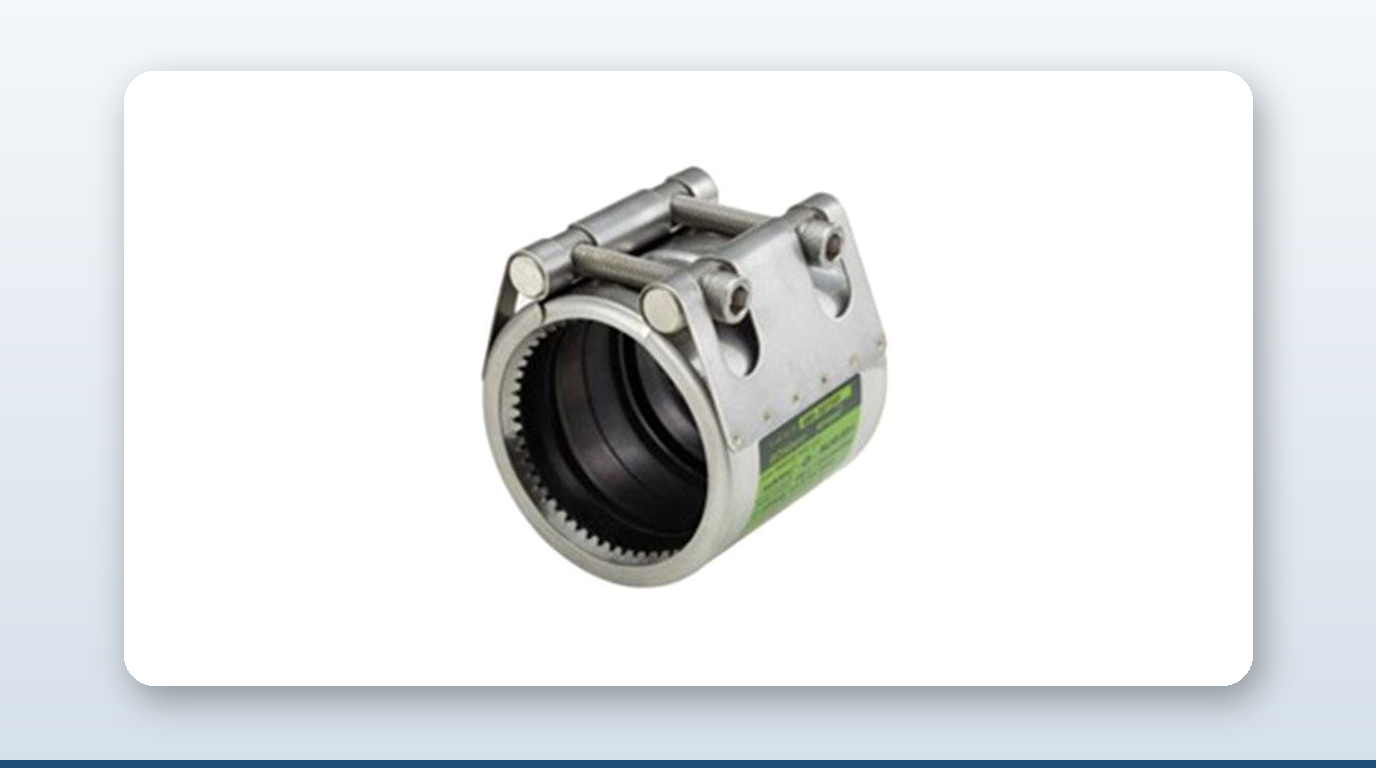
**ANSI/AWWA C219 — *Bolted, Sleeve-Type Couplings for Plain-End Pipe*** — is worth knowing because it is the standard that names the product class directly. It covers bolted sleeve-type couplings, reducing and transition couplings, and flanged-coupling-adaptors used to join plain-end pipe in water systems, from ½ inch upward, in carbon steel, stainless steel, ductile iron or malleable iron. The current edition is C219-23.
C219 is the cleanest single description of what a mechanical coupling is required to be, structurally. But note what it is not: C219 is a layer-one standard. In American practice the corresponding contact certification is NSF/ANSI 61, which is entirely separate.
AWWA C606 covers grooved and shouldered joints — the Victaulic-style world. Different product category, different jointing method.
In Singapore and Malaysia, C219 is a credential rather than a gate. Regional water specifications are built on BS-EN and SS lineage, with Malaysian work routed through JKR specifications. C219 conformance is useful supporting evidence, and it carries real weight where a US-influenced consultant is writing the spec. It is not the named local standard.
Singapore — SS Numbers and the PUB Gate
For potable water work in Singapore the chain runs like this:
| Standard | What it governs |
|---|---|
| SS 636 — Code of Practice for Water Services | The building-side code. Design, installation, fixing and testing of potable water-service installations, from the authority’s supply to the draw-off point. Current as SS 636:2018 with amendments to A4:2021; supersedes CP 48:2005. |
| SS 375 (or BS 6920) | Testing of finished-form non-metallic materials in contact with potable water. This is the hard gate. |
| SS 270 | Elastomeric seals. |
The mechanism worth understanding: **SS 636 is deemed mandatory under PUB’s *Stipulation of Standards & Requirements for Water Fittings*, and SS 636 in turn obliges every wetted non-metallic material to pass SS 375 or BS 6920.** So the building-services code is what invokes the contact gate.
Two practical consequences:
1. On the potable side, the contact certification is the blocker, not the structural standard. Get that certificate confirmed before anything else. 2. On the non-potable side — cooling water, plant service, raw and seawater, drainage — SS 636 largely does not apply and the potable gate does not bite. This is a much wider field of acceptable product.
Knowing which side of that line your application sits on saves a great deal of time.
Marine — Where Approval Attaches to the Combination
Marine work adds a rule that surprises people, and it is the single most expensive thing to get wrong.
Classification-society type approval — ABS, DNV, Lloyd’s Register, Bureau Veritas, Korean Register, ClassNK, RINA — attaches to the coupling and gasket as a combination, not to the coupling alone.
A stainless housing with the approved EPDM gasket carries the type approval. That same housing fitted with a different gasket compound has no approval and cannot be used on a classed pipe.
This is why aftermarket gaskets are a false economy in marine service. A sheet-cut “EPDM” gasket at a fraction of the price looks identical and voids the certificate. The OEM-supplied gasket is the approved gasket; certificate and part are inseparable.
While we are on elastomers: never specify “rubber gasket” without naming the compound, the cure system and the Shore A hardness in writing. Peroxide-cured EPDM and sulphur-cured EPDM look the same and behave very differently in continuous hot-water duty. Potable approvals attach to specific cured compounds, not to a polymer family. A correct specification line reads something like *”EPDM, peroxide-cured, BS 6920 approved, Shore A 70±5″*.
What to Ask For
When a specification says only “to relevant international standards,” these five questions resolve it:
1. What is the service? Potable, non-potable, seawater, fuel, fire-critical, classed vessel. The answer determines which layer-two certification applies — and often, that no layer-two certification applies at all. 2. What is the structural standard? AWWA C219 for bolted sleeve-type couplings, or the manufacturer’s stated pressure and dimensional basis. 3. What is the contact or service certification? SS 375 or BS 6920 for potable. ISO 19921/19922 for fire-critical. Class type approval for marine. 4. What flange drilling? JIS, EN PN or ASME class — and confirm it matches the mating face already installed. 5. What is the gasket compound, cure system and hardness — and is the certificate written against *that* combination?
A supplier who can answer all five without hedging is one you can buy from. A supplier who answers “yes, it’s certified” has not answered anything.
Getting the Certification Right Before You Order
Standards mismatches are cheap to catch at quotation and expensive to catch at inspection. A wrong flange drilling is a return. A missing potable-contact certificate can hold up a handover.
David Phee Enterprise supplies mechanical couplings, repair clamps and expansion joints across Singapore, Malaysia and Indonesia from our Kaki Bukit HQ, with same-day delivery on stocked lines. We can confirm the applicable structural standard, the contact or class certification, and the flange drilling against the manufacturer’s current documentation before anything ships — and tell you plainly when a product is not certified for the service you have described.
For technical enquiries and quotations, visit www.davidphee.com.
*Standards editions change. The editions cited here were current as at mid-2026 — SS 636:2018+A4:2021, AWWA C219-23, AWWA C606-22, ISO 19921:2005, ISO 19922:2005. Always confirm the current cut and the specific project specification before relying on any citation in this article.*