Singapore’s district cooling networks are growing fast enough to be measured in refrigeration tons added per year rather than per decade. SP Group’s Marina Bay network — already the world’s largest underground district cooling system at roughly 73,000 RT — is contracted to reach 90,000 RT by 2027 as Suntec City and new satellite plants join the loop. Keppel’s Jurong Lake District system alone is a 29,000 RT, S$950 million, 30-year build-own-operate contract. Every ton of that added capacity moves through pipework, and the question of where that pipework is welded shut for life and where it takes a mechanical joint is not academic — it determines how the network gets built, maintained, and repaired for the next three decades.
This guide explains why the buried trunk main is effectively a closed system, and where the real mechanical-coupling scope in a Singapore district cooling network actually sits: the plant room and the building-side energy transfer station.
Singapore’s District Cooling Operators
District cooling in Singapore is a chilled-water-only service — no steam, no condensate — supplied at roughly 6°C with a return around 13°C, a delta-T of about 6°C, regulated by EMA’s District Cooling Services Supply Code. Four operators run networks across the island:
| Operator | Network(s) | Scale |
|---|---|---|
| SP Group | Marina Bay, Tampines, HarbourFront, Suntec, Tengah | ~73,000 RT growing to 90,000 RT by 2027 at Marina Bay alone; HarbourFront adds 17,150 RT phased 2027–2031 |
| Keppel DHCS | one-north, Changi Business Park, Woodlands wafer-fab park, Bulim/Jurong Innovation District, Jurong Lake District | Over 82,000 RT installed after Bulim; JLD alone is 29,000 RT under a 30-year DBOO contract |
| ENGIE SEA | Punggol Digital District | ~30,000 RT across a 4 km underground trunk, under a 30-year DBOO contract from JTC |
| Sembcorp | Jurong Island Centralised Utilities | District cooling bundled with steam, power, and industrial water; smaller than the three city-side networks |
Why the Trunk Main Is a Closed System
Trunk mains across all four Singapore operators are welded carbon-steel pipe inside a pre-insulated jacket built to the EN 253 standard family. This is not a loosely lagged pipe — it is a factory-bonded assembly with three layers chemically fused into a single structural sandwich: a shot-blasted carbon-steel carrier pipe, a rigid polyurethane foam layer that is pressure-injected and load-bearing, and an outer high-density polyethylene casing. Embedded copper wires run the length of the pipe as a leak-detection surveillance circuit.
| Standard | Covers |
|---|---|
| EN 253 | The bonded pipe assembly itself — steel carrier, PUR foam, HDPE casing |
| EN 448 | Bonded fitting assemblies (bends, tees, reducers) |
| EN 488 | Bonded valve assemblies (buried valves within the casing) |
| EN 489 | Field joint assemblies over a welded carrier joint — a vendor-supplied, type-tested component |
| EN 13941 | Design and installation of bonded systems |
Field joints are made by butt-welding the carrier pipe, then sealing the casing gap with a vendor-supplied EN 489 casing joint — either an electrofused or welded HDPE sleeve, or a heat-shrink sleeve with the cavity foam-filled — before splicing the leak-detection wire through the joint so the surveillance circuit stays continuous end to end. Every part of that sequence is closed and vendor-specific. A mechanical coupling cannot be substituted anywhere in it: it would break the carrier weld continuity, interrupt the casing seal, disturb the load-bearing foam bond, and sever the leak-detection alarm circuit. This is why trunk mains under Marina Bay, Jurong Lake District, and Punggol Digital District are simply not mechanical-coupling territory, by the physics of the system rather than by preference.
Where Mechanical Couplings Actually Do the Work
Pre-insulated pipe terminates at four points where the network transitions to conventional, non-insulated pipe, and every one of those transition points is where mechanical-coupling scope actually lives:
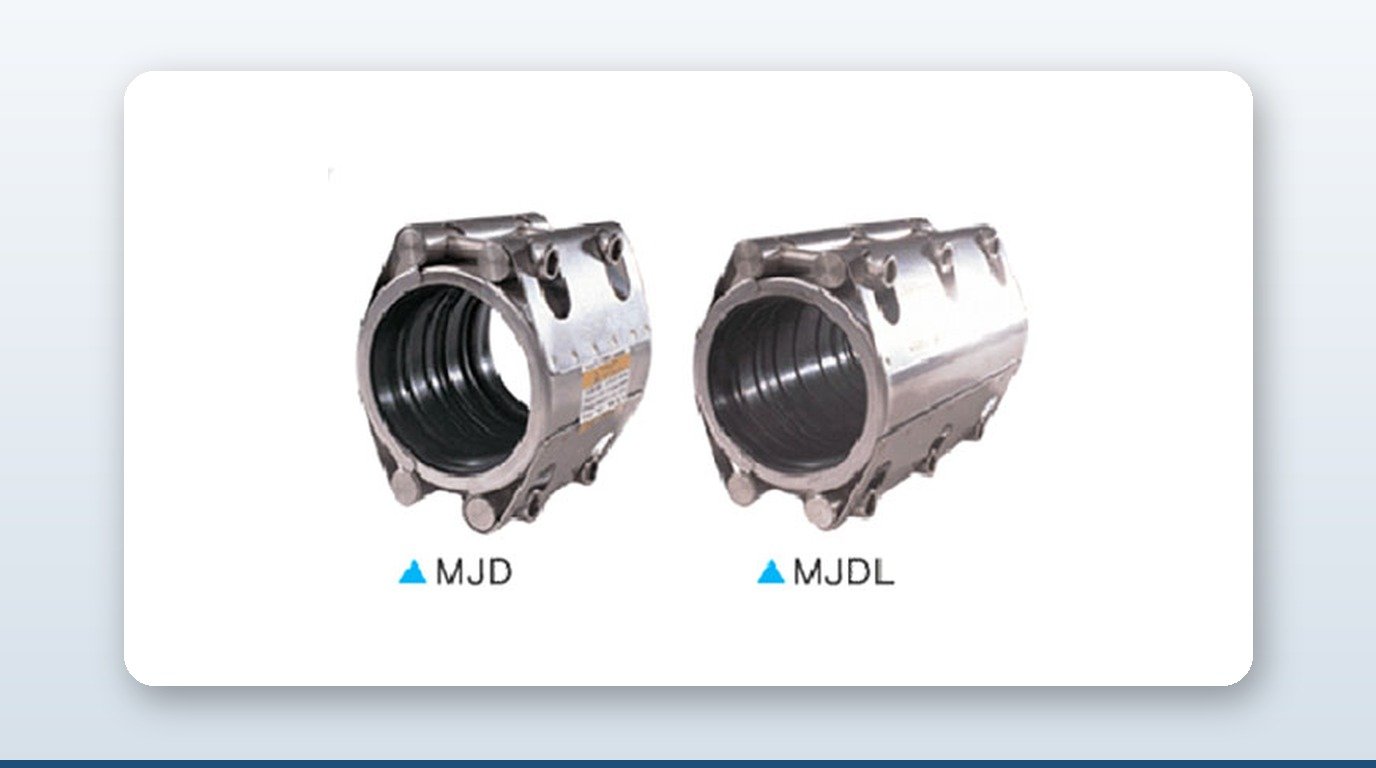
- – Plant-room headers. Where the buried trunk surfaces and terminates at a plant-room end seal or flange, the chiller pump suction and discharge piping downstream is bare steel — standard flexible-coupling territory for vibration isolation and axial movement at the pump base.
- – Energy Transfer Station (ETS) rooms. Every building joining a district cooling network gets an ETS room where the service drop transitions out of the insulated jacket into bare-steel primary and secondary heat-exchanger piping, strainers, and isolation and bypass spools. This is the highest-volume coupling application in the network, because it repeats at every connected building.
- – Valve chambers. Above-ground isolation valves and tie-ins sit in bare, flanged or coupled pipe rather than buried pre-insulated valves.
- – Above-ground tie-ins. Any run that leaves the ground — a bridge crossing, a plant tie-in — reverts to conventional pipe at the penetration point.
Service drops from the trunk to a building ETS typically run DN150–DN350 at around PN10, compared with DN500–DN1200 at PN16 for the trunk mains themselves. Spec language on the conventional side follows SS 553:2016+A1:2017 for the building-side ACMV scope and ASME B31.9 for the trunk piping classification, with the EN 253/448/488/489 family governing the buried bonded sections specifically.
Industrial-scale sites add a further wrinkle: Keppel’s Woodlands wafer-fab district cooling loop runs a colder primary loop, around 4°C, for process cooling rather than the standard 6°C comfort-cooling supply — a reminder that “district cooling” covers a range of duty even within a single operator’s network.
The One Documented Case of Network-Side Mechanical Couplings
ENGIE’s Punggol Digital District system is publicly documented as using mechanical couplings on its network piping — reportedly cutting construction time by close to 80% — with pipes installed at 45-degree angles to reduce pumping energy. This is the single public Singapore reference for mechanical-coupling adoption inside a district cooling network build, rather than purely at the plant-room and ETS boundary. It is worth noting as a documented data point on construction-time benefits, though the reduction is understood to apply to the conventional-side service and plant piping rather than to any joint inside the EN 253 bonded trunk itself.
Ageing Assets and In-Service Repair
A damaged section of the buried bonded trunk main is not a mechanical-clamp repair. Restoring it means exposing the run, cutting out the defect, re-welding the carrier pipe, re-foaming the insulation, fitting a new EN 489 casing joint, and re-splicing the leak-detection wire — or applying a specialist composite-wrap repair system rated for the service conditions. A mechanical clamp can restore pressure containment on bare pipe, but it cannot restore the PUR insulation, the HDPE casing, or the leak-detection circuit, which is why it is not an accepted permanent repair on the buried network.
Where mechanical repair clamps do belong is on the conventional pipe: legacy carbon-steel sections in plant rooms, ETS rooms, and brownfield retrofit projects such as the Tampines Eco Town distributed system or SP’s older HarbourFront-area infrastructure. Draining a 6°C chilled-water loop for a full re-weld is typically a multi-day event on a live network — a constraint that makes in-service clamp repair the practical choice on the conventional side, even where it is categorically ruled out on the buried bonded main.
Key Takeaways
- – Singapore’s four district cooling operators run trunk mains as welded, pre-insulated EN 253/448/488/489 bonded assemblies — a closed system where mechanical couplings have no role.
- – The real coupling scope sits at the interfaces where pre-insulated pipe transitions to conventional pipe: plant-room headers, ETS rooms, valve chambers, and above-ground tie-ins.
- – ETS rooms are the highest-volume application because they repeat at every building joining the network — each one needs coupled connections on primary/secondary heat-exchanger piping, strainers, and bypass spools.
- – ENGIE’s Punggol Digital District is the one Singapore network with a public record of mechanical-coupling adoption on the service side of its build, credited with a significant construction-time reduction.
- – In-service repair clamps are a practical necessity on ageing conventional-side CHW piping, but they cannot substitute for the specialist casing repair a damaged bonded trunk main requires.
About David Phee Enterprise
David Phee Enterprise supplies mechanical pipe couplings, expansion joints, and repair clamps to industrial and infrastructure projects across Singapore, Malaysia, and Indonesia, with same-day delivery from its Kaki Bukit HQ. As the exclusive Singapore distributor for JWC (Jeong Woo Coupling), DPE supports plant-room and ETS-room piping on district cooling projects. For technical enquiries, visit davidphee.com or get in touch directly.