Singapore is mid-way through a semiconductor fab construction supercycle worth more than S$70 billion between 2021 and 2030. Six major projects are active or recently completed: UMC’s US$5 billion Pasir Ris expansion, GlobalFoundries’ US$4 billion Woodlands expansion, Siltronic’s SGD 3 billion wafer fab, VSMC’s US$7.8 billion Tampines joint venture, and two Micron projects at North Coast Drive — a US$7 billion HBM packaging facility and a US$24 billion NAND fab that broke ground in January 2026. Each of these facilities is, at its core, a cleanroom wrapped around a Central Utility Building generating enormous chilled-water, cooling-tower, and fire-protection piping demand.
That demand is real, but so is a hard boundary that any engineer specifying couplings on a fab project needs to respect from the outset: the moment piping crosses from facility utility into ultrapure water or process chemical service, mechanical couplings are categorically excluded. This guide sets out where that line sits, what governs each side of it, and the gasket detail that separates a competent facility-side specification from a generic one.
Singapore’s Fab Construction Wave
| Project | Investment | Milestone |
|---|---|---|
| UMC (Pasir Ris) | US$5B (Phase 1) | Grand opening April 2025; volume production 2026 |
| VSMC — VIS/NXP JV (Tampines) | US$7.8B | Groundbreaking December 2024; initial production 2027; full ramp 55,000 wafers/month by 2029 |
| GlobalFoundries Fab 7 (Woodlands) | US$4B expansion | Opened September 2023; ramping to 2026 |
| Siltronic WSP2 (Tampines) | SGD 3B | Opened June 2024; ramping |
| Micron HBM Packaging (North Coast Drive) | US$7B | Groundbreaking January 2025; operations 2026 |
| Micron NAND Fab 10B (North Coast Drive) | US$24B over 10 years | Groundbreaking January 2026; production H2 2028 |
A single 300mm fab Central Utility Building (CUB) can consume 10–30 MW of chilled-water cooling. At the largest end of this cluster, Micron’s Fab 10B will house 700,000 sq ft of cleanroom space — Singapore’s largest — with a correspondingly large chiller plant: main CHW headers in that scale of facility are expected in the DN500–DN800 range, against DN150–DN500 for a smaller CUB such as UMC’s expansion.
The Line Between Process and Facility Piping
Semiconductor process piping is engineered to SEMI F57 and SEMI C78 standards, using orbital-welded or fusion-welded joints throughout. Contamination control, dead-leg elimination, particle-shedding limits, and leachate requirements exclude every form of mechanical coupling from this scope — there is no workaround, and it is not a certification gap that a different product line could close.
| System | Why mechanical couplings are excluded |
|---|---|
| Ultrapure water (UPW), all loops post-polish | Electropolished 316L stainless (orbital-welded) or high-purity PVDF/PFA/PP (fusion-welded) per SEMI F57/C78; any elastomeric seal risks leachate and wafer yield loss |
| High-purity chemical distribution (H2SO4, HCl, HF, H2O2, NH3, NMP, etc.) | High-purity PVDF/PFA thermoplastic, fusion-welded, or orbital-welded 316L; chemical purity and corrosion requirements exclude elastomeric-seal couplings |
| Process gas lines (N2, O2, Cl2, SiH4, WF6, etc.) | High-purity electropolished stainless, orbital-welded; contamination, particle shedding, and in some cases toxicity or pyrophoricity require a fully welded design |
| PCW tool-side distribution (inside the tool fence) | Purity requirements approach UPW; fusion-welded PVDF or electropolished stainless. Mechanical couplings are confined to the utility side of the heat-exchanger boundary |
| Abatement/scrubber exhaust ducting | High-temperature, corrosive gas ductwork in polypropylene, FRP, or CPVC — chemically bonded, not a mechanical-coupling application |
Utility Systems Where Mechanical Couplings Are Standard
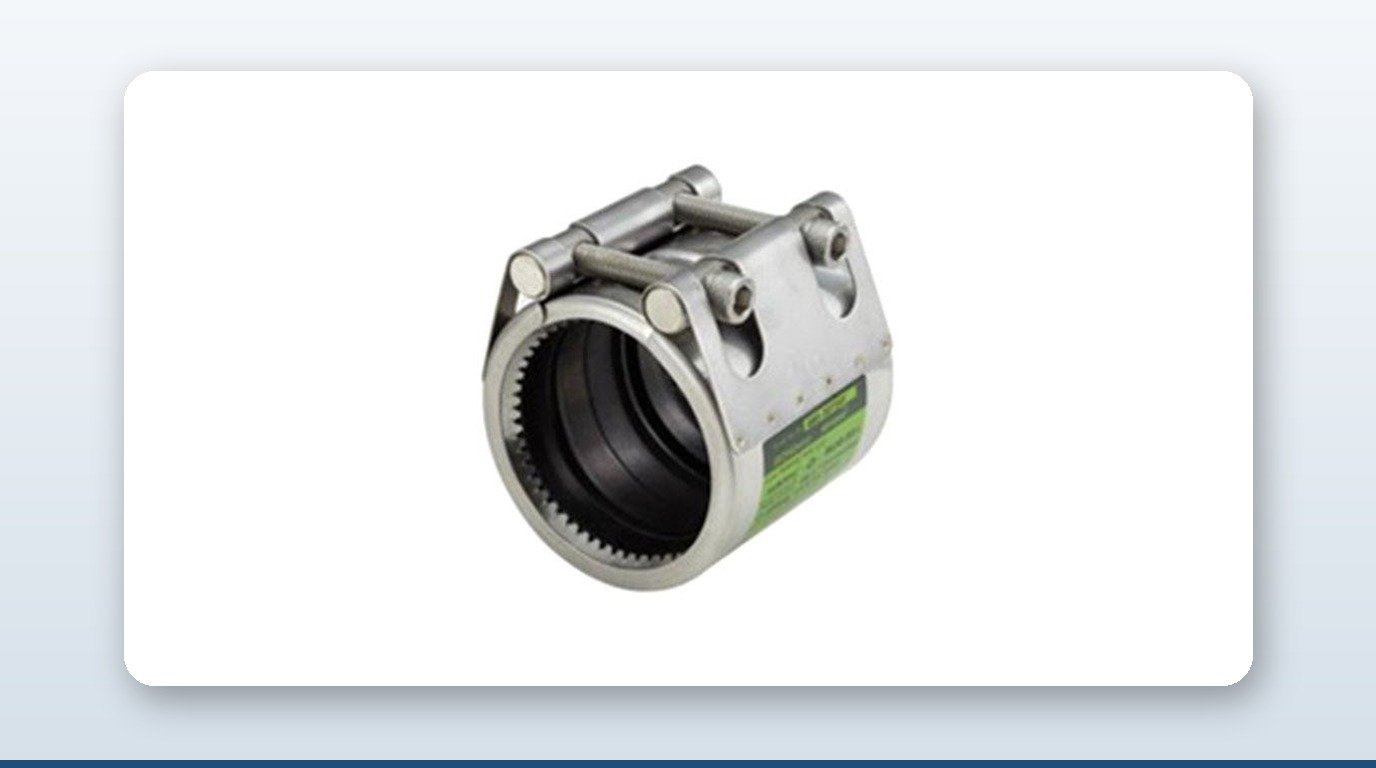
Outside that process boundary, a fab’s facility utility balance-of-plant looks like any large industrial mechanical plant, and mechanical couplings are the standard joint on most of it.
| System | Typical duty | Coupling application |
|---|---|---|
| CHW supply/return mains (CUB, plant room) | 6–18°C supply, treated water, ≤10 bar | Standard on headers and expansion provision |
| Condenser water / cooling-tower returns | Ambient to 35°C, treated water | Standard |
| PCW/TCS loops (utility side of tool boundary) | Closed-loop de-ionised water, non-UPW purity | Standard on the plant side of the heat exchanger, not the tool-side distribution |
| Makeup water / plant-service water headers | Potable or treated water | Standard |
| Acid-waste / scrubber-water drain headers | Mixed dilute-acid waste, scrubber blowdown, low pH, gravity/low pressure | Standard where grooved-end fittings are specified, with elastomer selection critical |
| Plant drain / sanitary / general drainage | Neutral-pH wastewater, gravity | Standard |
| Emergency in-service leak repair | Any utility header, running plant | Repair clamps standard |
| Pump-bay vibration isolation / expansion joints | CHW, CW, low pressure | Metal-bellows expansion joints on chiller and pump bays |
Fire Protection: A Separate, Non-Negotiable Spec
Every fab in this cluster runs a wet-pipe sprinkler system under NFPA 13, SS 637, and SCDF Fire Code requirements, and the coupling specification for that system is not the same as the one governing CHW and CW headers. UL listing or FM approval is mandatory for grooved couplings used on the fire-protection ring main — a separate, specifically certified product category, distinct from the general utility-grade grip and grooved couplings used elsewhere in the plant room. At the scale of Micron’s Fab 10B, the ring main will extend hundreds of metres around a 700,000 sq ft building, representing a substantial volume of certified fire-main joints on its own. Specifying engineers should treat fire-main coupling procurement as a distinct line item requiring its own UL/FM documentation, not an extension of the standard utility-coupling order.
Gasket Selection on Acid-Waste and Scrubber Drain Lines
The most technically demanding part of the facility-side scope is not pipe sizing — it is gasket compound selection on drain headers carrying dilute mixed-acid chemistry and scrubber blowdown. Standard EPDM gaskets are adequate for neutral or alkaline water, but are attacked by hydrofluoric acid, strong acids, ketones, and aromatic solvents, making them unsuitable for fab acid-waste service. NBR (Buna-N) offers better hydrocarbon resistance but performs poorly against HF, strong oxidisers, and halogenated solvents, and is similarly inappropriate.
FKM (fluoroelastomer, commonly known by the trade name Viton) resists HF, sulfuric acid, nitric acid, aromatic solvents, and most oxidisers, and operates to roughly 200°C — this is the minimum acceptable gasket standard for fab acid-waste drain service. AFLAS (a TFE/propylene copolymer) offers better resistance to steam and strong bases than FKM, and is preferred where hot potassium hydroxide or TMAH is the primary chemistry, a combination that appears more often in some process environments than others. Specifying FKM or AFLAS by name on any acid-waste or scrubber-drain coupling order — rather than defaulting to standard EPDM — is the detail that distinguishes a technically sound fab utility specification from a generic one.
Who Buys, and How the Spec Gets Written
Fab operators in Singapore almost never purchase utility couplings directly. Procurement for the CUB and facility utility scope runs through the cleanroom EPC contractor engaged for the design-and-build package — firms such as Exyte, L&K Engineering, and Samsung C&T have handled MEP scope across the projects listed above — with sub-trades under the EPC managing on-site installation. This is a materially different procurement structure from a refinery turnaround or an industrial plant expansion, where the operator’s own engineering team typically drives the specification directly. Engineers and procurement officers working on fab-adjacent utility scope should expect the EPC’s approved-vendor list, rather than the fab operator’s own materials register, to be the effective gate for any coupling specification.
Key Takeaways
- – Singapore’s fab construction wave (UMC, VSMC, GlobalFoundries, Siltronic, and two Micron projects) is generating significant CHW, condenser-water, and fire-main piping demand through at least 2028.
- – Mechanical couplings have zero role in ultrapure water, high-purity chemical, or process-gas piping — these are SEMI F57/C78-governed, orbital- or fusion-welded systems with no workaround.
- – Facility utility balance-of-plant — CHW/CW mains, PCW utility-side connections, makeup water, and drain headers — is standard mechanical-coupling territory, typically DN150–DN800 depending on facility scale.
- – Fire-protection ring mains require UL- or FM-listed grooved couplings under NFPA 13, SS 637, and SCDF requirements — a distinct certified product line, not an extension of standard utility couplings.
- – Gasket compound is not a minor detail on acid-waste and scrubber-drain headers: standard EPDM fails against HF and strong acids, and FKM or AFLAS should be specified explicitly.
About David Phee Enterprise
David Phee Enterprise supplies mechanical pipe couplings, expansion joints, and repair clamps to industrial projects across Singapore, Malaysia, and Indonesia, with same-day delivery from its Kaki Bukit HQ. As the exclusive Singapore distributor for JWC (Jeong Woo Coupling), DPE supports facility utility piping specifications for cleanroom and CUB projects. For technical enquiries, visit davidphee.com or get in touch directly.