Tuas Biomedical Park attracted S$13.5 billion in biomedical fixed-asset investment commitments in 2024 alone, and the projects behind that figure are large: AstraZeneca’s S$2 billion antibody-drug conjugate facility on 58 acres, WuXi Biologics’ US$1.4 billion CRDMO campus, Sanofi’s S$800 million Modulus plant, and active expansions at AbbVie, Novartis, and Lonza. More than 60 biopharmaceutical manufacturing plants now operate across Singapore, and eight of the world’s top ten biopharma companies manufacture here.
The reflex assumption when a piping supplier hears “pharmaceutical plant” is that the entire facility is orbital-welded stainless steel and there is nothing to quote. That assumption is correct for roughly half of any large biologics or API plant — and completely wrong for the other half. This guide sets out exactly where that line sits, what governs each side of it, and what an engineer or procurement officer specifying pipework for a Tuas facility needs to know before a coupling order goes out.
Singapore’s Pharma Build Wave, 2024–2029
| Project | Cluster | Investment | Build window |
|---|---|---|---|
| AstraZeneca ADC facility | Tuas South (58 acres) | US$1.5B | Groundbreaking Nov 2024; targeted operational 2029 |
| WuXi Biologics CRDMO | Tuas Biomedical Park (13.5 ha) | US$1.4B over 10 years | Active 2024–2026 |
| Sanofi Modulus | Tuas Biomedical Park | ~S$800M | Inaugurated Nov 2024; fully operational mid-2026 |
| Lonza Biologics Facility 2 | Tuas Biomedical Park | Up to US$350M | Under construction, with Lonza + Bio*One Capital JV |
| Novartis expansion | Tuas Biomedical Park | US$256M | Groundbreaking Mar 2024; active 2024–2026+ |
| AbbVie expansion | Tuas Biomedical Park | US$223M | Groundbreaking Jan 2024; operations targeted 2026 |
Tuas Biomedical Park itself spans 371 hectares across two phases, JTC-managed, and anchors S$12.1 billion in annual manufactured biomedical output. A second, more fragmented cluster sits in the Jurong/Pioneer corridor, and Takeda operates a separate biologics site in Woodlands.
The Hygienic Boundary — Where Mechanical Couplings Cannot Go
The product-contact and critical-utility side of a pharmaceutical plant is governed by a stack of standards that together exclude mechanical couplings categorically, not as a matter of preferred practice. ASME BPE (the Bioprocessing Equipment Standard) requires orbital-welded joints, electropolished 316L stainless with a surface finish of Ra ≤ 0.5 µm, zero dead legs, full drainability, and no elastomers unless specifically qualified. cGMP requirements under US FDA 21 CFR Parts 210/211 and EU GMP Annex 1 mandate material traceability and sterilisation-in-place capability. Any elastomer that does contact product or a critical clean utility must separately pass USP Class VI biological reactivity testing and meet FDA 21 CFR 177.2600 extraction limits — a compound-level qualification that standard coupling gasket materials such as EPDM or nitrile do not carry out of the box.
| System | Why mechanical couplings are excluded |
|---|---|
| Water for Injection (WFI) loops | ASME BPE orbital-welded 316L, no mechanical joints permitted, no elastomer used at all |
| Purified Water (PW) distribution loops | Same ASME BPE requirements; continuous hot recirculation around 80°C |
| Clean/culinary steam | Generated from PW; all downstream lines orbital-welded 316L, direct product/WFI contact |
| Clean-in-Place (CIP) supply/return | High-velocity caustic and acid solutions at elevated temperature, fully welded stainless |
| Sterilise-in-Place (SIP) lines | Pure steam injection at 121°C+, requiring full pressure-integrity welds |
| Bioreactor media/buffer lines (product contact) | ASME BPE plus USP Class VI elastomer requirement; standard gasket materials fail this standard |
| Fill-finish lines | Grade A/B cleanroom, aseptic process, stainless or PVDF tubing only |
It is also worth noting explicitly that sanitary tri-clamp fittings — the mechanical connection type genuinely used on some hygienic process lines — are a distinct product category from industrial mechanical couplings, supplied by specialist sanitary-fitting manufacturers rather than by industrial coupling suppliers. Repositioning a standard grip or slip-on coupling as a substitute in this scope is not a viable specification path.
The Balance-of-Plant: Where Couplings Are Standard Practice
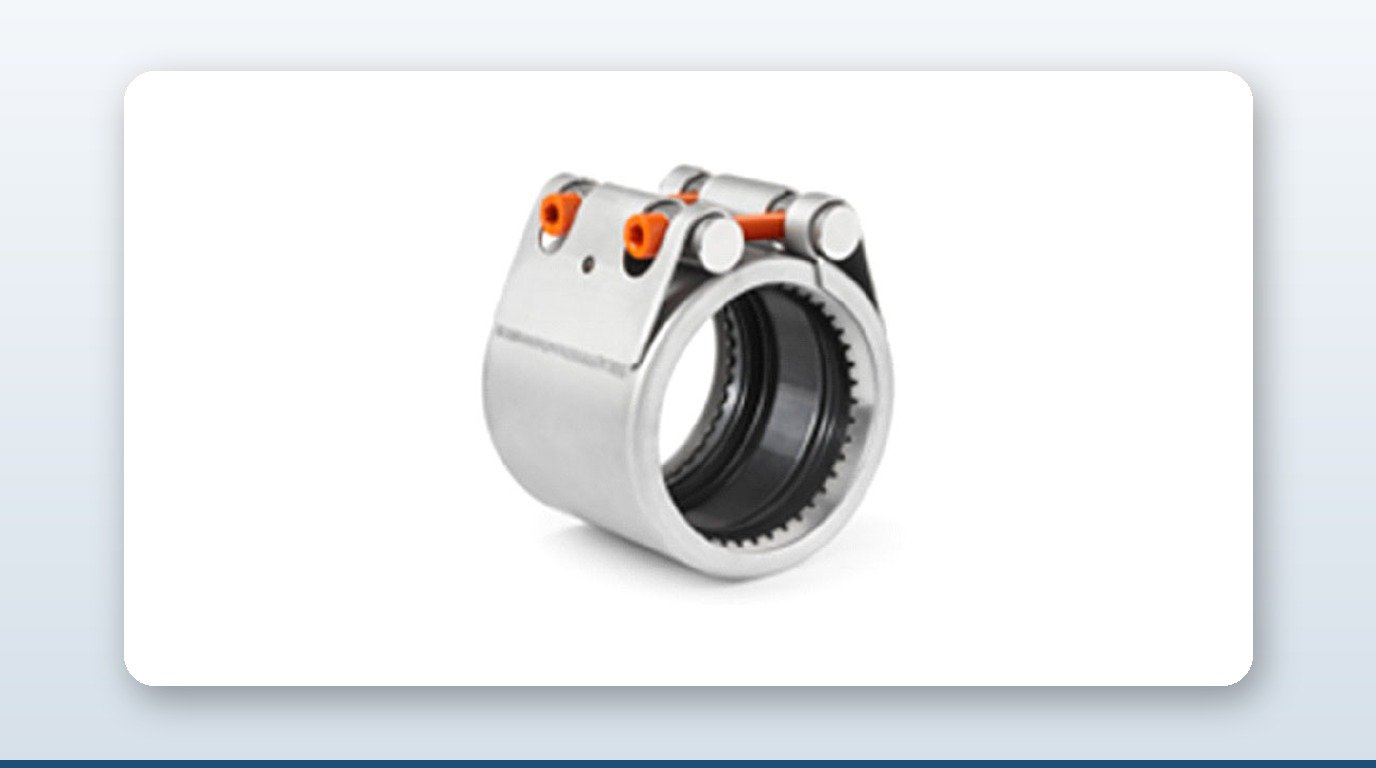
Every biopharmaceutical plant, regardless of product type or GMP tier, carries a substantial facility utility balance-of-plant that is entirely separate from the hygienic process side — industrial-grade piping installed by facility M&E contractors under the facility design package rather than the process-GMP package. This is where mechanical couplings are standard.
| System | Typical duty | Coupling application |
|---|---|---|
| CHW secondary distribution (facility side) | 6–12°C, roughly 4–10 bar, DN50–DN400 on facility headers | Standard — the largest-volume piping system in most biologics facilities |
| Glycol secondary loops | 40–60% glycol/water, –5°C to +10°C | Standard — compatible with standard EPDM gaskets |
| Condenser / cooling-water circuits | 28–35°C, treated water, DN100–DN400 | Standard |
| Cooling-tower return mains | Ambient temperature, low pressure | Standard |
| Plant steam (non-clean, low pressure) | 1–4 bar, non-GMP, HVAC zone reheating and space heating | Conditional — low-pressure, non-product-contact only |
| Condensate return (non-product) | Flash steam and hot condensate, low pressure | Conditional — non-product-contact utility condensate only |
| HVAC heating/cooling mains (AHU headers) | CHW or hot water, low pressure | Standard — a very common coupling application in large cleanroom buildings |
| Process/lab waste and neutralisation drain headers | Industrial-grade wastewater, not product-contact | Standard, with gasket selection reviewed for chemistry |
A useful distinction for anyone new to this sector: a process-equipment cooling jacket that sits in thermal contact with a bioreactor, but never touches the product itself, is still facility-side utility scope. USP Class VI and FDA 21 CFR 177.2600 apply only to product-contact or implant-contact circuits — standard EPDM gaskets remain acceptable on facility-side CHW, condenser water, fire-main, and HVAC headers, even on equipment that sits physically close to a GMP process.
Fire Protection and Potable Water — Certification Requirements
Every Tuas pharma plant, new or mature, has a firewater ring main, and the coupling specification for it follows the same rule as in any other Singapore industrial facility: SCDF Fire Code requirements mandate UL- or FM-listed grooved mechanical couplings on the fire-protection ring main, and this listing requirement is not interchangeable with the general utility-grade couplings used on CHW or CW headers. It is a separately certified line item, and every major new build currently under construction at Tuas — AstraZeneca, WuXi Biologics, AbbVie, Novartis, and Sanofi’s Modulus facility as it completes commissioning — needs one.
Potable and plant-service water headers carry their own local gate: Singapore Standard SS 375 governs mechanical couplings used in potable-water service, and any coupling specified into this scope needs to demonstrate compliance with that standard specifically, rather than relying on an equivalent overseas water certification alone.
Gasket Selection on Drain and Neutralisation Headers
Facility-side drain and neutralisation headers carrying lab or process waste are not automatically standard-EPDM scope. Where these headers carry acid or alkali waste streams from lab drains rather than neutral-pH general wastewater, gasket compound needs the same review applied to any industrial chemical-service line: PTFE or FKM gaskets are the appropriate choice over standard EPDM once acid or alkali chemistry is present, and this should be flagged and specified explicitly at the quotation stage rather than assumed. Everywhere else on the facility-side scope — CHW, glycol, condenser water, HVAC, and fire main — standard EPDM gaskets remain the norm.
Key Takeaways
- – Singapore’s pharma cluster, centred on Tuas Biomedical Park, is in an active 2024–2029 construction wave worth well over S$5 billion across just the six largest current projects.
- – Roughly half of any large biologics or API plant — the hygienic, product-contact side governed by ASME BPE, cGMP, and USP Class VI — is categorically closed to mechanical couplings.
- – The other half — CHW/glycol secondary loops, condenser water, HVAC mains, plant steam, and drain headers — is standard industrial mechanical-coupling territory, typically DN50–DN400 on facility headers.
- – Fire-protection ring mains need UL- or FM-listed grooved couplings under SCDF requirements, and potable-water headers need SS 375 compliance specifically — both distinct from general utility-coupling specification.
- – Gasket selection on drain and neutralisation headers should follow the actual chemistry present: PTFE or FKM for acid/alkali lab waste, standard EPDM elsewhere on the facility side.
About David Phee Enterprise
David Phee Enterprise supplies mechanical pipe couplings, expansion joints, and repair clamps to industrial and infrastructure projects across Singapore, Malaysia, and Indonesia, with same-day delivery from its Kaki Bukit HQ. As the exclusive Singapore distributor for JWC (Jeong Woo Coupling), DPE supports facility-side utility piping on pharmaceutical and biologics projects. For technical enquiries, visit davidphee.com or get in touch directly.