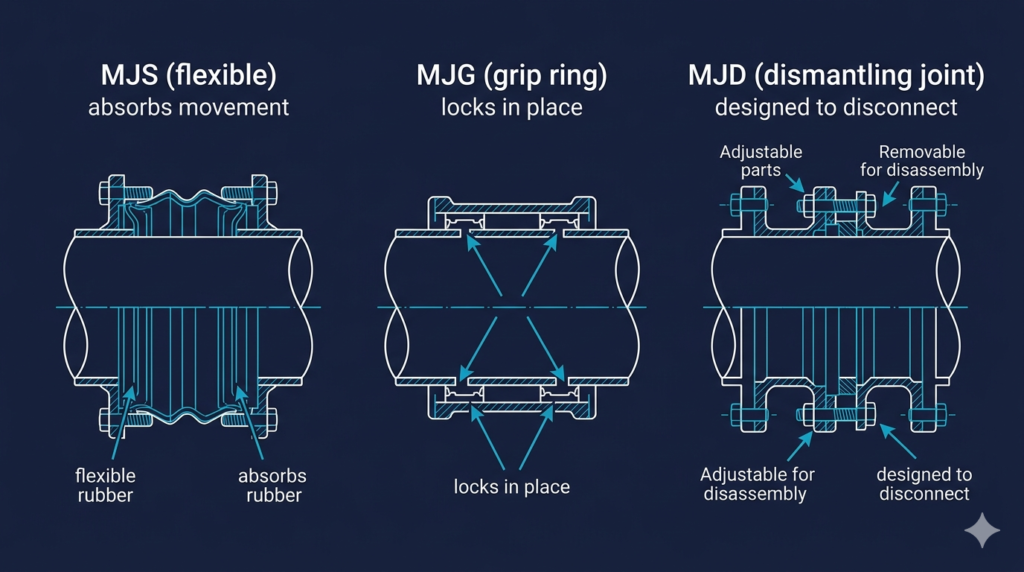
The MJG, MJD, and MJS coupling difference comes down to one question: does your pipe joint need to grip, flex, or disconnect? All three are JWC mechanical pipe couplings under the MP Joint brand — but each is engineered for a fundamentally different purpose. Choosing the wrong type is one of the most common and costly specification errors in industrial and maritime pipe systems.
This guide breaks down the MJG MJD MJS coupling difference clearly so you can specify the right model the first time.
Overview: The Three Types at a Glance
| Model | Type | Primary Function |
|---|---|---|
| MJS | Flexible | Absorbs vibration, thermal expansion, and angular movement |
| MJG | Grip Ring | Locks onto the pipe — resists pull-out, replaces flanges and unions |
| MJD | Dismantling Joint | Allows axial adjustment and future disconnection for maintenance |
Each type fits the same pipe OD range and uses the same bolt pattern — but their internal mechanisms are completely different. Understanding the MJG MJD MJS coupling difference before ordering will save you time, money, and failed installations.
MJS — The Flexible Coupling
What It Does
The MJS (and its long-body variant, the MJL) is designed to absorb movement. It handles:
- Vibration from pumps, engines, and mechanical equipment
- Thermal expansion and contraction in hot or cold service lines
- Angular deflection of up to 5° (small sizes) and 2–3° on larger diameters
- Axial movement of 5mm (DN15–DN150) and 10mm (DN175–DN500)
- Noise transmission — MJS couplings reduce pipe noise by over 60% versus welded joints
The MJS works by allowing controlled movement between the two pipe ends inside the coupling body. A rubber sealing sleeve (EPDM or NBR) provides the seal while accommodating the movement. The pipe ends are not gripped or locked — they float inside the coupling within the designed movement range.
When to Use MJS
- New pipe installations where vibration is present (pump rooms, engine rooms, mechanical plants)
- Hot water or steam lines subject to thermal expansion
- Above-ground pipe systems that undergo temperature cycling
- Any system where noise reduction is a priority
- Marine applications aboard vessels — engine room piping, cooling water lines, exhaust systems
Working Pressure
| Application | Pressure Range |
|---|---|
| Ship (marine) | 4.2 – 16 bar (size-dependent) |
| Industry | 8.4 – 32 bar (size-dependent) |
For higher pressure requirements, specify MJSF (Flexible Force Type) — the same flexible design rated for higher working pressures.
MJS Limitations
The MJS does not grip the pipe. Under sustained axial load or pressure surge, the pipe can pull out of the coupling. If pull-out resistance is needed, MJS is not the right choice — use MJG or MJSG instead.
MJG — The Grip Ring Coupling
What It Does
The MJG (and long-body variant MJGL) is the workhorse of the JWC range. Its defining feature is the patented grip ring — a stainless steel ring with teeth that bite into the outside surface of the pipe when the coupling is tightened. This creates a mechanical lock that resists pipe pull-out under pressure.
Key characteristics:
- No pipe end processing required — no grooving, threading, or welding
- Replaces flanges, unions, and groove joints
- Angular deflection: 5° (DN15–DN50), 4° (DN65–DN175), 2° (DN200 and above)
- Gap between pipe ends: 0–8mm (DN15–DN65), 0–15mm (DN80 and above)
The MJG also provides a degree of vibration absorption through its rubber gasket, but this is secondary to its primary function as a secure, pull-out-resistant joint.
When to Use MJG
- Any joint that must not pull apart under sustained pressure
- Replacing flanged joints where a smaller, lighter connection is preferred
- New pipe runs where you need a fast, weld-free installation
- Connecting pipes to pumps, valves, or equipment flanges (with appropriate adaptors)
- Underground or concealed pipe systems where joint access is limited
Working Pressure
| Application | Pressure Range |
|---|---|
| Ship (marine) | 7 – 16 bar (size-dependent) |
| Industry | 14 – 32 bar (size-dependent) |
For higher pressure, specify MJGF (Grip Force Type).
MJG Limitations
The grip ring bites into the pipe surface — this is its strength and its limitation. On PVC, HDPE, or internally lined pipes, the grip ring can damage the pipe wall. For softer pipe materials, use MJS or consult your supplier.
MJD — The Dismantling Joint
What It Does
The MJD is a dismantling joint — designed specifically for pipe systems that will need to be disassembled for maintenance, inspection, or equipment replacement. Unlike MJS and MJG, which are installed to stay in place, the MJD is specified when future disconnection is a planned requirement.
The MJD provides axial adjustment capability, allowing the pipe section to be shortened or lengthened slightly to remove and reinstall pumps, valves, or inline equipment without cutting the pipe. This is particularly valuable in:
- Pump inlet and outlet connections
- Valve isolation points
- Inline instrumentation connections
- Any location where equipment will be periodically removed for servicing
When to Use MJD
- Pump connections — where the pump will be lifted out for maintenance
- Valve and actuator connections — especially motorised valves that need periodic servicing
- Heat exchanger connections — where tube bundles must be withdrawn
- Any location in a pipe system designated as a maintenance access point
MJD vs Flanged Joint
The traditional solution for a maintainable pipe joint is a flanged connection. The MJD offers several advantages over flanges in the right context:
| MJD | Flanged Joint | |
|---|---|---|
| Installation time | Fast — no bolt circle alignment | Slow — flange face alignment critical |
| Space requirement | Compact | Larger flange OD footprint |
| Axial adjustment | Yes — built in | No — fixed face-to-face |
| Maintenance access | Easy disassembly | Requires full bolt removal |
| Pipe end preparation | None | Flanges must be welded or threaded |
However, flanges remain the standard for high-pressure and high-temperature process piping. MJD is best suited to utility and service piping where pressure is within PN16 range.
MJSG — The Flex-Grip Hybrid (Bonus Model)
Understanding the MJG MJD MJS coupling difference also requires knowing about the MJSG — JWC’s patented Flex-Grip series that combines both MJS and MJG characteristics in a single coupling.
One end of the MJSG acts as a grip ring (MJG), locking onto the pipe. The other end acts as a flexible coupling (MJS), absorbing movement. This makes it ideal for:
- Pump connections where vibration isolation and pull-out resistance are both needed
- Any joint where movement must be absorbed but the coupling must not pull away from one end
- Retrofitting existing flexible couplings that have experienced pull-out issues
If you are unsure whether you need MJS or MJG, MJSG is often the answer.
Side-by-Side Comparison: MJG MJD MJS Coupling Difference
| Feature | MJS (Flexible) | MJG (Grip Ring) | MJD (Dismantling) |
|---|---|---|---|
| Primary purpose | Absorb movement | Secure grip | Planned disconnection |
| Vibration absorption | Excellent | Moderate (via gasket) | Minimal |
| Pull-out resistance | Low | High (grip ring) | Medium |
| Future disconnection | No | No | Yes — by design |
| Axial adjustment | Limited | No | Yes |
| Angular deflection | Up to 5° | Up to 5° | Minimal |
| Pipe end preparation | None | None | None |
| Pressure range (industry) | 8.4 – 32 bar | 14 – 32 bar | PN16 typical |
| Gasket standard | EPDM / NBR | EPDM / NBR | NBR |
| Best for | Vibrating pipe runs, engine rooms | Secure no-weld joints | Pump and valve connections |
How to Choose: Decision Guide
Work through these questions in order:
1. Will this joint ever need to be disconnected for maintenance?
→ Yes → MJD
→ No → continue to question 2
2. Is pull-out resistance required? (sustained pressure, no mechanical support)
→ Yes → MJG (or MJSG if vibration is also present)
→ No → continue to question 3
3. Is vibration, noise, or thermal expansion the primary concern?
→ Yes → MJS
→ No, just need a basic coupling → MJG (most versatile general-purpose choice)
Application Examples by Industry
Maritime and Shipyards
On merchant vessels, the MJG MJD MJS coupling difference maps directly to location:
- Engine room piping: MJS for vibration absorption on main engine cooling water and exhaust lines
- Pump connections: MJSG or MJD — vibration isolation plus maintenance access
- Distribution runs (fixed): MJG — secure, no-weld joints throughout the vessel
Ship chandlers supplying merchant vessels in Singapore typically stock all three types across DN15 to DN150 for emergency and routine replacements.
Water Infrastructure
In PUB water distribution and treatment plants:
- Main distribution runs: MJG — permanent, pull-out-resistant joints
- Pump stations: MJD at pump connections, MJS on suction and delivery lines
- Repair of existing mains: Romacon repair clamps (not MJS/MJG/MJD — see our guide to pipe repair clamps for this application)
Oil and Gas
In refinery and petrochemical utility piping:
- Cooling water systems: MJS on equipment connections, MJG on fixed runs
- Process isolation valves: MJD where valves require periodic removal
- High-pressure service: Specify MJGF or MJSF Force Type variants
For Viton gasket requirements (hydrocarbon service), all three model types are available with Viton as an option — specify when ordering.
High-Pressure Variants: Force Type Series
For applications where standard PN16 is not sufficient, JWC offers Force Type variants across the MJS and MJG series:
| Standard Model | Force Type | Pressure Rating |
|---|---|---|
| MJS | MJSF | Up to 32 bar (industry) |
| MJL (long body) | MJSFL | Up to 32 bar (industry) |
| MJG | MJGF | Up to 32 bar (industry) |
| MJGL (long body) | MJGFL | Up to 32 bar (industry) |
The Force Type series uses the same installation method as the standard models — no special tools required. If your system operates above 16 bar, always specify the Force Type variant on your RFQ.
Sizing and Ordering
The MJG MJD MJS coupling difference does not affect sizing — all three use the same OD-based sizing system. Refer to the complete pipe coupling size chart for DN15 to DN300 OD ranges and bolt specifications.
When placing an order, specify:
- Model — MJS, MJG, MJD, or MJSG
- Size — pipe OD (not DN)
- Pipe standard — JIS, DIN, or ANSI
- Gasket material — EPDM (default for water/marine), NBR (general), Viton (hydrocarbon)
- Bolt material — galvanised (default) or stainless steel (corrosive environments)
- Pressure requirement — standard PN16 or Force Type for higher pressure
For same-day availability across the full JWC range in Singapore, contact David Phee Enterprise — exclusive JWC distributor in Singapore with stock across all standard sizes, models, and gasket materials.
Frequently Asked Questions
What is the main MJG MJD MJS coupling difference?
MJS absorbs movement and vibration. MJG grips the pipe and resists pull-out. MJD is designed for joints that need to be disconnected for future maintenance. They are all JWC mechanical couplings but engineered for different functions.
Can I use MJS and MJG interchangeably?
Not reliably. MJS allows the pipe to float inside the coupling — under sustained pressure without additional pipe support, the pipe can pull out. MJG locks onto the pipe with a grip ring and will not pull out. Use MJS where movement absorption is the priority; use MJG where a fixed, secure joint is required.
What is MJSG and how does it differ from MJS and MJG?
MJSG is the Flex-Grip hybrid — one end grips the pipe (MJG function), the other end flexes (MJS function). It is the best choice when you need both vibration absorption and pull-out resistance in the same joint.
Does the MJD work as a regular coupling too?
Yes — the MJD seals and holds the pipe like any mechanical coupling. Its dismantling capability is an added feature, not a limitation. The trade-off is that it is typically larger and more expensive than MJS or MJG, so it is not usually specified for standard pipe runs.
What gasket should I use for seawater service?
EPDM is standard for seawater and marine applications across all three coupling types — MJS, MJG, and MJD. For hydrocarbon service, specify Viton.
Are Force Type variants available for all three?
Yes — MJSF (Flexible Force Type) and MJGF (Grip Force Type) are available for higher pressure requirements. For MJD high-pressure variants, confirm with your supplier.
Do I need special tools to install any of these?
No. All three — MJS, MJG, and MJD — require only a torque wrench and standard hand tools. No pipe end processing, grooving, or welding is needed.
Key Takeaways
- The core MJG MJD MJS coupling difference: MJS flexes, MJG grips, MJD disconnects.
- Use MJS for vibration absorption and thermal expansion — not as a permanent fixed joint under sustained pressure.
- Use MJG as your standard go-to for secure, permanent, weld-free pipe connections.
- Use MJD wherever future maintenance disconnection is planned — pump connections, valve isolation points.
- When you need both grip and flex, specify MJSG.
- All three use the same OD-based sizing system — refer to the pipe coupling size chart for dimensions.
- Always specify gasket material: EPDM for water and marine, Viton for hydrocarbon service.
- For high-pressure applications, upgrade to Force Type variants: MJGF or MJSF.
1 thought on “MJG vs MJD vs MJS Couplings: How to Choose”