Fuel oil is the most fire-critical piping system on a merchant vessel, and it’s also the one surveyors scrutinise hardest before signing off a quote. The reason is simple: engine room fires are the most common category of marine casualty by frequency, and a fuel-oil leak onto an unprotected hot surface — a turbocharger casing, an exhaust manifold — is the dominant ignition mechanism. A coupling on that line either holds through a fire or it becomes part of the failure.
Inside machinery spaces of category A, every mechanical joint on a fuel line has to be an ISO 19921/19922 fire-tested approved type, per IACS UR P2.7.4 and operationalised through SOLAS II-2 Regulation 4.2.2.6. Get the cert state wrong and the line gets welded instead — slower, more expensive, and a lost sale.
Where the piping class actually changes
Fuel oil piping crosses from Class III to Class II to Class I purely on pressure and temperature, and the joint menu narrows sharply as it does:
| Stage | Pressure | Temperature | Class | Joint options |
|---|---|---|---|---|
| Bunker manifold / filler line | Atmospheric–5 bar | Ambient–50°C | Class III | Full mechanical menu, including slip-on |
| Transfer pump suction/discharge | 4–8 bar | 40–60°C | Class III/low II | Fire-tested grip-ring preferred; slip-on only if Class III |
| Settling to service tank (heated) | <5 bar | 60–90°C | Class II | Fire-tested grip-ring mandatory inside cat A; no slip-on |
| Booster discharge to engine | 8–13 bar | 120–150°C | Class II (borderline I) | Fire-tested + restrained, if surveyor accepts mechanical at all — most yards weld this section |
| High-pressure injection (post-pump) | 1,000–1,500+ bar | 130–150°C | Outside I/II/III | Welded inner pipe, jacketed double-wall mandatory — mechanical couplings effectively prohibited |
The practical rule: Class III opens the full mechanical-joint menu; Class II requires fire-tested certification plus restraint; Class I and the high-pressure injection lines are essentially a welded-only world. Three locations account for most of the salesable coupling demand on a fuel system — transfer-pump MRO points, the settling-to-service tank take-off, and the bunker filler station — and all three want the same spec: fire-tested grip-ring with an FKM gasket.
The gasket material decision
Getting the elastomer wrong on a fuel-oil joint is the single most common mistake on a multi-service vendor’s stock list.
| Compound | Fuel-oil verdict |
|---|---|
| FKM (Viton) | The marine fuel-oil default. Excellent on all hydrocarbon fuel oils; specify on every joint downstream of the supply pump. |
| AFLAS | Upgrade for biofuel blends above B30, where FKM approaches its chemical-resistance ceiling. |
| HNBR | Acceptable fallback on Class III/low Class II lines below 90°C if FKM isn’t available in the SKU. |
| NBR | Adequate only on ambient-to-50°C transfer and drain lines below B20 biofuel content — never on heated fuel oil. |
| EPDM | Never specify on a fuel-oil joint. EPDM swells dramatically in hydrocarbon service; it’s a water/glycol elastomer, not a fuel one. |
Post-IMO-2020 VLSFO blends add a second complication: they’re more paraffinic than legacy HFO, and the asphaltenes that used to stay in suspension precipitate out when the fuel is thermally stressed or commingled with an incompatible batch. That precipitate packs into gasket-cavity geometry — deep-groove slip-type couplings foul faster than tighter-cavity grip-type designs, which is a real argument for upgrading from slip-type to grip-type on a VLSFO-burning vessel’s transfer loop.
Fire-test certification — the four boxes a surveyor checks
- Type Approval Certificate from an IACS society (ABS, DNV, LR, BV, ClassNK, KR, or equivalent), naming the product, size range, pressure rating, and piping class covered.
- Fire-test reference (ISO 19921/19922) on the certificate face — without it, the coupling is locked out of every fuel-oil run inside machinery space cat A.
- Restraint capability documented against the line’s axial load — slip-on without this is limited to Class III, on deck, at 10 bar or below.
- Gasket compound named on the cert and matched to the fuel grade actually being carried.
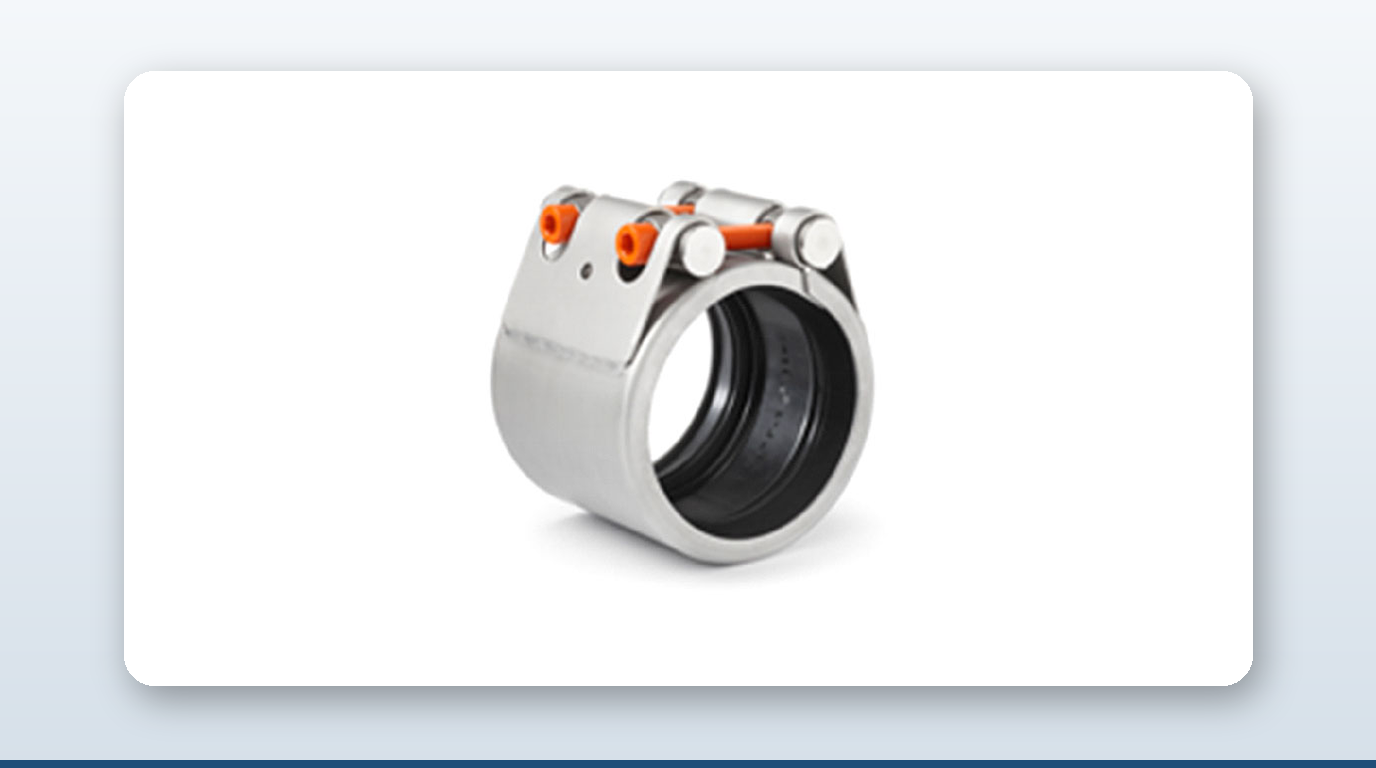
JWC’s Fire Resistant Cover — the same 800°C ± 50°C / 30-minute certification used on fire-main couplings — is what lifts the MJG grip-type body onto this list, at a lower cost than the Straub and Victaulic equivalents. Where the fuel line runs hot on the engine side, expansion is handled by a bellows joint rather than a coupling: A-Ju EJD with FKM lining for runs at or below 90°C (fuel return, settling-to-service suction), and Daicoup metal bellows above 90°C (booster discharge, hot supply).
Common failure modes
- Gasket char from flame impingement — a fire-tested grip-ring coupling holds for 30 minutes at 800°C; a non-fire-tested slip-on vents open within minutes.
- Bolt relaxation from thermal cycling — cold bunkering to 145°C supply and back overnight, repeated for years, gradually drops bolt preload below the sealing minimum.
- VLSFO asphaltene fouling at the gasket seat — the joint won’t reseal at the next re-torque; the fix is a thorough clean plus a switch to grip-type where cavity geometry allows.
- Spray shield removed during maintenance and not reinstalled — a fire-tested coupling with its intumescent cover intact effectively is the spray shield.
Key Takeaways
- Fuel oil piping crosses Class III → II → I purely on pressure and temperature, and the coupling menu narrows at each threshold.
- Inside machinery space cat A, every mechanical joint needs ISO 19921/19922 fire-test certification — no exceptions.
- FKM is the default fuel-oil gasket compound; never specify EPDM, and avoid NBR on heated lines.
- High-pressure injection lines downstream of the fuel pump are a welded, jacketed world — mechanical couplings don’t apply there.
- JWC MJG with Fire Resistant Cover clears the same fire-test gate as premium-tier competitors at a lower cost.
About David Phee Enterprise
David Phee Enterprise is Singapore’s exclusive distributor for JWC pipe couplings, including the Fire Resistant Cover range used on fuel-oil and fire-main lines, alongside A-Ju expansion joints — stocked at Empire Technocentre, Kaki Bukit for same-day delivery. For fuel-oil coupling specs or fire-test cert documentation, contact DPE or browse the catalogue at davidphee.com. Related reading: the MV ship piping system supply guide and pipe coupling corrosion and material selection.