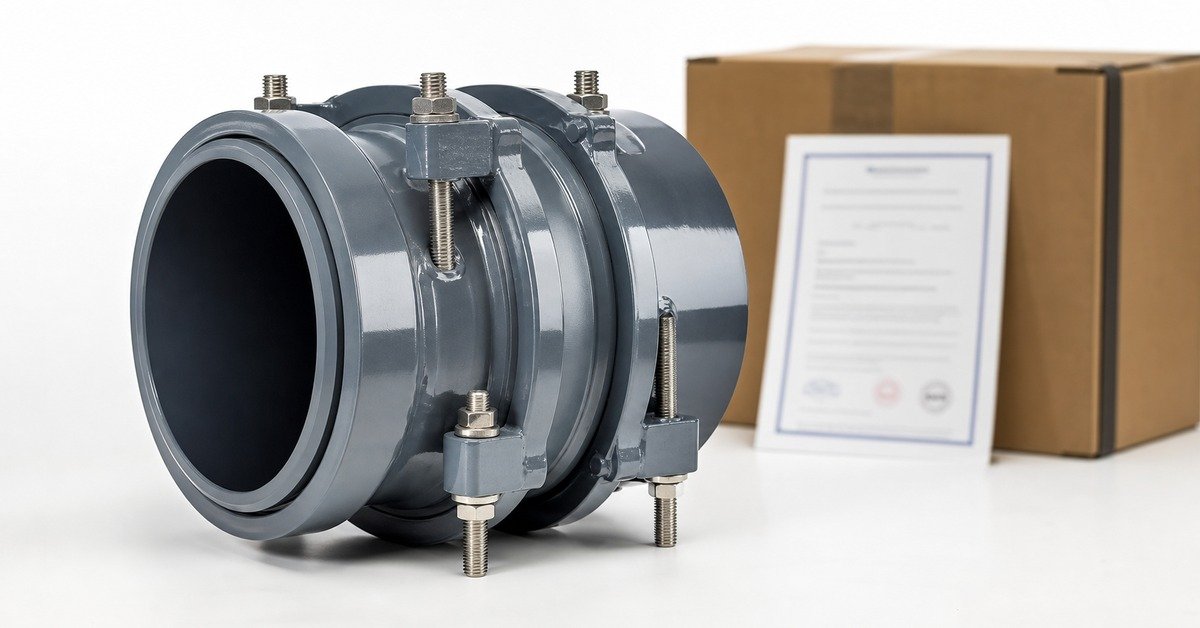
When piping systems experience thermal movement, vibration, or settlement, they need somewhere for that movement to go. Expansion joints absorb it — protecting the pipe, the flanges, and the equipment connected at each end. The Aju EJD series is one of the few expansion joints in Singapore that carries ABS Type Approval, making it a direct option for marine classification work.
What an Expansion Joint Does
A slip-type expansion joint allows axial movement — the pipe slides in or out of the coupling body as it expands or contracts with temperature change. Unlike a rubber bellow expansion joint (which absorbs movement through elastic deformation), a slip-type joint works by physical telescoping motion, guided by a seal that maintains pressure integrity throughout the travel range.
Advantages of slip-type over rubber bellow:
- Higher design pressures achievable in a compact package
- No rubber bellow fatigue from repeated cycling
- Works on rigid pipe where bellow flexibility isn’t practical
- Longer service life in high-cycle environments
For a comparison with rubber expansion joints, see rubber expansion joint PN16 Singapore.
Aju EJD Series: Full Specifications
| Parameter | Value |
|---|---|
| Type | Slip-type expansion joint |
| Size range | 40A – 1000A (JIS standard pipe) |
| Design pressure | 18 bar maximum |
| Body material | FCD450 ductile cast iron (middle ring + follower) |
| Bolt material | SS400 standard; SUS304 stainless available |
| Gasket material | NBR standard; Viton option available |
| Temperature range (NBR) | -18°C to +100°C |
| Temperature range (Viton) | -18°C to +200°C |
| Pipe standard | JIS |
| Coating | Epoxy gray |
| ABS Type Approval | Certificate 24-2535915-1-PDA, valid to 2029-03-13 |
| Origin | Korea |
The FCD450 body is ductile cast iron — significantly tougher than grey cast iron under impact and cyclic loading. This makes it appropriate for engine room and shipboard environments where vibration and mechanical shock are part of the operating environment.
ABS Type Approval: Why It Matters
ABS (American Bureau of Shipping) is one of the leading international ship classification societies. Class societies set the technical standards for vessel construction and ongoing certification, and equipment used in certain shipboard systems must be approved by the relevant class society.
The Aju EJD carries ABS Type Approval under Certificate 24-2535915-1-PDA, valid until 2029-03-13. This means:
- ABS has reviewed and tested the product to its standards
- The product can be specified for ABS-classed vessels without separate approval applications
- Ship chandlers, yards, and vessel operators sourcing for ABS-classed fleets can quote the certificate number directly
For marine work without class certification, any expansion joint can be used at the buyer’s discretion. But for vessels under ABS classification — or vessels requiring ABS-certified components for a specific system — the EJD removes the approval risk from the procurement process.
Other major class societies accept ABS Type Approved components on a case-by-case basis. Buyers specifying for DNV, Lloyd’s, or BV-classed vessels should confirm cross-recognition with the relevant class surveyor.
Marine Applications: Class II and III Piping
ABS classifies shipboard piping into three classes based on pressure and temperature:
- Class I: High-pressure and high-temperature systems (boiler steam, high-pressure fuel)
- Class II: Medium-pressure and medium-temperature service
- Class III: Low-pressure, low-temperature, and non-critical service
The Aju EJD is approved for Class II and Class III shipboard piping. Typical marine applications:
- Engine room cooling water lines — diesel main engine jacket water circuits, which experience thermal cycling as load changes
- Ballast water piping — large-diameter (up to 1000A) systems where expansion absorption is needed across long piping runs
- Fire protection lines — CO₂ and wet pipe systems in machinery spaces
- Sea water service lines — hull penetration-adjacent runs where some movement absorption is required
The 1000A maximum size covers the largest pipe diameters found in ballast and cooling water systems on bulk carriers, tankers, and large container vessels.
Comparison: EJD vs JWC MJS vs Rubber Expansion Joint
| Feature | Aju EJD | JWC MJS | Rubber Bellow (PN16) |
|---|---|---|---|
| Type | Slip expansion joint | Flexible coupling | Rubber bellow |
| Primary function | Axial movement absorption | Pipe joining, some flexibility | Axial + angular + lateral |
| Design pressure | 18 bar | PN10–PN16 | PN16 |
| Size range | 40A–1000A | DN15–DN300 | Various |
| ABS Type Approved | Yes | No | No |
| Temperature (max) | 100°C (NBR), 200°C (Viton) | Per gasket selection | Per rubber type |
| Body material | Ductile iron | Ductile iron | Metal flanges + rubber body |
| Pipe preparation | JIS plain-end | Plain-end | Flanged end connections |
| Marine class certification | ABS Class II & III | Not rated | Not rated |
The JWC MJS is a coupling for joining pipe lengths with some lateral flexibility — it’s not designed for controlled axial movement absorption. The rubber bellow provides multi-axis movement but introduces bellow fatigue and is limited by the rubber’s temperature and pressure ratings. The Aju EJD is the correct product when the engineering requirement is axial expansion absorption at rated pressure in a certified marine system.
For the JWC MJS product in detail, see JWC pipe couplings in Singapore — MJS, MJG, MJH buyer’s guide.
Industrial Applications
Outside marine service, the Aju EJD applies wherever thermal movement and 18-bar design pressure coincide:
- Process piping in chemical plants — high-temperature fluid systems where thermal cycling is significant
- District cooling systems — large-bore chilled water mains (200A–600A) with long runs between expansion provisions
- Water treatment facilities — pump discharge and header piping where settlement or thermal expansion occurs
- Power station auxiliary piping — cooling water and service water circuits
The JIS pipe compatibility aligns the EJD with the pipe standards common in Singapore, Japan, Korea, and throughout ASEAN. Buyers working to ASME or EN pipe standards should confirm OD compatibility before specifying.
Gasket Selection: NBR vs Viton
The default NBR gasket handles the majority of applications: water, cooling water, air, and most non-aggressive process fluids up to 100°C. NBR is the correct choice for marine cooling water, ballast, and fire protection lines.
Switch to Viton when:
- Service temperature exceeds 100°C
- The fluid is fuel oil, hydraulic oil, or a petroleum product
- Chemical resistance to aromatic hydrocarbons is required
Viton extends the temperature ceiling to 200°C, opening the EJD to higher-temperature service and fuel system-adjacent applications. Confirm the fluid type and temperature envelope before specifying gasket material. For broader gasket selection guidance, see NBR, EPDM, and Viton gasket selection.
Sourcing in Singapore
David Phee Enterprise supplies Aju EJD expansion joints from Singapore, covering the full size range from 40A to large-bore for delivery to Singapore-based ship chandlers, shipyards, and industrial contractors. ABS certificate documentation (Cert 24-2535915-1-PDA) is available on request for class society compliance records.
For vessel operators requiring ABS-certified components with short notice — a vessel in port at PSA, Sembcorp, or Keppel — confirm stock availability and size requirements directly via RFQ.
Key Takeaways
- The Aju EJD is a slip-type expansion joint: axial movement absorbed by telescoping, not rubber deformation — rated to 18 bar maximum
- Size range is 40A to 1000A on JIS standard pipe, covering virtually all marine and industrial piping diameters
- ABS Type Approval (Cert 24-2535915-1-PDA, valid to 2029-03-13) qualifies the EJD for Class II and Class III shipboard piping — including engine room cooling water, ballast, and fire lines
- FCD450 ductile cast iron body, SUS304 bolt option, NBR to 100°C or Viton to 200°C — material selection covers most marine and process applications
- The EJD is not a substitute for a flexible pipe coupling (JWC MJS) or a rubber bellow — each serves a different movement absorption requirement