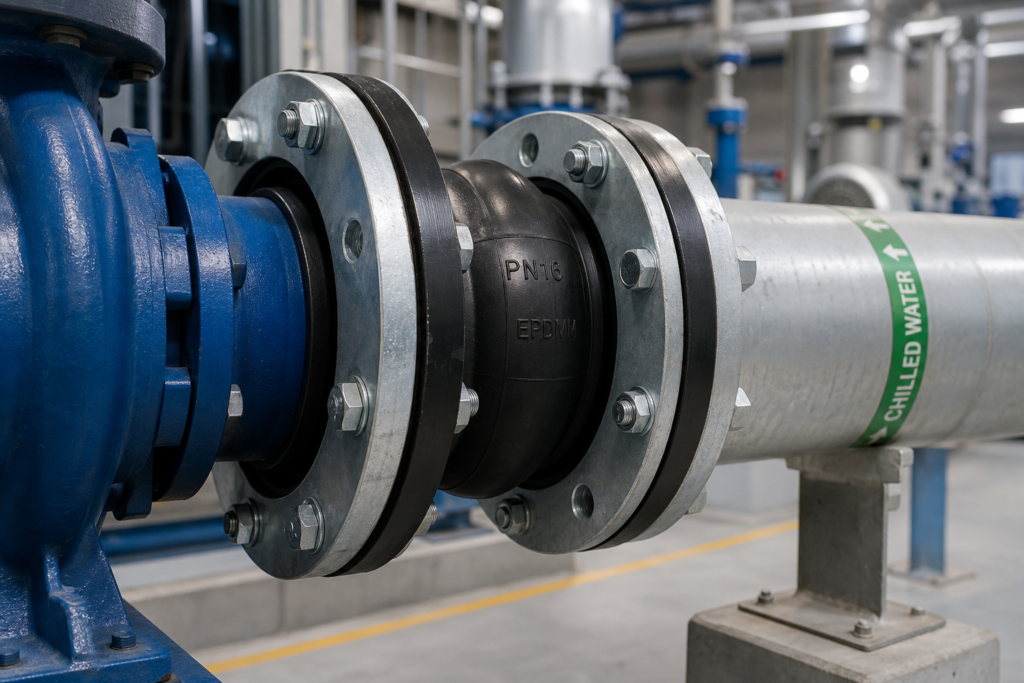
A rubber expansion joint is a flexible connector — usually a single-arch or twin-arch elastomer bellows reinforced with fabric and clamped between two flanges — that lets a piping system absorb movement, vibration, and minor misalignment without transmitting stress into the pipework or the equipment at either end. PN16 is the pressure class (16 bar working pressure) that has become the de facto standard for building services, marine auxiliaries, and water infrastructure in Singapore. It covers the working pressures of nearly every chilled water, condenser, fire main, ballast, and process line that does not run on high-pressure steam or hydraulic service.
This article walks through the five applications where a PN16 rubber expansion joint is not optional — it is the right answer — and what to specify so the joint actually performs in Singapore conditions.
What a PN16 Rubber Expansion Joint Is
Before the use cases, the anatomy. A typical PN16 single-arch rubber expansion joint consists of:
| Component | Material | Function |
|---|---|---|
| Bellows | EPDM, NBR, Viton, or natural rubber, fabric-reinforced | Flexes to absorb axial, lateral, and angular movement |
| Flanges | Carbon steel, galvanised steel, or stainless steel | Bolts to mating pipe flanges |
| Retaining rings | Ductile iron or carbon steel | Clamps the bellows lip against the flange face |
| Reinforcement plies | Polyester or nylon cord | Prevents bellows ballooning under pressure |
PN16 means a continuous working pressure of 16 bar at ambient temperature, with a typical burst rating of 3–4× working pressure. Movement capacity for a single-arch DN100 unit is roughly ±15 mm axial compression, ±8 mm extension, ±10 mm lateral, and ±15° angular — vendor-specific, always confirm against the datasheet. For larger movements, twin-arch and triple-arch versions extend the range.
The bellows material drives compatibility. EPDM is the default for hot and cold water. NBR handles oil-bearing fluids. Viton covers chemically aggressive or high-temperature service. Choosing the wrong elastomer is the single most common cause of premature joint failure — see NBR vs EPDM vs Viton gaskets for the selection logic.
Use 1 — Vibration Isolation at Pumps and Compressors
The most common application. A centrifugal pump or chiller compressor running at 1450 or 2900 rpm transmits low-frequency vibration directly into the discharge piping unless something flexible breaks the path. Over weeks and months, that vibration loosens flange bolts, fatigues weld toes, and produces audible drumming through ceiling voids in commercial buildings.
A PN16 rubber expansion joint installed on the suction and discharge of every pump removes that path. The bellows absorbs the higher-frequency components and decouples the rigid pipework from the rotating equipment.
Specification points for pump duty:
- Single-arch is sufficient for most pumps; twin-arch only if pump misalignment is suspected
- EPDM bellows for chilled water and condenser water; NBR for fuel oil pumps
- Use control rods on suction joints if the system has open ends — the vacuum on suction can otherwise pull a rubber bellows inward and tear it
- Mount the joint as close to the pump flange as possible — every metre of rigid pipe upstream defeats the isolation
For a Singapore commercial chiller plant running 24/7, this single component decides whether the pump room is silent or vibrating the floor above. Skipping it almost always shows up as a maintenance complaint within twelve months.
Use 2 — HVAC Chilled Water and Condenser Water Systems
Singapore’s commercial property stock is built around large central chiller plants serving office towers, hotels, malls, and hospitals. Chilled water typically runs at 6–12°C, condenser water at 30–35°C, both at PN10 to PN16 working pressure. Distance between the chiller, the pumps, and the air handling units routinely exceeds 200 m vertically and horizontally, with thermal expansion of the steel risers reaching 30–50 mm over a vertical run.
PN16 EPDM rubber expansion joints absorb that thermal movement at strategic anchor points and decouple the chillers from the riser pipework. They also provide a service break — if a chiller needs to be removed for overhaul, the joint comes out as a single bolted assembly without cutting pipe.
The Singapore Standard SS 553 (Code of Practice for Air-Conditioning and Mechanical Ventilation) does not mandate a specific joint type, but mechanical engineers consistently specify rubber expansion joints on chiller inlet and outlet, pump suction and discharge, and at floor-level transitions on tall risers.
Common sizes specified: DN80 to DN300 single-arch EPDM, PN16, with carbon steel flanges and EPDM bellows rated for −30°C to +100°C. For complete chiller plants, see maritime supply chain Singapore for parallel patterns in heavy plant rooms.
Use 3 — Marine Engine Room Cooling Water and Ballast
On any ABS, DNV, Lloyd’s, or BV-classed merchant vessel in Singapore waters, the engine room cooling water systems, ballast lines, and bilge mains all incorporate flexible joints to handle hull working stresses, engine vibration, and thermal cycling between sea state and tropical port conditions. Class society requirements specifically reference type-approved expansion joints for service in Class II and Class III piping.
Standard PN16 rubber expansion joints meet the working pressure but the type-approval requirement narrows the field. The slip-type design is more common on classed vessels for high-pressure marine duty — A-Ju’s slip-type expansion joint, for example, is ABS Type Approved (Cert 24-2535915-1-PDA, valid through March 2029) and rated to 18 bar for sizes 40A to 1000A. For lower-pressure ballast and bilge lines, certified rubber expansion joints in EPDM or NBR are common.
Practical specification points for marine duty:
- ABS, DNV, or Lloyd’s Type Approval is required for Class II and III piping on classed vessels
- NBR bellows for fuel-contact service; EPDM for seawater, condensate, and ballast
- Stainless flanges (SUS 304 or SUS 316) for direct seawater service
- Confirm the certificate validity date matches the project handover schedule
For ship chandlers supplying Singapore-flagged vessels and shipyard newbuilds, holding type-approved expansion joints in stock is what separates a serious supplier from a parts-list reseller.
Use 4 — Fire Protection and Sprinkler Mains
PUB-approved fire main systems and sprinkler installations across Singapore commercial buildings run at PN16 working pressure with hydrostatic test pressure typically 1.5× working. Rubber expansion joints are installed on the suction and discharge of fire pumps — both jockey pumps and main duty pumps — to absorb vibration during weekly testing and to handle pressure surges during actual activation.
The joint specification on fire service is more conservative than on chilled water:
- EPDM bellows are standard, certified for potable and fire service
- Reinforcement plies must withstand the surge from a fire pump cut-in without bellows distortion
- Working pressure must comfortably exceed the pump shutoff head — for a pump with 12 bar shutoff, PN16 is appropriate; PN10 is not
- Annual inspection is part of the building’s fire certification regime under SCDF requirements
A failed fire main expansion joint during a test or live activation has consequences far beyond the cost of the part. Specifying the right PN16 component once is cheaper than every alternative.
Use 5 — Cooling Tower and Condenser Water Lines
Open cooling towers serving condenser water loops in Singapore commercial and industrial buildings present a specific service environment: warm water (30–35°C), continuous oxygen exposure, biocide chemistry, and cooling tower vibration transmitted into the riser pipework.
PN16 EPDM rubber expansion joints handle this combination well. The EPDM elastomer is resistant to the chlorine and bromine biocides used in tower water treatment, the working pressure has comfortable headroom over the typical 4–8 bar tower circulation pressure, and the vibration isolation prevents tower fan and pump vibration from being transmitted into the building structure.
Specification points for cooling tower duty:
- EPDM bellows; NBR will degrade under continuous biocide exposure
- Galvanised or epoxy-coated carbon steel flanges to resist corrosion at the tower deck
- Twin-arch design for towers with significant lateral movement during fan operation
- Drain provision below the joint — a failed bellows on an open tower line floods plant rooms quickly
For larger commercial cooling tower plants, the specification often pairs the rubber expansion joint with grooved couplings on the rigid pipework. See grooved coupling vs flanged joint Singapore for where each connection style fits.
PN16 Rubber Expansion Joint Specification Table
| Parameter | Typical Value |
|---|---|
| Working pressure | 16 bar continuous |
| Test pressure | 24 bar hydrostatic |
| Burst pressure | 48–64 bar (3–4× working) |
| Vacuum rating | −0.5 to −0.9 bar (with internal liner or control rods) |
| Temperature — EPDM | −30°C to +100°C |
| Temperature — NBR | −18°C to +90°C |
| Temperature — Viton | −18°C to +200°C |
| Axial compression (DN100) | ±15 mm |
| Lateral movement (DN100) | ±10 mm |
| Angular movement (DN100) | ±15° |
| Flange standard | JIS, BS, ANSI, or DIN — match the mating pipe flange |
| Sizes commonly stocked | DN50 to DN300 in Singapore |
Always confirm specific movement and pressure values against the manufacturer’s datasheet for the exact size and bellows material specified.
FAQ
What does PN16 mean for a rubber expansion joint?
PN16 is the pressure class — 16 bar continuous working pressure at ambient temperature. It is the most common rating for building services, marine auxiliaries, and water infrastructure in Singapore, covering chilled water, condenser water, fire main, and most ballast service.
Which bellows material should I specify for chilled water?
EPDM is the standard choice. It handles the temperature range of chilled and condenser water service, resists biocides used in cooling tower treatment, and provides long service life in continuous water-contact applications. NBR is the wrong choice for chilled water because chlorine biocides degrade it.
Are rubber expansion joints suitable for marine use?
Yes, but classed vessels require type-approved expansion joints. Slip-type expansion joints (such as A-Ju’s ABS Type Approved series) are common on Class II and III piping. Standard rubber expansion joints are used on lower-criticality service such as ballast, bilge, and accommodation systems. Always confirm type approval against the class society specification.
How often should rubber expansion joints be inspected?
Annual visual inspection during planned maintenance is standard for commercial building service. For fire protection systems, inspection forms part of the SCDF annual certification regime. Marine joints are inspected at scheduled docking surveys. Replace any joint showing surface cracking, weeping, or bolt-hole distortion.
Can a single-arch joint absorb axial and lateral movement at the same time?
Yes, within published limits. Combined movement reduces the available capacity in each direction — if a joint is rated to ±15 mm axial and ±10 mm lateral, you cannot use both maxima simultaneously. For large combined movements, specify a twin-arch or triple-arch joint.
Key Takeaways
- PN16 (16 bar working pressure) is the standard pressure class for rubber expansion joints in Singapore building services, marine auxiliaries, and fire protection
- The five essential applications are pump and compressor isolation, HVAC chilled and condenser water, marine engine room and ballast, fire main, and cooling tower lines
- EPDM is the default bellows material for water service; NBR for oil-bearing fluids; Viton for high-temperature or chemically aggressive duty
- Marine Class II and III piping requires type-approved expansion joints (ABS, DNV, Lloyd’s, or BV) — confirm certificate validity matches project handover
- Single-arch joints handle most service; twin-arch or triple-arch is specified where combined or large movements exceed single-arch capacity
- Always pair rubber expansion joints with the right control rods and flange grade for the specific service — vacuum service, marine, and fire main each have additional requirements
About David Phee Enterprise
David Phee Enterprise supplies rubber expansion joints, slip-type expansion joints, pipe couplings, and repair clamps to ship chandlers, shipyards, MEP contractors, and PUB-approved water infrastructure projects across Singapore, Malaysia, and Indonesia. As the exclusive Singapore distributor for Jeong Woo Coupling (JWC) and a long-standing supplier of A-Ju ABS Type Approved marine expansion joints, DPE holds PN16 rubber expansion joints in standard sizes from DN50 to DN300 with same-day delivery on stocked items. Visit davidphee.com for quotations, datasheets, and stock enquiries.