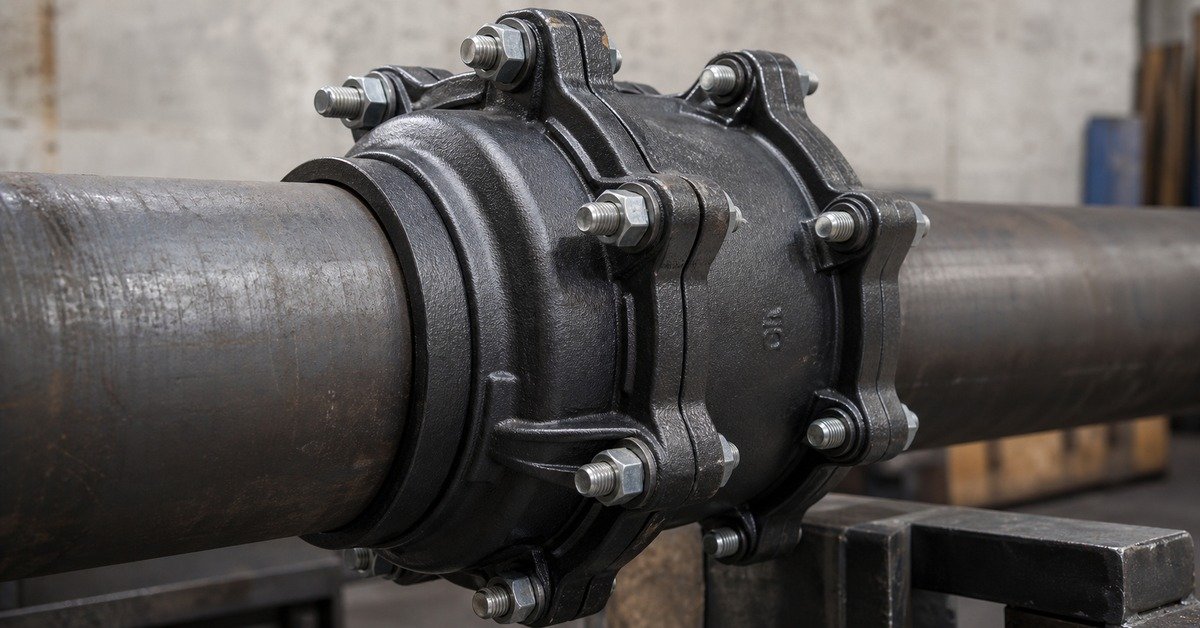
Dresser couplings are one of the most referenced brands in US water utility and gas distribution infrastructure. When American-designed projects, US-specification plants, or utility drawings reach Singapore procurement teams, Dresser part numbers often appear in the BOM. Understanding what each Dresser style does — and where to find equivalent stock locally — keeps projects moving.
What Dresser Couplings Are
Dresser (now under Enpro Industries) manufactures flexible mechanical pipe couplings for plain-end pipe. No grooving, threading, or pipe preparation required — the pipe end inserts into the coupling body and the assembly is bolted together.
The basic construction across all Dresser styles:
- Middle ring — the central sleeve that spans the pipe joint
- Follower rings — tightened against both sides to compress the gaskets
- Gaskets — provide the fluid seal against the pipe OD
- Bolts — draw the followers in to create compression
The middle ring allows limited angular deflection and axial movement, making Dresser couplings suitable for buried piping where thermal movement or ground settlement is expected.
Dresser Styles: 38, 65, and 90
Style 38 — Standard Flexible Coupling
The Style 38 is Dresser’s baseline model and the most widely specified. It covers plain-end pipe for water distribution and gas piping.
- Body: Ductile iron middle ring and followers
- Bolts: Standard grade steel (T-head bolts, hex nuts)
- Gaskets: Buna-N (NBR) standard; EPDM available
- Sizes: 1/2 inch to 30 inches and beyond
- Working pressure: Typically 250 psi (17.2 bar) on standard configurations for water and gas service
- Angular deflection: Limited — accommodates misalignment in buried piping
The Style 38 is what most people mean when they say “Dresser coupling” without a style qualifier. It is the dominant plain-end flexible coupling in American water utility work.
Style 65 — Heavy-Duty Coupling
The Style 65 uses a heavier ductile iron body and a hex-bolt pattern rather than the T-head bolts of the Style 38. It is designed for higher-pressure service and larger-diameter mains where the Style 38 body is not rated.
- Applications: Large-diameter water transmission mains, industrial piping where higher bolt load is required
- Bolt pattern: Hex bolt with through-bolts (stronger draw than T-head)
- Body: Heavier wall ductile iron
- Typical use: Municipal water authority projects, US-specification industrial plants
| Feature | Style 38 | Style 65 |
|---|---|---|
| Body weight | Standard | Heavy-duty |
| Bolt type | T-head | Hex through-bolt |
| Primary use | Water distribution, gas | Large mains, industrial |
| Pressure rating | Up to 250 psi standard | Higher-rated configurations |
Style 90 — High-Pressure Service
The Style 90 is for high-pressure gas and liquid lines. It uses a thicker cross-section, higher-grade hardware, and is rated for pressures above the Style 38’s standard range. Typical applications include natural gas transmission, industrial process piping, and high-pressure water injection.
Procurement teams encountering a Style 90 specification are usually dealing with an American oil and gas engineering package.
How Dresser Style 38 Compares to JWC MJS
The JWC MJS is the most direct functional comparison to the Dresser Style 38 in the Singapore market — both are plain-end flexible couplings without any pipe grooving requirement.
| Feature | Dresser Style 38 | JWC MJS |
|---|---|---|
| Pipe preparation | None (plain-end) | None (plain-end) |
| Coupling type | Flexible | Flexible / slip |
| Body material | Ductile iron | Ductile iron |
| Hardware | Steel T-head bolts | SUS304 stainless bolts |
| Gasket | NBR or EPDM | NBR standard |
| Origin | USA (Enpro Industries) | Korea (Jeong Woo Coupling) |
| Singapore stock | Limited — import on demand | Same-day from DPE |
| Angular deflection | Yes (middle ring) | Yes |
Both function on plain-end pipe without grooving. The hardware differs: Dresser uses steel T-head bolts; JWC MJS uses SUS304 stainless as standard — an advantage in marine and tropical environments where bolt corrosion is an operational concern.
The JWC MJS is not a drop-in dimensional substitute — bolt patterns, flange geometry, and middle ring lengths differ. But for new installations or replacement work where functional equivalence rather than dimensional interchangeability is acceptable, the MJS is the natural Singapore-stocked alternative.
For a detailed look at how JWC flexible couplings are configured, see the JWC MJS, MJG, and MJH buyer’s guide.
Where Dresser Is Specified in Singapore
Dresser couplings appear in Singapore and ASEAN procurement when:
- An American engineering firm has designed the plant and written US-standard specs. Oil refineries, LNG terminals, and petrochemical plants designed by US houses frequently specify Dresser by brand.
- US-origin infrastructure is being maintained or expanded. Some Singapore water infrastructure installed decades ago used Dresser products and requires like-for-like replacement parts.
- American standards contracts. Projects governed by AWWA (American Water Works Association) standards tend to specify Dresser-type couplings.
Outside these scenarios, Singapore and ASEAN buyers more commonly specify JWC or Aju, which are stocked locally and carry Korean and European origin certifications aligned to JIS and EN standards.
Availability in Singapore
Dresser couplings are not widely stocked in Singapore. Most procurement happens through:
- Direct import from US Dresser distributors (lead time: two to six weeks depending on size and style)
- Regional distributors in Malaysia or Thailand who carry limited Dresser stock
- Project-specific import orders placed well in advance
For time-sensitive work — a vessel in port, a plant shutdown window, a repair job — the import lead time makes Dresser impractical unless the order was placed weeks earlier as part of planned maintenance.
David Phee Enterprise stocks JWC MJS and MJG in Singapore across DN15 to DN300 for same-day delivery. When a Dresser specification needs to be fulfilled quickly and functional equivalence is acceptable to the project engineer, JWC is the standard substitute. See mechanical coupling vs flange joint for guidance on where plain-end flexible couplings sit in the broader connection type selection.
Specifying Substitutes for Dresser
When substituting from a Dresser specification, the process:
- Identify the Dresser style. Style 38 (standard flexible) or Style 65 (heavy-duty) covers the vast majority of Singapore enquiries. Style 90 (high-pressure gas/liquid) is project-specific.
- Note the pipe OD and schedule. Dresser couplings are dimensioned to specific pipe ODs. Confirm the actual OD before specifying an alternative.
- Match working pressure. The JWC MJS at PN16 (16 bar) covers most standard service. For higher-pressure Dresser applications, confirm the JWC model rating against the design pressure.
- Document the substitution. American-specification projects usually require engineer approval for any brand substitution. Provide JWC datasheets and material certifications.
Key Takeaways
- Dresser (Enpro Industries) makes plain-end flexible couplings dominant in US water utility and gas distribution — Style 38 is the standard model, Style 65 is heavy-duty, Style 90 is high-pressure
- Dresser Style 38 and JWC MJS are functionally similar: both are plain-end flexible, ductile iron body, limited angular deflection — the hardware grade differs (steel T-head vs SUS304 stainless)
- Dresser is not widely stocked in Singapore — expect two-to-six-week import lead times; JWC MJS ships same-day from local stock
- Dresser specifications appear on US-origin engineering projects, American-standards oil and gas plants, and legacy US-specification water infrastructure
- For functional substitution, map Style 38 → JWC MJS (flexible) and document the equivalence for engineer approval with JWC datasheets