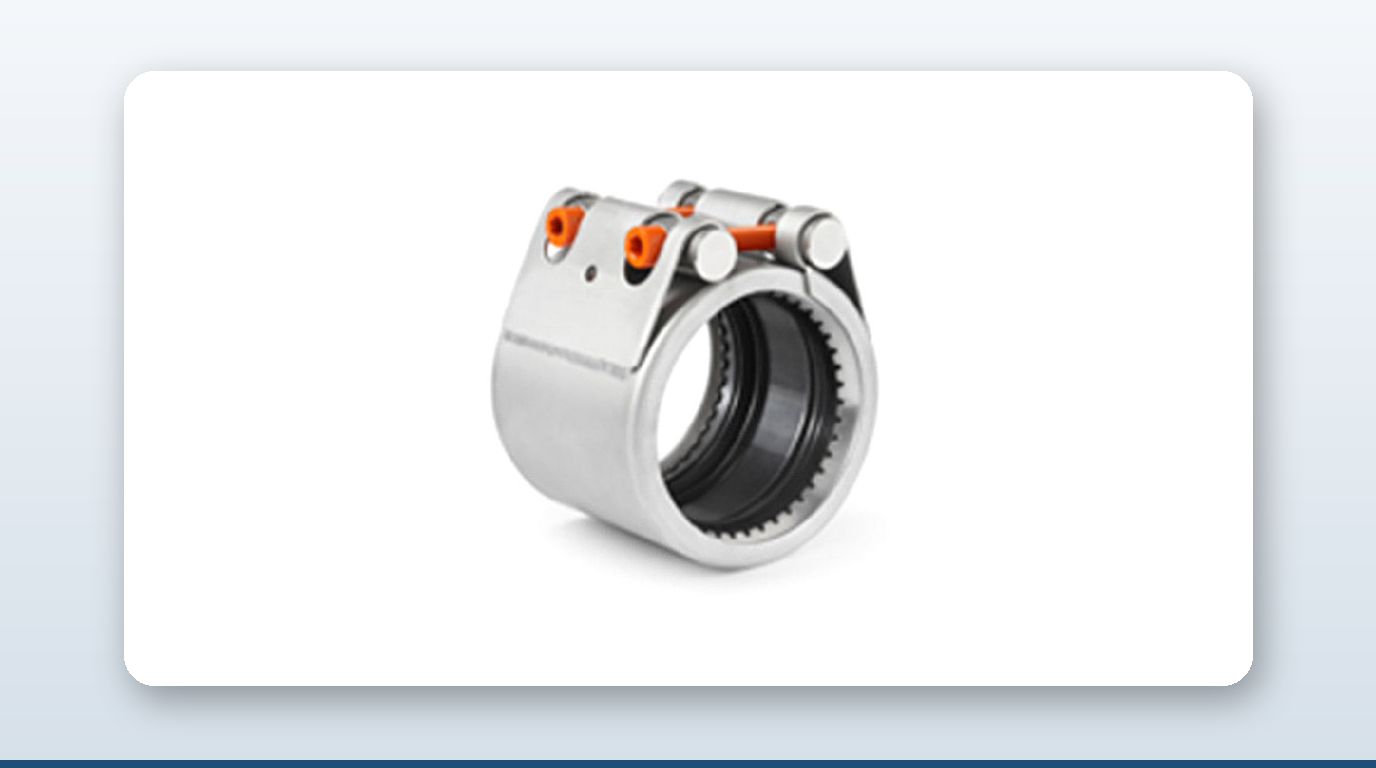
A DN150 pipe coupling sits at the upper end of what a two-person crew can still handle with hand tools on site, and it’s a size where getting the specification wrong is expensive — larger couplings, larger bolts, and a bigger reinstallation job if the wrong one arrives. DN150 is used across building services mains, larger industrial lines, and marine piping wherever flow volume steps up from the mid-size DN100 range.
This guide covers what DN150 means on the pipe, the coupling types and pressure ratings available at this size, material and gasket selection for larger-bore joints, and the fitting issues that come up more often once you’re working at 150mm-plus.
What DN150 Actually Means
DN150 is the ISO/EN nominal bore designation for what’s commonly called “6-inch” pipe (NPS 6). On carbon-steel and stainless-steel pipe to ASTM A53/A106 or ASTM A312, DN150 has a fixed outside diameter of 168.3 mm, independent of wall schedule — a Schedule 40 and a Schedule 80 DN150 pipe both measure 168.3 mm OD.
JWC labels this size 150A under its Korean/JIS-style sizing convention — the same nominal class as DN150. As with any DN order, confirm the pipe material and standard alongside the size: ductile iron, HDPE, and other pipe materials use different OD conventions at the same nominal label, and a steel-sized DN150 coupling will not seal correctly on a ductile-iron DN150 main. See our guide on pipe OD vs nominal bore for the full material-by-material breakdown, and our DN100 pipe coupling guide for the adjacent mid-size class.
Typical Applications for DN150
DN150 is a step up in flow capacity from DN100 and shows up wherever a piping system’s main trunk line, rather than a branch or service run, needs a mechanical joint:
- Larger building services mains — chilled water and condenser water trunk lines in commercial and industrial developments
- Industrial process mains — where DN100 branch lines feed into a larger common header
- Marine mains — larger seawater, ballast, and cooling mains on vessels at Seatrium and comparable yards, where the size and pressure duty both step up from engine-room branch piping
- Water infrastructure mains — larger-diameter distribution runs in PUB-adjacent projects
JWC Coupling Options at DN150 (150A)
Both core JWC families cover DN150 as standard sizing:
| Model | Type | Size Range Covering 150A | Working Pressure (Ship) | Working Pressure (Industrial) | Movement Allowance |
|---|---|---|---|---|---|
| MJG / MJGL | Grip Ring (patented, anti-pull-out) | 15A–350A | 7–16 bar | 14–32 bar | 4° angular deflection, 0–15mm gap setting |
| MJS / MJL | Flexible (vibration/noise absorption) | 15A–600A | 4.2–16 bar | 8.4–32 bar | 5mm axial movement |
At DN150, MJG/MJGL remains the pull-out-resistant option — worth specifying on mains where thrust loads or thermal movement are a concern, or where a failed welded joint is being replaced without hot work. MJS/MJL remains the vibration- and noise-absorbing option, relevant on mains feeding from or into pump stations and engine rooms.
For guidance on choosing between the two coupling types across the full size range, see our coupling type comparison guide.
Pressure Ratings at DN150
The same two-band structure applies at DN150 as at every other size in the JWC range: a ship/marine rating and a higher industrial rating. For the grip-ring type, that’s 7–16 bar (ship) versus 14–32 bar (industrial); for the flexible type, 4.2–16 bar (ship) versus 8.4–32 bar (industrial).
At the larger DN150 bore, confirming the correct pressure band matters more, not less — a larger coupling under-rated for its actual duty represents a bigger failure surface than the equivalent mistake at DN50 or DN100. State the application context (ship or industrial) clearly at RFQ stage.
Material and Gasket Selection for DN150
JWC’s materials platform is consistent across sizes: stainless steel SUS 304/316 casing, SUS 301H grip rings, and a choice of EPDM, NBR, Silicone, or FKM (Viton) rubber gaskets.
At DN150 and above, gasket compression area is larger, which makes correct compound selection for the actual fluid and temperature more consequential — a mismatched gasket on a larger-bore joint has more surface exposed to degradation. EPDM remains the general-purpose default for water and mild-chemical duty, NBR for oil-based fluids, and FKM (Viton) where higher temperature or more aggressive chemical exposure is expected. Confirm both the fluid and its operating temperature when specifying.
Common Site Fitting Issues at DN150
A few issues come up more frequently once you’re working at DN150 and larger, compared with smaller branch-line sizes:
- Out-of-round pipe ends. Larger-diameter pipe deforms more easily under its own weight, support spacing, or years of thermal cycling. Measure OD at four points around the circumference before ordering, and size to the largest reading.
- Handling and alignment during installation. A DN150 coupling and its mating pipe ends are heavier and less forgiving of misalignment than DN50 or DN100 — plan for two-person handling and confirm the coupling’s angular deflection allowance (4° for MJG/MJGL) covers any as-built misalignment before assuming a straight fit.
- Bolt torque sequencing. Larger couplings typically use more bolts around the circumference; tightening in a proper cross-pattern sequence, rather than working around the ring in order, keeps gasket compression even.
- Confirming pressure band before ordering, not after. Because DN150 sits on larger industrial and marine mains, the cost of specifying the wrong pressure band — and having to swap a fitted coupling — is higher than at smaller branch sizes.
Key Takeaways
- DN150 = NPS 6 = 168.3 mm OD on standard carbon and stainless steel pipe; JWC labels the same size “150A.”
- Both JWC families cover DN150: MJG/MJGL for pull-out resistance, MJS/MJL for vibration and noise absorption — the choice depends on what the joint needs to do, same as at DN100.
- Ship and industrial pressure ratings differ — confirm application context at RFQ stage, especially at this larger bore where a mis-specified coupling is costlier to correct.
- Gasket compound matters more at larger bore — EPDM, NBR, Silicone, and FKM (Viton) are all available; match to fluid and temperature.
- Measure OD on older or non-standard mains before ordering — out-of-round pipe is more common at DN150 and above than at smaller branch sizes.
About David Phee Enterprise
David Phee Enterprise is the exclusive Singapore distributor for Jeong Woo Coupling (JWC), stocking DN150 and adjacent sizes across the MJG, MJGL, MJS, and MJL ranges for same-day delivery to ship chandlers, shipyards, and industrial contractors across Singapore, Malaysia, and Indonesia. For sizing help, pressure-band confirmation, or a DN150 coupling quote, visit davidphee.com.