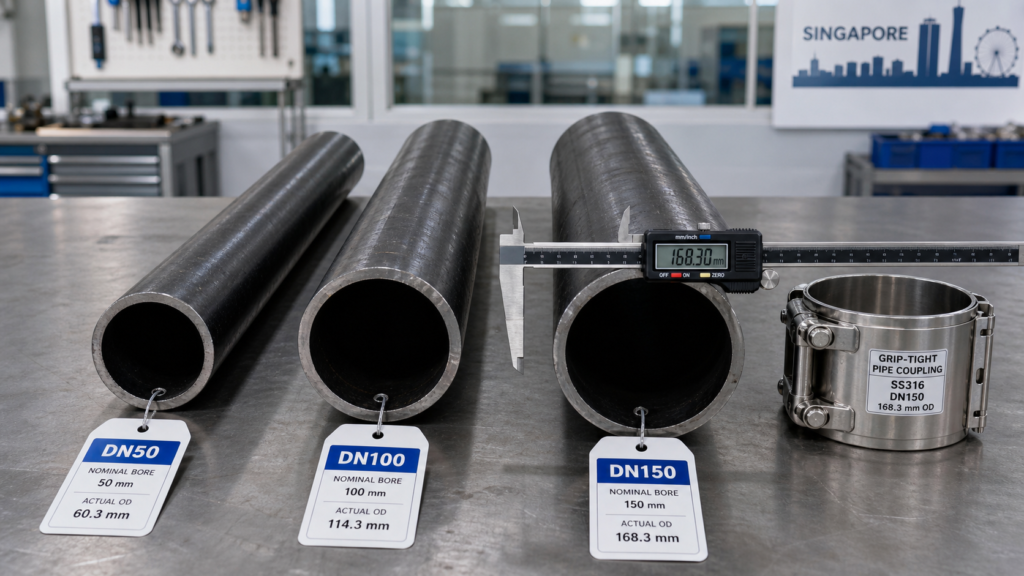
Most pipe-coupling failures that show up on a project’s commissioning report were ordered wrongly weeks earlier. Not specified wrongly — ordered wrongly. The contractor asked for a “DN100 coupling,” the supplier sent one, and the coupling does not fit the pipe on site. The pipe is the correct DN. The coupling is the correct DN. They still do not match.
The reason is one of the most common, and most costly, misunderstandings in industrial piping: confusing nominal bore (DN) — a label — with outside diameter (OD) — a measurement. A mechanical pipe coupling grips the outside of the pipe. It does not know what the inside diameter is, and it does not care. It cares about the OD, the OD tolerance, and the gasket compression range. If those numbers are wrong, the coupling either leaks or will not fit at all.
This article explains what pipe OD is, how it relates to DN and NPS, why the same “DN50” label can mean different things on different pipe materials, and how to size a coupling correctly without guessing.
Pipe OD vs Nominal Bore (DN): The Core Difference
Pipe Outside Diameter (OD) is the literal physical measurement of the outside of the pipe, taken with callipers or a circumference tape. It is in millimetres or inches. It is a real, measurable number.
Nominal Bore (DN) is a numerical label — a sizing convention. DN comes from the French Diamètre Nominal and is the ISO/EN designation for pipe size. DN50 means “the pipe size historically known as 2-inch nominal.” It does not literally mean the bore is 50 mm. On a Schedule 40 carbon-steel pipe, DN50 has an actual inside diameter closer to 52.5 mm and an actual OD of 60.3 mm.
The corresponding US convention is NPS — Nominal Pipe Size — expressed in inches. NPS 2 = DN50. NPS 4 = DN100. The numbers diverge above NPS 14, where NPS values match the actual OD in inches (NPS 14 = 14.000″ OD = 355.6 mm), while DN remains a metric label.
The critical point for coupling selection: DN and NPS are labels. They are not the dimension the coupling grips. The coupling grips the OD.
Why DN50 Is Not 50 mm OD
For carbon-steel pipe to ASTM A53/A106 and stainless-steel pipe to ASTM A312 — the two most common pressure piping materials in Singapore industrial and marine work — the outside diameter for each DN is fixed by standard, regardless of wall thickness. Changing schedule (Sch 40, Sch 80, Sch 160) changes the wall thickness, which eats into the bore. The OD stays the same.
This is why a Sch 40 and a Sch 80 DN50 pipe both measure 60.3 mm on the outside. A coupling sized for DN50 carbon steel will fit either schedule — the OD is identical. What changes is the working pressure rating, because the wall is thicker.
The full mapping for the most common pipe sizes used with mechanical couplings:
| DN | NPS | Carbon / Stainless Steel OD (mm) | OD (inches) |
|---|---|---|---|
| DN15 | ½” | 21.3 | 0.840 |
| DN20 | ¾” | 26.7 | 1.050 |
| DN25 | 1″ | 33.4 | 1.315 |
| DN32 | 1¼” | 42.2 | 1.660 |
| DN40 | 1½” | 48.3 | 1.900 |
| DN50 | 2″ | 60.3 | 2.375 |
| DN65 | 2½” | 73.0 | 2.875 |
| DN80 | 3″ | 88.9 | 3.500 |
| DN100 | 4″ | 114.3 | 4.500 |
| DN125 | 5″ | 141.3 | 5.563 |
| DN150 | 6″ | 168.3 | 6.625 |
| DN200 | 8″ | 219.1 | 8.625 |
| DN250 | 10″ | 273.0 | 10.750 |
| DN300 | 12″ | 323.9 | 12.750 |
These values come from ANSI/ASME B36.10M (carbon steel) and B36.19M (stainless). They are the same numbers a coupling manufacturer uses to set the housing diameter and gasket compression range for steel-pipe couplings.
For coupling-size and bolt-spec data alongside these OD values, see [INTERNAL: pipe-coupling-size-chart-dn15-dn300].
Where the Same DN Means a Different OD
The trap is that not all pipe materials use the steel OD convention. Several common materials are sized on a different scheme, and using a steel-OD coupling on them will not work.
HDPE / PE pipe (ISO 4427). HDPE is sized by actual outside diameter. A “DN63” HDPE pipe is literally 63 mm OD. There is no offset and no schedule. The number on the label is the dimension on the pipe. DN50 HDPE — if it exists in a given catalogue — would be 50 mm OD, which is materially smaller than DN50 steel (60.3 mm). A grip-type coupling for steel will not seal on HDPE of the same DN label.
Copper tube (EN 1057 / BS EN 1057). Copper plumbing tube is sized by nominal OD, expressed in millimetres. A “15 mm copper” tube is 15.0 mm OD. A “22 mm copper” tube is 22.0 mm. These are also smaller than the steel pipe of the same nominal designation. Couplings used on copper are usually compression fittings or copper-specific mechanical couplings, not steel-pipe couplings.
Ductile iron pipe (ISO 2531 / EN 545). Ductile iron uses DN sizing but its OD is larger than steel of the same DN. DN100 ductile iron is 118 mm OD, not 114.3 mm. DN200 ductile iron is 222 mm OD, not 219.1 mm. Couplings for ductile iron — typically used on PUB potable and raw water mains in Singapore — are dimensioned to the ISO 2531 OD and will not fit steel of the same DN.
Stainless tube (sanitary, ASME BPE / DIN 11850). Sanitary tube is sized by exact OD in millimetres or inches, with thin walls and tight tolerances. “DN50” sanitary tube is typically 52 mm or 53.0 mm OD depending on standard — not 60.3 mm. Sanitary couplings are matched to this convention.
The practical rule: before ordering a coupling, confirm the pipe material and the standard it is made to. “DN100” alone is not enough information. “DN100 carbon steel to ASTM A53, Sch 40” tells the supplier exactly which OD to size the coupling for.
How to Measure Pipe OD in the Field
When the pipe specification is unknown, or when a coupling is being sourced for an existing line, measure the OD directly. Two methods, both reliable:
1. Pi tape (circumference tape). A pi tape is a calibrated steel measuring tape with graduations that read OD directly when wrapped around the pipe’s circumference. Accuracy is typically ±0.1 mm. This is the field standard for pipes above DN80 where a calliper jaw cannot span the diameter.
2. Outside callipers or digital callipers. For pipes up to DN80, a 200 mm or 300 mm digital calliper measures OD directly. Take readings at four points around the circumference and average them — if the pipe is out-of-round, all four will differ. The largest reading is the controlling OD for coupling selection.
Record the measurement to one decimal place in millimetres. Round up, not down — a coupling sized to a smaller OD than the pipe actually has will not close.
OD Tolerance and Coupling Working Range
Pipe OD is not a single number. Every pipe standard allows a manufacturing tolerance — typically ±1% of OD for welded carbon-steel pipe, tighter for seamless and stainless. This means a DN150 pipe with a nominal 168.3 mm OD can legitimately measure anywhere from about 166.6 mm to 170.0 mm and still be in spec.
Mechanical pipe couplings are designed with this tolerance built in. A reputable grip-type or grooved coupling specifies a working OD range — for example, “168.0 mm to 170.0 mm” for a DN150 unit. As long as the measured pipe OD falls inside this range, the coupling will seal. Outside the range, the gasket either does not compress enough or is over-compressed and extrudes.
This is why substituting a coupling sized for a different pipe standard is dangerous even when the DN matches. A ductile-iron-sized coupling on a steel pipe sits on a smaller OD than the gasket was designed for, and the gasket compression is wrong. The coupling may close on the bolts but will not seal under pressure.
For specification sheets including OD ranges by coupling model, see [INTERNAL: jwc-coupling-specifications].
Common Sizing Mistakes
The four most frequent errors when sizing pipe couplings:
- Ordering by DN label alone. “We need 50 couplings, DN100.” Without the material and standard, the supplier guesses — usually carbon steel, sometimes wrong.
- Assuming HDPE and steel of the same DN are interchangeable. They are not. The OD difference is material — a steel coupling will not close on an HDPE pipe of nominally the same DN.
- Ignoring out-of-round in old pipework. Pipes that have been in service for years can deform under wall loads, support settlement, or thermal cycling. Measure four points; size to the largest.
- Mixing schedules without checking the coupling’s pressure rating. OD is the same across schedules for steel, but the pipe’s working pressure changes. Couple a Sch 40 to a Sch 80 with a coupling rated for Sch 40 pressures and the joint becomes the system’s weakest point under surge.
Key Takeaways
- Pipe OD is what a coupling grips. DN and NPS are labels. The coupling’s housing and gasket are sized to the actual outside diameter, not the nominal designation.
- DN50 steel pipe is 60.3 mm OD, not 50 mm. The full DN ↔ OD mapping for carbon and stainless steel is fixed by ASME B36.10M/B36.19M and does not change with schedule.
- The same DN means different ODs on different materials. Steel, HDPE, ductile iron, copper, and sanitary tube each follow a different convention. Always specify the material and standard alongside the DN when ordering.
- Measure before you order when the pipe spec is unknown. A pi tape or callipers takes one minute and saves a return trip.
- Match the pipe OD to the coupling’s published working range. Outside that range, the gasket compression is wrong and the joint will leak regardless of bolt torque.
About David Phee Enterprise
David Phee Enterprise is the exclusive Singapore distributor for Jeong Woo Coupling (JWC) and a long-standing supplier of Aju, Romacon, and Smith-Blair pipe couplings, repair clamps, and expansion joints. Operating from Empire Technocentre in Kaki Bukit, DPE supplies ship chandlers, shipyards, and industrial contractors across Singapore, Malaysia, and Indonesia with same-day delivery on stocked items, plus sizing support for mixed-material lines, ductile iron mains, and non-standard ODs. Visit davidphee.com for sizing enquiries, datasheets, and stock checks.