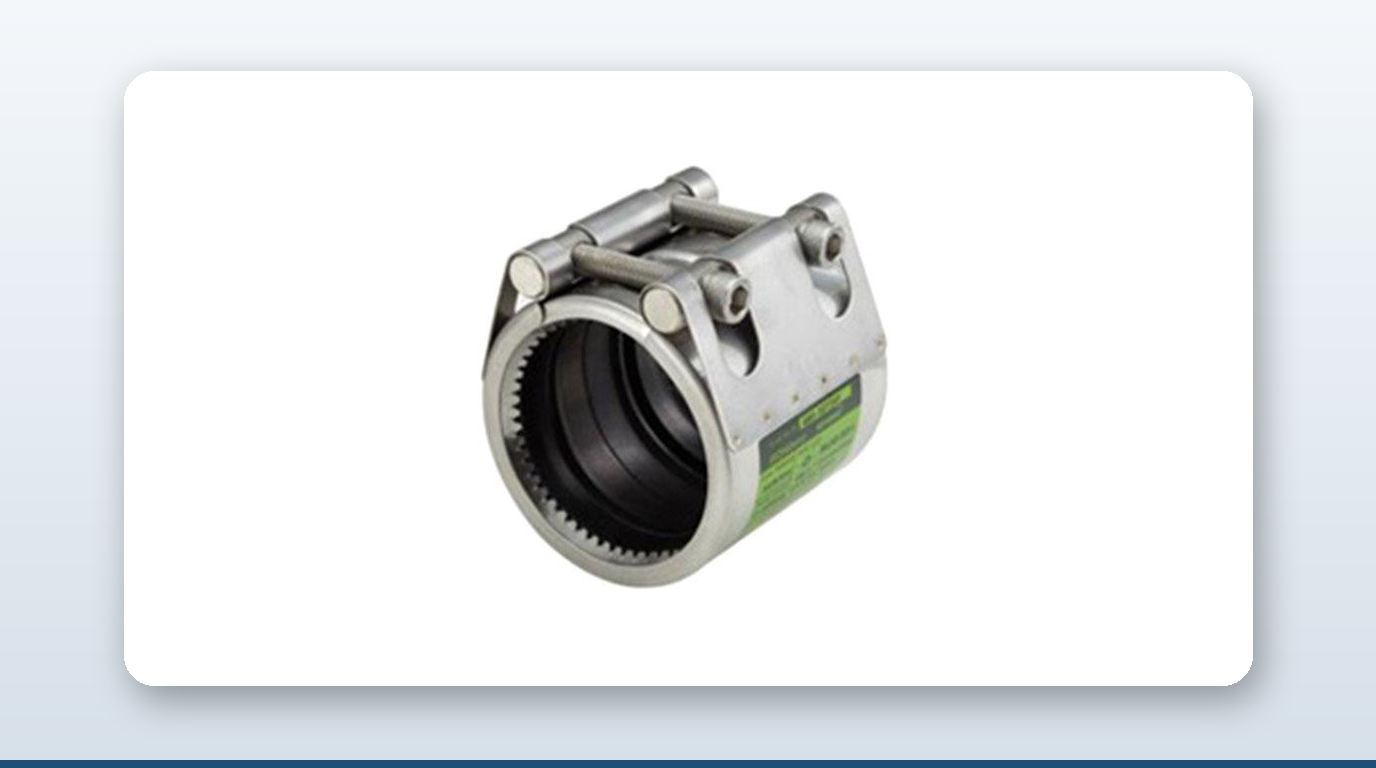
A DN100 pipe coupling is one of the most commonly quoted sizes in Singapore’s industrial and marine piping trade, and also one of the easiest to order incorrectly. “DN100” tells a supplier the nominal size class, but not the pipe material, the pressure duty, or which coupling type fits the joint. Get any of those wrong and the coupling either doesn’t seal or doesn’t fit at all.
This guide covers what DN100 actually means on the pipe, the coupling types available at this size, realistic pressure expectations, material and gasket choices, and how to specify a DN100 pipe coupling so the first one sent is the right one.
What DN100 Actually Means
DN100 is the ISO/EN nominal bore designation — commonly known in the trade as “4-inch” (NPS 4). On carbon-steel and stainless-steel pipe built to ASTM A53/A106 or ASTM A312, DN100 has a fixed outside diameter of 114.3 mm, regardless of wall schedule. A Schedule 40 and a Schedule 80 DN100 pipe both measure 114.3 mm OD — the difference is wall thickness and working pressure, not the dimension the coupling grips.
JWC, DPE’s primary coupling supplier, labels this same size 100A under its Korean/JIS-style sizing convention. When ordering, “DN100,” “4-inch,” and “100A” all refer to the same nominal pipe size — but always confirm the pipe is steel to the standards above. HDPE, ductile iron, and copper pipe use different sizing conventions entirely at the same nominal label. For the full breakdown of why this matters, see our guide on pipe OD vs nominal bore.
Typical Applications for DN100
DN100 sits in the mid-size range most piping systems actually run at — large enough to carry meaningful flow, small enough to handle with hand tools on site. Common uses in Singapore include:
- Building services — chilled water risers, condenser water lines, and fire protection sub-mains in commercial and industrial developments
- Pump discharge and suction lines — a size where vibration absorption at the pump connection becomes worth specifying
- Shipyard and marine engine room piping — DN100 is a frequent size for auxiliary seawater, bilge, and cooling lines on vessels serviced at Seatrium and similar yards
- Water infrastructure branch mains — PUB-adjacent distribution and service connections at this diameter
JWC Coupling Options at DN100 (100A)
DPE stocks two JWC coupling families that cover DN100 as standard sizing, each suited to a different job:
| Model | Type | Size Range Covering 100A | Working Pressure (Ship) | Working Pressure (Industrial) | Movement Allowance |
|---|---|---|---|---|---|
| MJG / MJGL | Grip Ring (patented, anti-pull-out) | 15A–350A | 7–16 bar | 14–32 bar | 4° angular deflection, 0–15mm gap setting |
| MJS / MJL | Flexible (vibration/noise absorption) | 15A–600A | 4.2–16 bar | 8.4–32 bar | 5mm axial movement |
MJG/MJGL is the choice when the priority is preventing the pipe from pulling out of the joint — pump discharge thrust, thermal movement, or replacing a failed welded connection without hot work. It installs with hand tools and needs no pipe edge preparation.
MJS/MJL is the choice when the priority is absorbing vibration, noise, or minor bending — pump connections, engine room runs, and any line where a rigid weld would transmit stress into adjoining equipment.
For a side-by-side comparison of when to use grip versus flexible coupling types across all sizes, see our coupling type comparison guide.
Pressure Rating Expectations at DN100
DN100 couplings from JWC carry two published pressure bands, and the distinction matters when specifying: a ship/marine rating and a higher industrial rating, reflecting the different service and certification contexts these two applications operate under. A DN100 grip-ring coupling is rated 7–16 bar for ship applications versus 14–32 bar for industrial duty; the flexible type runs 4.2–16 bar (ship) versus 8.4–32 bar (industrial).
When specifying, state which context the coupling is going into — a marine engine room job and an onshore industrial pump line at the same DN100 size can call for different pressure documentation even if the physical coupling looks identical.
Material and Gasket Options
JWC couplings across the range use a consistent materials platform: stainless steel SUS 304/316 casing, SUS 301H grip rings, and a choice of rubber gasket compounds — EPDM, NBR, Silicone, or FKM (Viton).
Gasket selection generally follows the fluid being carried. EPDM is a common default for water and general mild-chemical duty. NBR is typically specified where oil-based fluids are present. FKM (Viton) is reserved for higher-temperature or more aggressive chemical service where EPDM would degrade faster. Confirm the medium and operating temperature with your supplier before finalising gasket compound — this is a detail worth getting right at order stage rather than after installation.
How to Specify a DN100 Coupling Correctly
To get a first-time-correct quote and delivery, provide:
- Pipe material and standard — e.g. “carbon steel, ASTM A53, Schedule 40” — not just “DN100”
- Application context — ship/marine or industrial, since this determines the pressure band
- Media and operating temperature — to select the correct gasket compound
- Required movement or deflection — if the joint needs to absorb vibration, bending, or thermal expansion, specify MJS/MJL; if pull-out resistance is the priority, specify MJG/MJGL
- Measured pipe OD — if the pipe’s origin or standard is unknown, measure it directly rather than assuming 114.3 mm; see our pipe OD sizing guide for field measurement methods
Common Mistakes When Ordering DN100 Couplings
- Ordering “DN100” with no material specified. The supplier has to guess the pipe standard, and a guess that’s wrong means a return trip.
- Assuming the ship-rated pressure covers an industrial application. The two bands exist for a reason — using a ship-rated coupling on an industrial-duty line can under-spec the joint.
- Skipping the gasket conversation. A DN100 coupling with the wrong rubber compound for the fluid will degrade and leak well before the housing does.
- Not confirming OD on older or non-standard pipe. Pipe that has been in service for years, or that isn’t to a standard steel spec, should be measured before ordering — don’t assume 114.3 mm.
FAQ
Is DN100 the same as 4-inch pipe?
Yes. DN100 (metric nominal bore) and NPS 4 (4-inch, US convention) refer to the same nominal pipe size, with an outside diameter of 114.3 mm on standard carbon or stainless steel pipe.
What does “100A” mean on a JWC coupling?
100A is JWC’s own sizing notation for the same nominal size class as DN100 — the two labels refer to the same coupling.
Can one DN100 coupling handle both ship and industrial pressure duty?
No — JWC publishes separate pressure bands for ship and industrial applications at DN100. Specify which context the coupling is for so the correct rating is quoted.
Do I need to know the pipe schedule to order a DN100 coupling?
The OD is the same across schedules for steel pipe, so schedule alone doesn’t change coupling fit. It does affect the pipe’s working pressure, which should be checked against the coupling’s rating.
Key Takeaways
- DN100 = NPS 4 = 114.3 mm OD on standard carbon and stainless steel pipe; JWC labels the same size “100A.”
- Two JWC families cover DN100: MJG/MJGL (grip ring, anti-pull-out) and MJS/MJL (flexible, vibration/noise absorption) — pick based on what the joint needs to do.
- Pressure ratings differ by application context — ship/marine and industrial duty carry separate published bands at DN100.
- Gasket compound should match the fluid — EPDM, NBR, Silicone, and FKM (Viton) are all available; confirm media and temperature before ordering.
- Specify material, standard, and application context — not just “DN100” — to get a correct quote on the first attempt.
About David Phee Enterprise
David Phee Enterprise is the exclusive Singapore distributor for Jeong Woo Coupling (JWC), stocking DN100 and adjacent sizes across the MJG, MJGL, MJS, and MJL ranges for same-day delivery to ship chandlers, shipyards, and industrial contractors across Singapore, Malaysia, and Indonesia. For sizing help, gasket compatibility questions, or a DN100 coupling quote, visit davidphee.com.