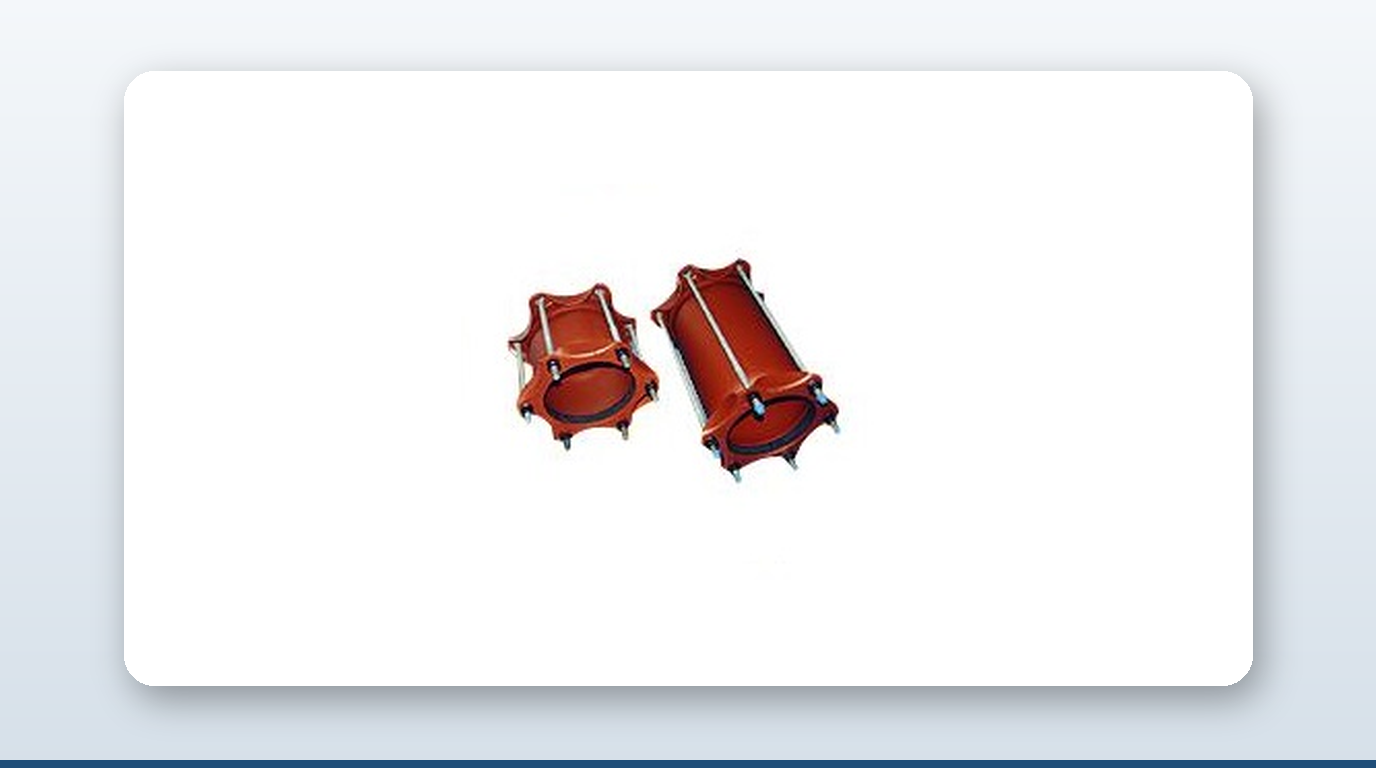
On a same-day RFQ, the question that decides delivery speed is rarely the pipe size — it is the joining method. A contractor who specifies threaded fittings is committing to hand-cutting threads on site, one joint at a time. A contractor who specifies a mechanical grip-type coupling is committing to a housing, a gasket, and a set of bolts that close over plain pipe ends in minutes. Both methods have been standard in Singapore piping for decades. Neither is obsolete. But they solve different problems, and picking the wrong one shows up as a leak, a labor overrun, or a joint that cannot be serviced without cutting pipe.
This article compares grooved and threaded pipe couplings on the factors that actually change a project’s outcome: installation speed, leak-tightness, vibration tolerance, and maintenance. It also covers where threaded joints still make sense, and where mechanical couplings are now the default choice for DPE’s ship chandler, shipyard, and industrial customers.
How Each Joining Method Actually Works
Threaded pipe joints cut helical threads into the pipe end — either machine-cut in a workshop or hand-cut on site with a pipe threading machine or die set. A threaded fitting (coupling, elbow, tee) is then screwed onto the threaded pipe end, usually with PTFE tape or pipe-jointing compound on the threads to seal against leaks. The seal comes from the mechanical interference of the mating threads plus the sealant filling the microscopic gaps between them.
Grooved and grip-type mechanical couplings take a different approach entirely. A groove or grip surface is formed on (or gripped onto) the pipe end, and a coupling housing — typically two or more segments — closes around it with an elastomeric gasket compressed between the housing and the pipe OD. Bolts draw the housing segments together, compressing the gasket to form the seal. No threads are cut into the pipe wall, and in grip-ring designs like JWC’s MJG/MJGL range, the pipe end does not need any edge processing at all — the coupling grips a plain pipe end directly.
The distinction matters for sizing and sourcing: threaded fittings are matched to NPT or BSP thread standards, while mechanical couplings are sized to the pipe’s actual outside diameter. For a primer on that distinction, see our guide to pipe OD vs nominal bore.
Installation Speed and Labor Cost
This is where the two methods diverge most sharply on a live jobsite.
Threading a pipe end takes real time and real equipment. Each joint requires cutting the pipe to length, deburring, threading with a die or power threader, cleaning cutting oil off the threads, applying sealant, and torquing the fitting home with a pipe wrench — usually two wrenches, one to hold the pipe steady. On larger bore sizes, threading requires a powered threading machine, which means transporting the machine to site or running cable to it. Rework is expensive: a mis-cut thread means re-cutting or scrapping the pipe length.
Mechanical couplings install with hand tools in a fraction of the time. For a grip-type coupling like JWC’s MJG, there is no pipe-end processing at all — the pipe is cut to length, the coupling housing is placed over the plain ends, and the bolts are torqued down. DPE positions this as installing “in minutes with hand tools, no welding, no thread-cutting, no downtime.” On a run of multiple joints — a plant room, a riser, a repair section — the time saved compounds fast, because every joint skips the threading step entirely.
The practical labor-cost gap widens further on larger bore pipe, where threading becomes slower and physically harder, while a mechanical coupling’s installation time barely changes with size.
Leak-Tightness and Pressure Rating
Both methods can hold pressure reliably when installed correctly — but they fail differently, and threaded joints are less forgiving.
Threaded joints depend on the thread quality and the sealant. A poorly cut thread, over-tightening that cracks a fitting, or degraded PTFE tape all create a leak path. Threaded joints are also more prone to galling on stainless steel, where the threads can seize and gall during assembly, sometimes requiring the fitting to be scrapped. Once corrosion sets into exposed threads over years of service, disassembly for maintenance becomes difficult without damaging the joint.
Mechanical couplings seal on gasket compression, not thread fit. JWC’s MJG/MJGL range is rated 7–16 bar for ship/marine applications and 14–32 bar for industrial applications, depending on size — pressure performance that does not depend on cut-thread quality, because there is no thread to cut. As long as the pipe OD falls within the coupling’s specified gap tolerance (0–8 mm for smaller sizes, 0–15 mm for 80A and above), the gasket compresses evenly and seals. This tolerance also means mechanical couplings absorb minor OD variation and installation misalignment that would leak on a rigid threaded joint.
For applications needing to absorb ongoing vibration or thermal movement rather than a fixed joint, JWC’s flexible MJS/MJL range extends this further — see rigid vs flexible grooved couplings for HVAC for that comparison.
Vibration and Movement Tolerance
Threaded joints are rigid. Once made up, a threaded connection has essentially zero give — which is fine for a static line, but a liability anywhere the pipe sees vibration, pump pulsation, or thermal expansion and contraction. Rigid threaded joints transmit vibration straight through the pipe run, and repeated cyclic stress on a threaded connection can loosen it or crack the fitting at the thread root over time.
Mechanical couplings tolerate movement by design. JWC’s grip-type range permits angular deflection — 5° on 15A–50A sizes, tapering to 2° on 200A and above — so the joint can flex slightly rather than transmitting stress. The flexible MJS/MJL line goes further, allowing measured axial movement (5 mm on smaller sizes up to 15 mm on 550A and above) specifically to absorb vibration, bending, and thermal expansion. On marine engine room pipework, ship chandler installations, and pump discharge lines — all common DPE customer scenarios — this movement tolerance is often the deciding factor over a rigid threaded joint.
Maintenance and Disassembly
A threaded joint can be disassembled — that is one of its genuine advantages over welding — but only if the threads have not seized or corroded shut. Breaking a threaded joint that has been in service for years, especially in a marine or corrosive environment, frequently requires heat, penetrating oil, or cutting the pipe and re-threading a new length.
A mechanical coupling is designed for repeat disassembly. Unbolting the housing segments releases the joint cleanly, without damaging the pipe end, because the pipe was never threaded or welded in the first place. For maintenance-heavy applications — pump connections, filter housings, sections that get isolated for periodic inspection — this is a meaningful lifecycle advantage. It is also why mechanical couplings are commonly used to replace a failed welded or threaded joint during emergency repairs: no welding equipment, no re-threading, and the connection is live again in minutes.
Grooved vs Threaded Coupling Comparison Table
| Factor | Threaded Joint | Mechanical / Grip-Type Coupling |
|---|---|---|
| Pipe-end prep | Thread must be cut (machine or hand-cut) | Plain pipe end, no processing (grip-ring types) |
| Install speed | Slower — cutting, threading, sealant, torque per joint | Faster — housing + bolts, hand tools |
| Leak path | Thread fit + sealant quality | Gasket compression on pipe OD |
| Pressure rating | Depends on fitting rating and thread integrity | 7–32 bar depending on size and application (JWC MJG/MJGL) |
| Vibration tolerance | Rigid — transmits vibration and stress | Angular deflection built in; flexible types absorb axial movement |
| Disassembly for maintenance | Difficult once seized/corroded | Designed for repeat unbolt/rebolt |
| Best fit | Small bore, low pressure, legacy threaded systems | Larger bore, speed-critical installs, vibration-prone lines |
| Typical bore range | Small bore, commonly ≤DN50 | 15A–600A depending on JWC series |
When Threaded Still Makes Sense
Threaded joints are not being phased out, and there are still situations where they are the right call:
- Small-bore, low-pressure lines. Instrument tubing, small drain lines, and utility connections below roughly DN50 are often threaded by convention, and the labor-time gap versus a mechanical coupling is small at that size.
- Legacy systems. A pipe run built on threaded fittings decades ago is usually extended or repaired in kind, unless the whole section is being upgraded.
- Low-cost, low-criticality runs. Where the joint sees no vibration, no pressure cycling, and failure consequence is minor, a threaded fitting can be the cheaper option per joint on very small quantities.
When Mechanical Couplings Win
For the bulk of DPE’s ship chandler, shipyard, and industrial customer base, mechanical couplings are now the practical default:
- Larger bore pipe, where threading time and difficulty scale up sharply.
- Speed-critical installs and repairs — same-day turnarounds where site downtime has a direct cost, particularly on vessel piping and pump discharge lines.
- Vibration-prone or misaligned lines, where a rigid threaded joint is a stress-fracture risk over time.
- Maintainability-driven design, where a section needs to come apart cleanly for inspection or replacement without cutting pipe.
JWC’s grip-ring MJG/MJGL range and flexible MJS/MJL range together cover most of this territory — from 15A up to 600A depending on series — which is why DPE stocks them as the modern first-choice recommendation ahead of threaded fittings for anything beyond small-bore utility work.
FAQ
Is a grooved or grip-type coupling stronger than a threaded joint?
Strength depends on the specific product and pressure rating rather than the method alone, but mechanical couplings avoid the thread-root stress concentration that makes threaded joints prone to fatigue cracking under vibration.
Can I convert an existing threaded line to a mechanical coupling?
Often yes, particularly with grip-type couplings that accept plain pipe ends — the threaded section can be cut back to plain pipe and joined with a grip-ring coupling, avoiding a full re-thread.
Do mechanical couplings need special tools to install?
No. Grip-type and grooved-style mechanical couplings install with standard hand tools — typically a socket or torque wrench for the housing bolts — with no threading machine or welding equipment required.
Which method is faster for a same-day repair?
Mechanical couplings, in almost every case. A grip-ring coupling can close over a cut, plain pipe end in minutes, while a threaded repair requires cutting, threading, and sealing a new joint on site.
Key Takeaways
- Threaded joints seal on thread fit and sealant; mechanical couplings seal on gasket compression against the pipe OD — different failure modes, different tolerances for installation error.
- Mechanical couplings install faster, especially at larger bore sizes, because there is no thread-cutting step — grip-ring types like JWC’s MJG/MJGL need no pipe-end processing at all.
- Threaded joints are rigid; mechanical couplings tolerate vibration and movement by design, which matters on pump lines, marine pipework, and anywhere thermal expansion is a factor.
- Threaded still fits small-bore, low-pressure, and legacy systems — it is not obsolete, just narrower in scope than it used to be.
- For larger bore, speed-critical, or vibration-prone installs, mechanical couplings are the practical default for most of DPE’s current customer base.
About David Phee Enterprise
David Phee Enterprise is the exclusive Singapore distributor for Jeong Woo Coupling (JWC), whose grip-ring MJG/MJGL and flexible MJS/MJL ranges cover most pipe-joining needs from 15A up to 600A. Operating from Empire Technocentre in Kaki Bukit, DPE supplies ship chandlers, shipyards, and industrial contractors across Singapore, Malaysia, and Indonesia with same-day delivery on stocked couplings, plus guidance on choosing the right joining method for a given pipe run. Visit davidphee.com for sizing enquiries and stock checks.