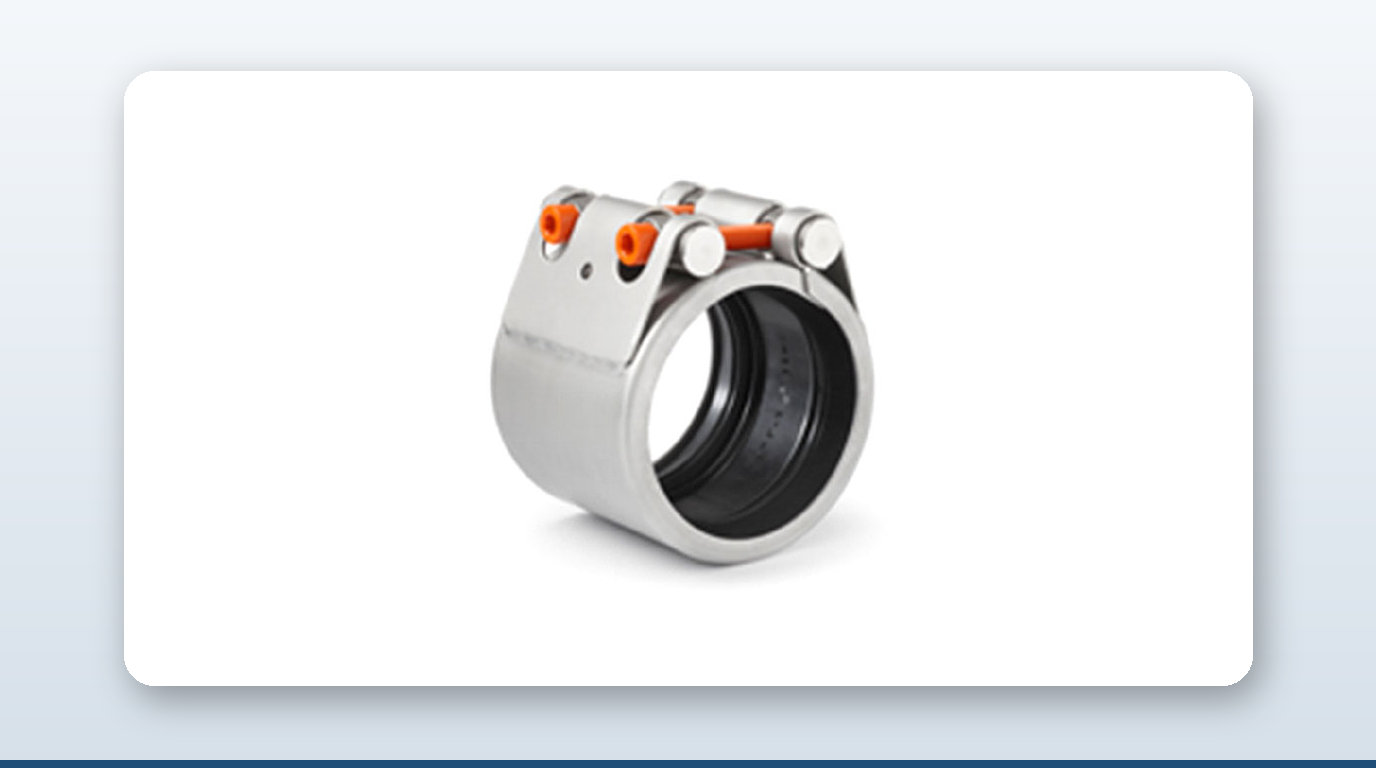
Every coupling on a pressure line eventually needs attention. The question that actually costs money is whether that attention is a five-minute gasket swap or a full coupling replacement — and plants that don’t have a clear answer tend to default to whichever is easier to schedule rather than whichever the joint actually needs. Neither over-replacing nor under-repairing is free: one wastes budget, the other risks an unplanned leak on a live line.
This guide covers what a proper pipe coupling maintenance inspection should check, the specific signs that separate a simple gasket replacement from a full coupling swap, how mechanical couplings simplify this whole process compared to welded or flanged joints, and a practical checklist to run on your next scheduled inspection.
Signs of Coupling Wear to Look For
Most coupling failures don’t happen suddenly — they show warning signs weeks or months ahead, if someone is looking for them.
Gasket degradation. Rubber gaskets harden, crack, or take a permanent compression set over time, especially in fluctuating temperature or aggressive chemical environments. A gasket that has lost its elasticity won’t re-seat properly even if the housing bolts are re-tightened. Visible cracking, a flattened cross-section, or a gasket that no longer springs back when pressed with a thumb are all signs it’s past its service life.
Bolt torque loss. Vibration, thermal cycling, and gasket creep (the gasket slowly compressing further under sustained load) all cause coupling bolts to lose torque over time. A bolt that backs off even slightly reduces gasket compression, which is usually the first mechanical cause of a slow weep before it becomes a visible leak.
Visible leaks or weeping. Even a small amount of moisture or staining at a coupling joint is a signal, not a nuisance to wipe away. Weeping usually means either bolt torque loss or gasket degradation — catching it here is far cheaper than catching it after the joint lets go under a pressure surge.
Corrosion on the housing. Surface rust on a coated or coupling housing, especially at the seam where two housing halves meet, indicates the coating has been compromised — by abrasion, chemical exposure, or age. On stainless steel housings, look for pitting or discolouration rather than uniform rust, which can indicate chloride exposure or galvanic corrosion from a dissimilar-metal contact point nearby.
Movement or misalignment at the joint. A coupling that has developed play, or where the pipe either side has visibly shifted, points to a mechanical problem beyond the coupling itself — possibly inadequate pipe support, ground settlement, or thermal expansion the system wasn’t designed to absorb.
Inspection Frequency and What to Check
Inspection frequency should scale with how critical the line is and how harsh its environment is — a buried potable water main and an exposed marine engine-room line don’t need the same schedule.
| Application | Suggested inspection interval | Priority checks |
|---|---|---|
| Marine / engine room piping | Per class survey cycle + visual check on routine rounds | Corrosion, bolt torque, visible leaks |
| Above-ground industrial process lines | Quarterly to annual, per plant maintenance schedule | Gasket condition, bolt torque, housing corrosion |
| Buried water/sewer mains | At scheduled main renewal or when a leak is reported | Joint restraint integrity, corrosion at exposed sections |
| High-vibration lines (near pumps, compressors) | More frequent than static runs — vibration accelerates bolt loss | Bolt torque specifically |
| Chemical dosing zones | Shorter interval than bulk-flow sections | Gasket chemical degradation |
At each inspection, a proper pipe coupling maintenance inspection covers four things in order: visual check of the housing and gasket seam for leaks or corrosion, a torque check on the bolts against the coupling manufacturer’s specified torque value, a check for any movement or misalignment at the joint, and a note of when the coupling was last serviced so wear can be tracked over time rather than assessed from a single snapshot.
Replace vs Repair: How to Decide
This is the decision that actually determines cost and downtime, and it comes down to whether the problem is isolated to the gasket or has affected the coupling housing and hardware.
Gasket replacement alone is usually sufficient when:
– The housing shows no corrosion, cracking, or deformation
– Bolts are still within spec after re-torquing (no stripped threads, no permanent stretch)
– The leak or weep stops once the gasket is replaced and bolts are correctly torqued
– The coupling is otherwise within its expected service life for the application
Full coupling replacement is the right call when:
– The housing shows corrosion pitting, cracking, or coating failure that exposes base metal to the fluid
– Bolt holes are worn, elongated, or bolts repeatedly lose torque even after replacement — a sign the housing itself is deforming under load
– The coupling has been over-compressed or over-torqued in the past, permanently distorting the housing geometry
– The coupling model is being retired from a plant’s approved list, or the working pressure requirement has increased beyond the original spec
– Repeated gasket failures happen faster than the expected service interval, indicating a housing or alignment problem rather than a normal-wear gasket
A useful rule of thumb: if the fix stays inside the gasket cavity, it’s a repair. If the fix touches the housing, the bolt holes, or the coupling’s structural integrity, it’s a replacement. Mixing this up — replacing a gasket on a housing that’s already compromised — just delays the same failure to the next inspection cycle.
Why Mechanical Couplings Simplify Maintenance
This whole inspect-and-decide process is dramatically simpler on mechanical couplings than on welded or flanged joints, which is a large part of why they’ve become the standard for maintainable pressure joints:
- No hot work required for replacement. Swapping a mechanical coupling is a bolt-off, bolt-on job. A welded joint failure means cutting, re-fabricating, and re-welding — hours of hot-work permits and downtime versus minutes.
- Fast swap on live-adjacent sections. Because installation doesn’t require curing time or post-weld inspection, a coupling replacement can often be scheduled inside a short isolation window rather than a full shutdown.
- Visual and mechanical inspection is straightforward. The gasket and bolts are externally accessible without cutting into anything, unlike a welded joint where internal condition can only be assessed by NDT or destructive inspection.
- Stock compatibility. Because coupling sizing follows standard OD ranges (see our guide on pipe OD and nominal bore sizing), a correctly specified replacement coupling is usually available off the shelf rather than requiring custom fabrication.
Practical Maintenance Checklist
Run this at every scheduled coupling inspection:
- Visually inspect the housing for corrosion, cracking, or coating damage
- Check for any leaking, weeping, or staining at the joint
- Verify bolt torque against the manufacturer’s specified value — not just “snug”
- Inspect the gasket where visible for cracking, hardening, or compression set
- Check for pipe movement or misalignment either side of the coupling
- Record the inspection date, findings, and any action taken for the next cycle
- Flag any coupling showing housing-level damage for replacement rather than re-gasketing
For guidance on the installation side of this — correct torque sequence, gasket seating, and alignment when a coupling is first fitted or replaced — see our pipe coupling installation guide.
When to Call a Supplier for Same-Day Replacement Stock
Some findings can’t wait for a scheduled procurement cycle — a corroded housing on a live line, a leak that’s worsening, or a coupling model being phased out mid-project. In those cases, the deciding factor is usually whether a supplier can get the correct replacement size and material on site the same day the problem is found, rather than the coupling itself. A supplier who stocks a broad size and material range locally, and can confirm compatibility against the pipe OD and existing coupling model on the phone, turns a replace decision into a same-day fix instead of a multi-day wait. See our guide to choosing a pipe coupling supplier in Singapore for what to look for.
Key Takeaways
- A pipe coupling maintenance inspection checks four things: housing condition, gasket condition, bolt torque, and joint alignment — in that order, since each rules out or confirms the next.
- Gasket degradation and bolt torque loss are the earliest warning signs — catching them at inspection is far cheaper than catching them as a leak.
- Repair (gasket swap) is enough when only the gasket has failed and the housing and bolts are sound. Replace the whole coupling when the housing, bolt holes, or structural geometry are compromised.
- Mechanical couplings simplify maintenance versus welded or flanged joints — no hot work, externally visible wear points, and straightforward bolt-off/bolt-on replacement.
- Inspection frequency should match application risk — higher for vibration-prone and chemical-dosing zones, standard for static industrial runs.
- Keep a supplier relationship for same-day replacement stock on critical lines, so an urgent replace decision doesn’t become an extended shutdown.
About David Phee Enterprise
David Phee Enterprise is the exclusive Singapore distributor for Jeong Woo Coupling (JWC) and a long-standing supplier of Aju, Romacon, and Smith-Blair pipe couplings and repair clamps, operating from Empire Technocentre in Kaki Bukit. DPE stocks a broad range of coupling sizes and gasket materials locally and supplies ship chandlers, shipyards, and industrial contractors across Singapore with same-day delivery — including urgent replacement stock when an inspection turns up a coupling that can’t wait for a standard order cycle. For a same-day stock check on a specific coupling size or model, visit davidphee.com.