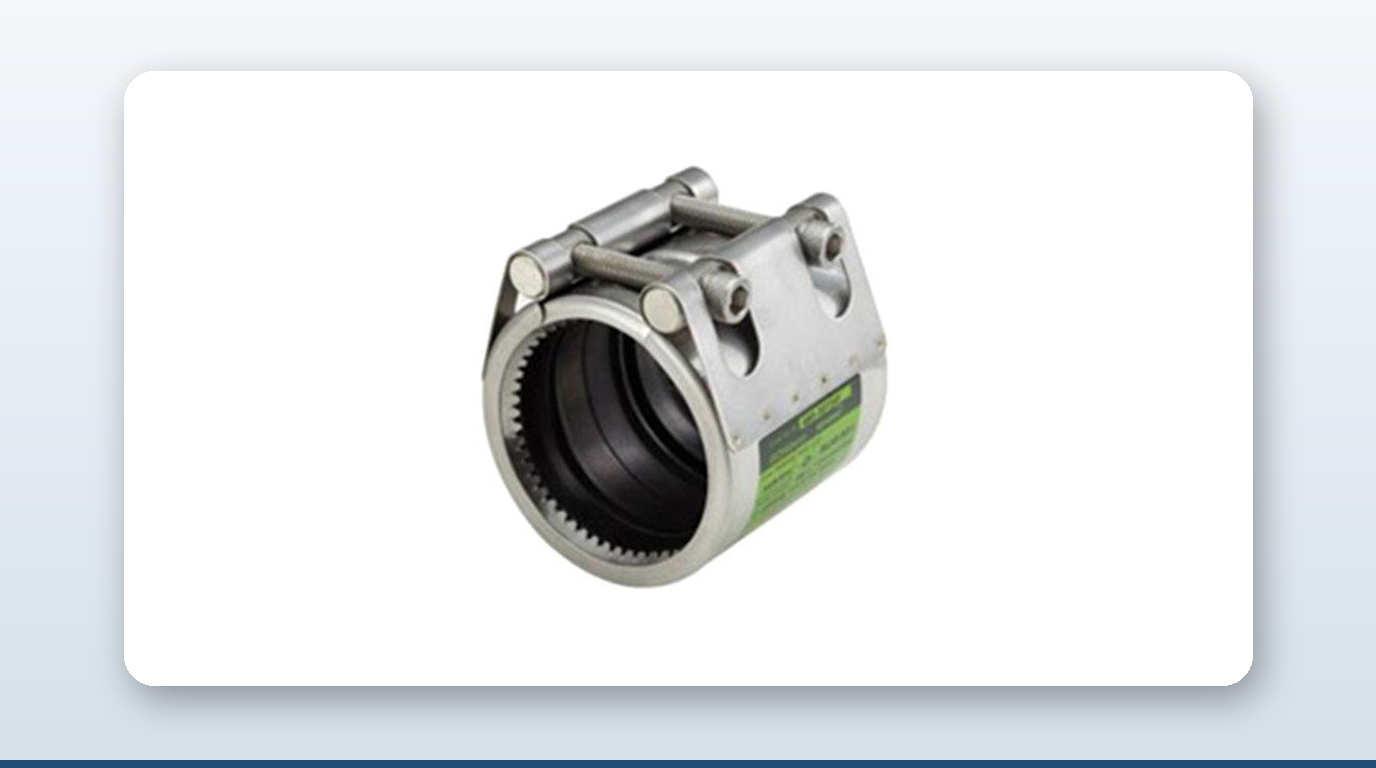
“Class” on a marine piping drawing causes more confusion than almost any other word in the spec. It has nothing to do with which classification society — ABS, DNV, LR — is surveying the vessel (see our guide on classification society Type Approval for that separate question). Piping Class is a service-severity tier defined inside IACS Unified Requirement P2, and it’s what actually determines whether a mechanical coupling is allowed on a given line at all.
All eleven IACS societies adopt the same Class I/II/III table, because UR P2 binds every member. Get the class wrong on a quote and the consequence isn’t cosmetic — a coupling that’s freely permitted on a Class III line can be flatly prohibited one class up.
How a line gets classed
IACS UR P2.2 sets the boundary using two axes — design pressure and design temperature — and the threshold depends on what the line carries:
| Service medium | Class III (both ≤) | Class I (either >) |
|---|---|---|
| Steam | 7 bar and 170°C | 16 bar or 300°C |
| Thermal oil | 7 bar and 150°C | 16 bar or 300°C |
| Fuel oil / lube oil / flammable hydraulic oil | 7 bar and 60°C | 16 bar or 150°C |
| Other media (water, air, gas, non-flammable hydraulic) | 16 bar and 200°C | 40 bar or 300°C |
Anything that falls between the two thresholds is Class II. The reading rule is important: a line is Class I if either pressure or temperature exceeds the ceiling — both don’t need to be breached. A few services are classed by definition regardless of pressure or temperature: cargo oil pipes and open-ended lines (drains, vents, exhaust) are always Class III; toxic media and flammable media above their flash point default to Class I unless specific protective safeguards are designed in; valves and fittings on the ship’s side or at a collision bulkhead are Class II minimum even at low pressure.
The sharpest fact for a coupling buyer: Class I bans slip-on couplings outright
IACS UR P2.7.4 Table 8 sets which joint types are permitted per class, and this is where the class distinction turns into a purchasing decision:
| Joint type | Class I | Class II | Class III |
|---|---|---|---|
| Slip-on — machine-grooved | Permitted | Permitted | Permitted |
| Slip-on — grip type | Not permitted | Permitted | Permitted |
| Slip-on — slip type | Not permitted | Permitted | Permitted |
| Compression coupling — swage type | Permitted | Permitted | Permitted |
Grip-type and slip-type couplings — the two families that make up most of a standard mechanical coupling catalogue — are excluded from Class I entirely. Only machine-grooved slip-on couplings qualify at that top tier. In Class II, grip-type and slip-type couplings are allowed, but only combined with Type Approval, a fire-tested certificate, and often restraint when the line sits in a Category A machinery space or carries flammable oil. In Class III, mechanical joints are freely permitted with Type Approval alone.
Housing material follows the same logic: Class I and Class II steel pipe must be seamless-drawn (or welded to an equivalent standard), which is why a coupling with an ordinary grey cast-iron housing is restricted to Class III use only, below 220°C — while 316L stainless or duplex housings can support Class II flammable-oil service provided the fire-test certificate is in place.
What this looks like on an actual vessel
Mapping typical engine-room and deck lines on a commercial cargo vessel makes the pattern concrete:
- Sea water and fresh water cooling mains (roughly 3 bar, 32°C) — Class III. Slip-on couplings freely usable.
- HFO supply to the main engine (roughly 7 bar, 95°C) — Class II, because the temperature axis alone breaches the 60°C fuel-oil threshold. A restrained, fire-tested grip-type coupling is required here, not a plain slip-type.
- Fire main (roughly 10 bar, ambient) — Class III by pressure/temperature, but fire-tested couplings are still required regardless of class wherever SOLAS Ch.II-2 essential-service rules apply.
- Starting air (roughly 30 bar, ambient) — Class II; slip-on joints are not permitted at all here, only pipe unions and compression couplings, per the same Table 8.
- Hydraulic steering gear (200–250 bar) — Class I. Mechanical joints are rarely used at all; see our comparison of mechanical couplings vs flanged joints for how high-pressure applications are usually handled instead.
LNG carriers add a further overlay: cargo piping is treated as Class I-equivalent regardless of measured pressure under the IMO IGC Code, so cargo and fuel-gas supply lines are welded and full-radiographed with mechanical couplings effectively excluded — but the vessel’s auxiliary systems (inert gas distribution, glycol cooling, fire main, sea water) remain ordinary Class II/III and stay fully quotable.
Where mutual recognition helps — and where it doesn’t
The EU RO Mutual Recognition scheme covers mechanical joints, Class III pipe fittings, and expansion joints specifically — meaning one MR-issued certificate from any single EU-recognised society covers Class III work across all of them, but only for EU-flagged vessels. Class I and Class II mechanical joints sit outside the MR product list entirely, so society-specific Type Approval remains unavoidable at those tiers regardless of flag.
Key Takeaways
- Piping “Class” (I/II/III) and classification “society” (ABS, DNV, LR) are unrelated concepts that happen to share a name — don’t conflate them when reading a spec.
- Class is set by a two-axis pressure/temperature threshold per service medium, with an OR-logic rule: either axis breaching the ceiling pushes a line to the next class up.
- Slip-type and grip-type slip-on couplings are prohibited outright in Class I — only machine-grooved slip-on joints are permitted at that tier.
- Class II mechanical joints need Type Approval plus a fire-tested certificate (and often restraint); Class III needs Type Approval alone.
- Even where a line is otherwise Class III, SOLAS essential-service requirements (fire main, for example) can still mandate fire-tested couplings regardless of class.
About David Phee Enterprise
David Phee Enterprise (DPE), based at Empire Technocentre, Kaki Bukit, supplies JWC-brand pipe couplings across the Class II and Class III range most commercial vessels actually specify — grip-type and slip-type, fire-tested and Type-Approved where required. To confirm which class and coupling type your line needs before you quote, visit www.davidphee.com or contact our team.