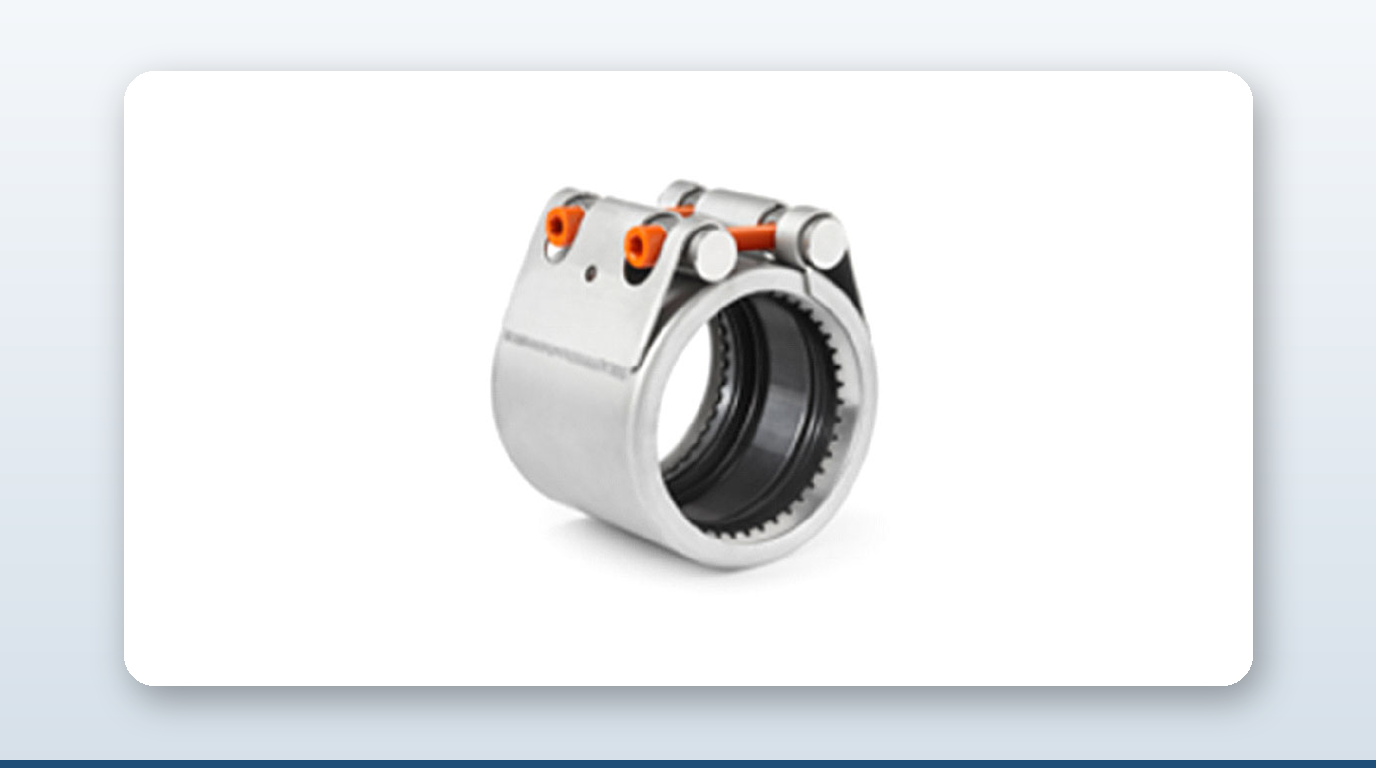
A shipyard buyer asking “is this coupling class-approved?” is really asking two separate questions at once: which classification society is surveying this vessel, and does the coupling hold a valid Type Approval Certificate (TAC) from that specific society. Confusing the two — or assuming one society’s approval covers all the others — is the single most common mistake in marine coupling procurement.
Eleven classification societies belong to the International Association of Classification Societies (IACS) and together class roughly 90% of world commercial tonnage: ABS, BV, CCS, ClassNK, CRS, DNV, IRS, KR, LR, PRS, and RINA. IACS publishes Unified Requirements — URs — that every member folds into its own rules within a year of adoption, which is why the technical bar for a coupling’s Type Approval is broadly the same everywhere, even though each society issues and administers its own certificate.
What a Type Approval actually certifies
For mechanical pipe couplings, the relevant IACS family is UR P (Piping): UR P2 sets the joint-selection and material rules, UR P2.7.4 covers mechanical joints specifically, and UR P2.11 sets the type-approval test regime. Every coupling seeking Type Approval is put through the same core test battery regardless of which society is running it — tightness (hydraulic and pneumatic), pressure impulse, burst pressure, pull-out, vacuum, and vibration testing per UR P2.11.5, plus fire resistance testing per ISO 19921 on a test bench built to ISO 19922.
The approval path is also broadly consistent: a manufacturer submits drawings, materials data and an ISO 9001 quality manual, the society reviews the design (Product Design Assessment, or PDA), witnesses prototype testing on representative sizes, audits the factory (Manufacturer Assessment, MA), and issues a single certificate covering all production at that factory — typically for five years. A shipyard buyer then accepts that certificate at face value rather than surveying every individual unit.
DNV, ABS and LR — how the three differ
These three societies cover the bulk of tonnage a Singapore-based coupling supplier will encounter, and each runs its programme slightly differently.
DNV issues a Type Approval Certificate (form TA 251) under DNV-RU-SHIP Pt.4 Ch.6, and is the strictest on renewal discipline: certificates carry a mandatory 2-year and 3.5-year periodic assessment during the 5-year term — miss one and the certificate can be suspended while still reading “valid” on paper. DNV also uniquely recognises fire-resistance for pure slip-type couplings at specific listed sizes, where most other societies confine fire-tested approval to grip-type couplings only. DNV’s registry is free and searchable at approvalfinder.dnv.com.
ABS runs its Type Approval Program as a combined Product Design Assessment plus Manufacturer Assessment, together yielding a Confirmation of Product Type Approval. The MA component requires an annual factory audit rather than DNV’s 2-year/3.5-year cadence. ABS is also the class society the US Coast Guard leans on for metal pipe couplings via its Alternate Compliance Program — USCG doesn’t run its own type-approval series for metal couplings and instead accepts the underlying class society certificate. ABS’s public registry sits at eagle.org/ABSEaglePrograms/ta/ta-search.jsp.
LR (Lloyd’s Register) certifies coupling Type Approval under Pt.5 Ch.12 of its Rules for Classification of Ships and publishes a searchable registry through its LR Approvals portal. Renewal cadence sits at the standard 5-year term with a factory audit during the period, without DNV’s fixed mid-term survey dates.
All three — along with eight other IACS societies — participate in the EU RO Mutual Recognition scheme (under EU Regulation 391/2009, Article 10), which lets a single MR-issued Type Approval on mechanical joints, Class III pipe fittings, and expansion joints be honoured across all EU-recognised societies, but only for vessels flying an EU member-state flag. Outside that flag scope, each society’s certificate stands alone — a DNV certificate does not automatically satisfy an ABS or LR surveyor on a non-EU-flag vessel, and vice versa.
Verifying a certificate before you quote
Every claim above is checkable. DNV, ABS, LR, and four of the other IACS societies run free public registries — search by manufacturer name, product family, or certificate number, and the result shows the exact scope, size range, and expiry date. A cited certificate number that doesn’t return a match, or one whose expiry has already passed, is worth flagging before a quote goes out — a manufacturer that misses DNV’s mid-term audit, for instance, can have a certificate that reads “valid through 2029” while actually suspended.
Where JWC stands
DPE’s exclusive Singapore-distributed brand, JWC (Jeong Woo Coupling), holds verified Type Approval from all seven IACS societies most relevant to regional shipyard and ship-manager specifications, each independently confirmed against certificate documentation:
- ABS PDA 25-0231088-PDA, valid through 2030-06-22
- BV 56997/B0, valid through 2029-10-07 — uniquely permits SUS316L gasket housings in addition to SUS304/316
- DNV TAP0000054 Rev.4, valid through 2029-06-30
- LR LR2481788TA, valid through 2029-09-30 — the only one of the seven with JWC’s MJD/MJDL large-bore slip family in explicit scope
- RINA MAC007322PU, valid through 2027-04-18
- ClassNK (NK) TA25707M, valid through 2030-12-23
- KR (Korean Register) CWN25263-PE002, valid through 2030-06-15
Fire-resistance scope varies by society and coupling family — grip-type MJG and slip-grip MJSGL are fire-tested across all seven, while DNV additionally recognises the pure slip-type family (MJS/MJL/MJSF) as fire-tested at specific listed sizes, a scope none of the other six societies extend to. That distinction matters when a spec calls for a fire-tested coupling in a Category A machinery space — see our guide on Class I, II and III marine piping for how piping class interacts with fire-test requirements.
Key Takeaways
- A classification society (who surveys the vessel) and a Type Approval Certificate (what the coupling holds) are two separate questions — never assume one automatically covers the other.
- DNV, ABS and LR all certify couplings against the same IACS UR P2/P2.11 test battery, but differ in audit cadence: DNV requires mandatory 2-year and 3.5-year mid-term surveys, ABS requires an annual factory audit, and LR follows the standard 5-year term.
- Public, free registries exist for DNV, ABS, LR and several other IACS societies — verify a cited certificate number and expiry before quoting rather than trusting a brand’s own claim.
- The EU RO Mutual Recognition scheme lets one certificate cover multiple societies, but only for EU-flagged vessels — non-EU flag work needs a society-specific certificate regardless.
- JWC holds independently verified Type Approval from all seven IACS societies most relevant to this region, with DNV uniquely extending fire-tested scope to JWC’s pure slip-type coupling family.
About David Phee Enterprise
David Phee Enterprise (DPE), based at Empire Technocentre, Kaki Bukit, is the exclusive Singapore distributor for JWC (Jeong Woo Coupling) — a brand with verified marine Type Approval from all seven of the region’s most-cited classification societies. For a classed-vessel coupling quote with the exact certificate number your surveyor needs, visit www.davidphee.com or contact our team directly.