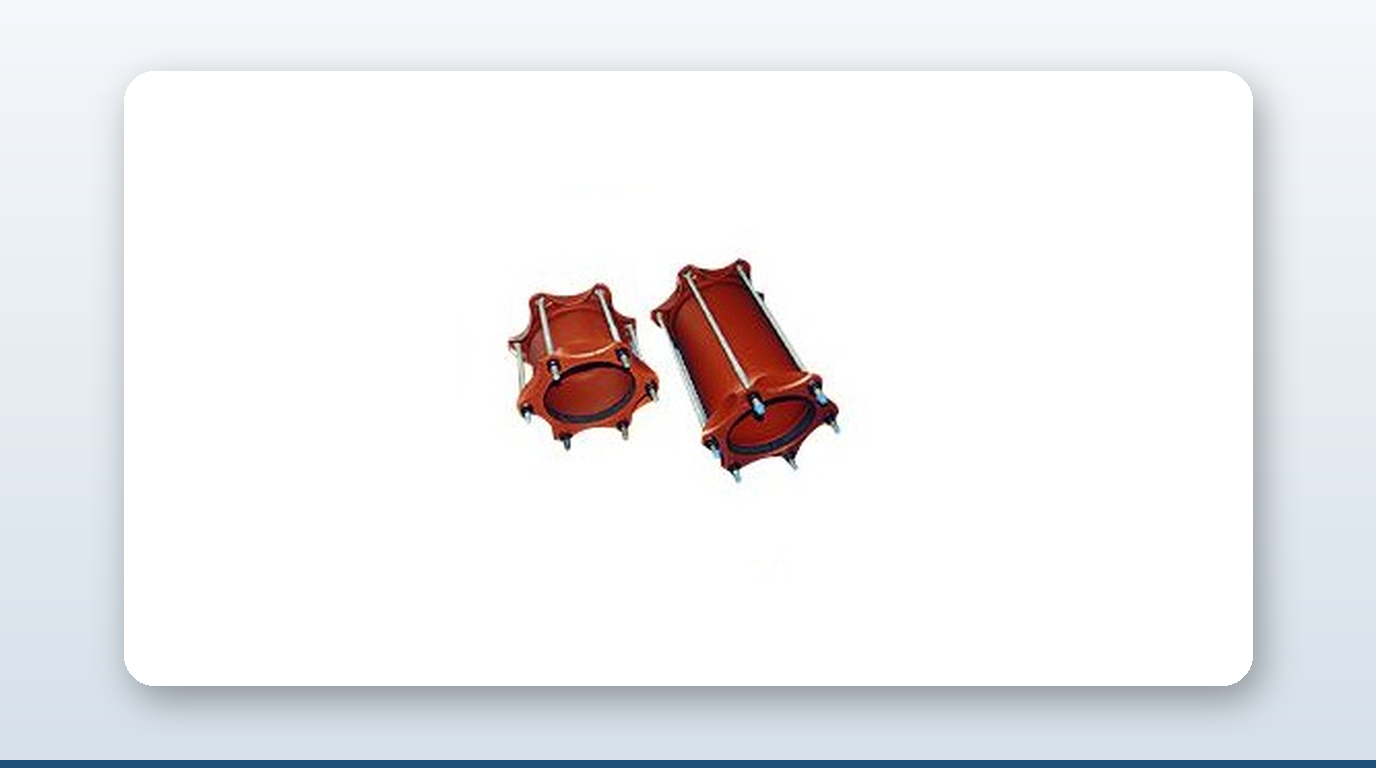
A pipe coupling joint is a small geometric trap. Three different metals — housing, bolts, and the pipe itself — meet there, separated only by a thin elastomer gasket, sitting in chloride-rich seawater. When those metals aren’t compatible, galvanic corrosion pipe coupling failure can take out a carbon-steel housing in as little as six months while the pipe it’s bolted to shows no damage at all. This isn’t a coupling defect — it’s a materials-pairing mistake made at the spec stage, and it’s entirely preventable once you understand the four conditions that drive it.
This article works through what actually happens at a mixed-metal coupling joint: the galvanic series that ranks which metals are “noble” and which are “active” in seawater, the area-ratio effect that decides which part dies first, the MIL-STD-889 potential-difference thresholds that define a compatible pairing, a reference table for common housing-and-pipe combinations, bolt-grade selection, and the insulation-kit hardware that breaks the electrical path before it becomes a warranty claim.
The Four Conditions That Create a Galvanic Cell
A galvanic cell only exists when all four of the following are present at once:
1. Two electrochemically different metals — an anode and a cathode with different free-corrosion potentials. 2. A metallic electrical connection between them — bolts touching housing touching pipe, with no isolation. 3. A conductive electrolyte wetting both — seawater, brackish water, condensate, or even humid salt-laden air. 4. Continuous oxygen access at the cathode to support the reduction reaction.
Remove any one of these four and the cell stops working. Every mitigation described below — insulation kits, gasket choice, cathodic protection — is really just a way of breaking one of these four conditions, usually #2 or #3. At a marine coupling joint, all four are present by default unless the designer specifies otherwise.
Reading the Galvanic Series in Seawater
Metals are ranked by their free-corrosion potential in flowing, aerated seawater, measured against a saturated calomel electrode (SCE). The further apart two metals sit on this scale, the stronger the driving force for corrosion current between them.
| Metal (most noble → most active) | Approx. potential vs SCE (mV) | Coupling relevance |
|---|---|---|
| Titanium | +100 to +200 | Premium naval/FPSO coupling housings |
| 316L (passive) | −50 to +50 | Standard marine housing material |
| 304L (passive) | −50 to +100 | Fresh-water only |
| 70/30 cupronickel | −150 to −50 | Naval/desal pipe |
| 90/10 cupronickel (UNS C70600) | −200 to −100 | Most common commercial SW pipe |
| Nickel-aluminium bronze (NAB) | −250 to −180 | Naval SW piping |
| 316L (active — in a tight crevice) | −350 to −500 | The “active 316” cliff |
| Carbon steel / cast iron | −600 to −700 | Never bare on CuNi or duplex without isolation |
| Zinc anode | −1000 to −1100 | Engineered sacrificial element |
As a working rule: two metals within roughly 150 mV of each other behave as a compatible couple in marine service. Two metals separated by more than 300 mV are a galvanic time bomb without isolation.
Area Ratio: Why the Smaller Part Fails First
The corrosion rate of the anodic (corroding) metal rises roughly in proportion to the ratio of cathode surface area to anode surface area. A small anode wired to a large cathode is the worst possible configuration — every oxygen-reduction event on the big cathodic surface has to be balanced by metal loss somewhere, and if the anode is small, that loss concentrates fast.
Worked example — the classic failure mode. A carbon-steel housing (DN 200, wetted internal area ≈ 0.138 m²) is fitted onto a 30 m run of 90/10 CuNi pipe (DN 200, wetted internal area ≈ 18.6 m²) on a seawater cooling main.
| Surface area | CS housing (anode) | CuNi pipe (cathode) |
|---|---|---|
| Wetted area | 0.138 m² | 18.6 m² |
| Cathode : anode ratio | — | 135 : 1 |
| Expected corrosion rate on the housing | ~0.5–1.5 mm/yr, localized perforation in 6–18 months | negligible |
The housing is a small anode coupled to a vast cathode, and it dies long before the pipe shows any sign of attack. The reverse geometry — a small, noble 316L housing on a large carbon-steel pipe — is actually benign, because the small noble area can’t drive enough current to damage the much larger anodic surface. The rule of thumb: large-anode/small-cathode is fine; small-anode/large-cathode is catastrophic.
MIL-STD-889 Compatibility Thresholds
MIL-STD-889 defines the maximum permissible potential difference for a dissimilar-metal couple to be considered “compatible,” scaled to service environment.
| Environment | Max permissible potential difference | Applicability |
|---|---|---|
| Harsh — outdoor, salt-spray, marine atmosphere | 0.15 V | Any deck piping, seawater, ballast, or fire-main joint |
| Normal — uncontrolled indoor/industrial | 0.25 V | Engine-room piping above the bilge |
| Controlled — temperature/humidity regulated | 0.50 V | Not applicable aboard a vessel |
Read against real coupling pairings: 316L (passive) vs 90/10 CuNi sits at roughly 100–200 mV — just inside the 0.15 V harsh-environment limit, acceptable provided gasket isolation is intact. Carbon steel vs 90/10 CuNi sits at roughly 400–500 mV, three to four times over that limit — an insulation kit is mandatory. 304 (A2-70) bolts against a passive surface in chloride service sit right at the cliff edge.
Classification society rules echo this in less prescriptive form. ABS, DNV, LR, BV, ClassNK, and KR all require, in their own wording, that dissimilar metals in contact be galvanically compatible or electrically isolated — but none of them specify which housing-pipe-bolt combination to actually use. That burden sits with the designer and supplier.
Material Pairing at the Coupling Joint
A quick reference for common housing-and-pipe combinations at a marine coupling:
| Pipe material → | CuNi 90/10 | Duplex 2205 / 2507 | 316L stainless | Carbon / cast iron |
|---|---|---|---|---|
| 316L (A4-80) housing | Acceptable, isolation prudent | Compatible | Same material | Housing is cathode — CS pipe corrodes preferentially |
| Carbon steel housing (bare) | Galvanic death — dies in 6–18 months | Same | Same | Matched, no couple |
| Carbon steel housing + full insulation kit | Acceptable | Acceptable | Acceptable | Matched |
| Duplex 2205 housing | Housing is cathode, modest CuNi pipe wastage on short runs | Matched | Acceptable | Severe — CS corrodes |
| Titanium housing | Housing is cathode, strong driver — CuNi pipe wastage at the joint | Similar | Similar | Catastrophic on CS |
Two less obvious failure patterns hide in this table: the pipe itself can corrode preferentially right at the coupling shoulder when the housing is the more noble metal (seen on NAB pipe fitted with an unisolated 316L housing), and bolts can fail silently — losing pre-load and letting the gasket relax — long before anyone suspects the gasket itself.
Bolt Selection: The Silent Failure Point
The bolt is the smallest piece of metal in the joint and carries the highest stress, so galvanic loss there has an outsized effect: lost pre-load means a relaxed gasket, which means a leak that’s often misdiagnosed as a gasket failure.
| Bolt grade | Material | Specification rule |
|---|---|---|
| A2-70 | 304L | Not for seawater, ballast, or fire-main service — fresh-water and topside use only |
| A4-80 | 316L | Standard for all seawater/ballast/fire-main/BWTS coupling joints |
| Duplex 2205 | 22Cr-5Ni-3Mo | Premium; cycling service; SCC-resistant; long-term FPSO |
| Monel K-500 | Ni-Cu age-hardened | Best choice on CuNi pipework when budget allows |
| Hot-dip galvanised CS | Zn-coated CS | Not for seawater — galvanic nightmare once the zinc layer breaches |
Austenitic stainless bolts (304 or 316) under tensile pre-load in chloride water above roughly 50°C are also vulnerable to chloride stress-corrosion cracking, independent of the galvanic question. The working rule: A4-80 below 50°C, duplex 2205 for continuous service above 50°C (main-engine seawater outlets, jacket-water heat-exchanger lines), and Monel K-500 for naval or NAB pipework where budget allows.
Insulation Kits: Breaking the Electrical Path
A flange isolation kit electrically separates the housing from the pipe and from the bolts — it’s the practical tool for breaking condition #2 above.
| Component | Function | Notes |
|---|---|---|
| Insulating gasket | Isolates housing face from pipe face while sealing | G-10 fibreglass laminate is the marine default; avoid graphite-bearing gaskets on stainless — graphite is electropositive and accelerates pitting |
| Bolt sleeves (one per bolt) | Isolate bolt shank from the flange bore | G-10 or PTFE; Mylar has the highest dielectric strength but fails earlier mechanically |
| Insulating washers | Isolate bolt head/nut from the flange face | Must be paired with a steel backup washer, or bolt torque crushes the washer and restores metal contact |
| Steel backup washers | Distribute bolt load over the insulating washer | Omitting this is the single most common field-installation error |
| Bore-sealing element (optional) | Seals the flange-ID-to-gasket-ID gap against electrolyte ingress | Adds cost; recommended for cycling service and chlorinated seawater |
Other field errors that silently void a kit: a misaligned sleeve letting the bolt shank touch the flange bore, graphite-based anti-seize used on insulating surfaces (it’s conductive), metal shavings or mill scale bridging the gasket face, and a damaged sleeve from over-torque. The verification step that catches all of these: measure DC resistance across the joint with a megger after torque-up. A reading below 1 megohm means the kit has failed somewhere and needs to be re-investigated.
Inspection: Catching Galvanic Corrosion Before It Leaks
| Sign | Typical location | Stage |
|---|---|---|
| White/chalky/green deposit on housing exterior under gasket overhang | Bilge side of SW coupling | Early (months 3–6) |
| Bolt-head pitting, missing zinc plating | Bolt heads in saline atmosphere | Early |
| Bolt-thread discolouration | Thread engagement | Mid (months 6–12) |
| Housing wall thinning at the gasket footprint (detectable by UT) | Inside the housing under the gasket | Mid-late |
| Pin-hole leak at gasket trailing edge | Housing OD trailing the gasket | Terminal |
The standard detection methods are a DC resistance check with a megger across the housing-to-pipe interface (part of any dry-docking inspection on a kitted joint), a half-cell potential survey for a snapshot reading at each fitting, and ultrasonic thickness surveys at coupling shoulders and bolt-engagement zones scheduled alongside the routine pipe survey.
Key Takeaways
- – A galvanic cell needs all four of: dissimilar metal potentials, metallic electrical contact, a conductive electrolyte, and oxygen access at the cathode — removing any one stops the corrosion.
- – Area ratio decides which part fails first: a carbon-steel housing on a 30 m run of 90/10 CuNi pipe faces a 135:1 cathode-to-anode ratio and can perforate in 6–18 months.
- – MIL-STD-889 sets 0.15 V as the maximum compatible potential difference for harsh marine service; carbon steel against 90/10 CuNi sits 3–4 times over that limit, while 316L against CuNi sits within it.
- – A4-80 (316L) bolts are standard below 50°C; duplex 2205 bolts are specified above 50°C because chloride stress-corrosion cracking becomes a separate risk at elevated temperature.
- – Omitting the steel backup washer under an insulating washer is the single most common field error that defeats a flange isolation kit.
- – A megger reading below 1 megohm across an insulated joint means the isolation kit has failed and needs re-investigation — this should be a standard dry-docking check.
About David Phee Enterprise
David Phee Enterprise is the exclusive Singapore distributor for JWC pipe couplings, stocked at Empire Technocentre, Kaki Bukit for same-day delivery, alongside Romacon repair clamps and Smith-Blair couplings for the flanged, bolted joints where dissimilar metals meet across a coupling housing, bolt circle, and gasket. For coupling specs or certification documentation on any of these ranges, contact DPE or browse the full catalogue at davidphee.com. Related reading: seawater pipe coupling material selection and pipe coupling bolt torque specs.