Two AWWA standards get quoted in water-utility pipe specifications, and they are easy to confuse because both cover “mechanical couplings” in a general sense. AWWA C219 and AWWA C606 in fact cover two structurally different families of product, and knowing which one names your coupling — and which one your supplier simply cannot enter — saves time on every water-utility enquiry.
This article sets out what each standard actually specifies, why C606 sits outside most flexible-coupling suppliers’ range entirely, and how the two standards are treated in Singapore, Malaysia, and Indonesia specifications.
AWWA C219: The Standard for Bolted Sleeve-Type Couplings
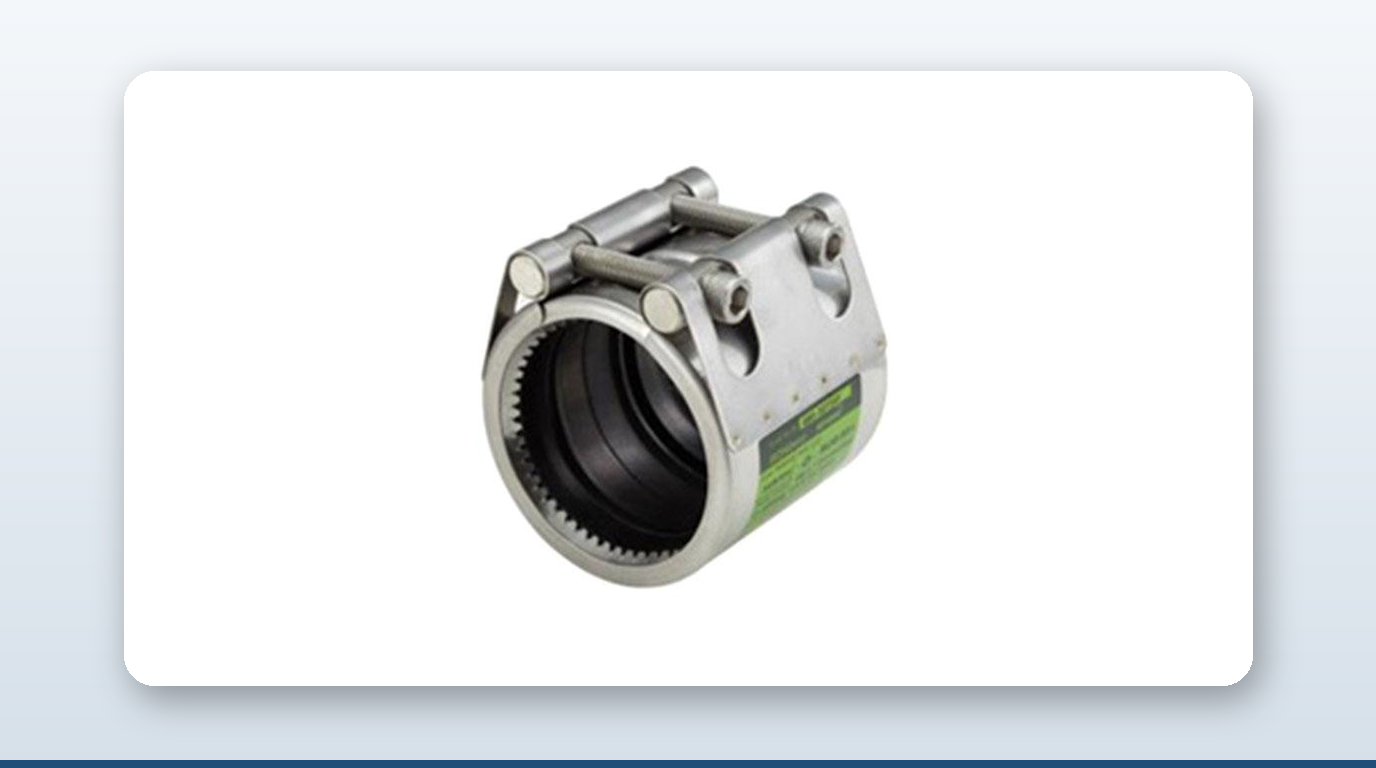
ANSI/AWWA C219 — Bolted, Sleeve-Type Couplings for Plain-End Pipe — covers bolted sleeve-type (slip-on) couplings, reducing or transition couplings, and flanged-coupling-adaptors used to join plain-end pipe in water and wastewater systems, from ½ in. and up. This is the standard that names the general product family a flexible pipe coupling belongs to.
C219 specifies the mechanical fundamentals: sleeve/middle-ring and follower-ring materials (commonly ductile iron to ASTM A536, carbon steel, or stainless steel), gasket compounds (typically NBR or EPDM), bolting (to AWWA C111 / ANSI A21.11 or equivalent high-strength low-alloy grades), gasket-seating geometry, and hydrostatic proof testing. Fabricated welded sleeves also undergo a cold-expansion test to verify weld integrity. Typical pressure ratings for water-utility flanged-coupling-adaptors run 150–275 psi depending on construction.
C219 also covers restraint: beyond the standard non-restrained joint (which relies on external thrust blocking), optional anchor studs or restrained variants let a flanged-coupling-adaptor resist axial thrust directly — useful in buried mains where a concrete thrust block isn’t practical.
AWWA C606: The Grooved-Joint World (and Why It’s a Different Product)
ANSI/AWWA C606 — Grooved and Shouldered Joints — covers a completely different mechanical architecture: grooved ductile-iron pipe from 4–36 in., grooved steel/aluminium/brass pipe of IPS dimensions from ¾–24 in., and the fittings that key into a roll-grooved or cut-grooved pipe end. This is the Victaulic-style world of piping, common in treatment-plant process galleries, pump-house manifolds, and any run where an engineer has standardised on grooved-end assembly for speed.
The critical distinction: a C606 grooved coupling requires the pipe itself to be grooved. A plain-end flexible coupling — the C219 product family — is not dimensionally or functionally interchangeable with a C606 grooved joint, no matter how mechanically capable it is. When a spec calls for C606, a supplier without a grooved-end product line simply does not bid that line item; there is no substitution path.
The Layer C219 Doesn’t Cover: Potable-Water Contact
The single most important limit of AWWA C219 is what it does not say anything about: whether the coupling is safe in contact with drinking water. C219 is a mechanical and structural standard — it proves the joint holds pressure and is dimensionally sound. Potable-water safety is a separate certification layer entirely: NSF/ANSI 61 in the US, and in Singapore, the SS 375 + ASTM F1476 + AS-NZS 4020 stack administered by PUB.
This means a coupling can be fully C219-compliant and still be legally excluded from a potable water main if it lacks the contact certification. The two layers are independent, and a supplier quoting into a potable-water job needs both — mechanical conformance alone is not the whole answer. Our guide to ISO, JIS, and BS coupling standards covers how this same structural-standard-versus-contact-certification split shows up across other regional standard families.
Where C219 and C606 Sit in Singapore, Malaysia, and Indonesia
AWWA C219 is globally recognised, but it is not the primary named coupling standard in any of Singapore, Malaysia, or Indonesia — the region’s water-utility specs are rooted in BS-EN, Singapore Standards, and JKR lineage rather than AWWA.
| Jurisdiction | Primary coupling standard | Where AWWA C219 fits |
|---|---|---|
| Singapore (PUB) | BS-EN / SS (Stipulation of Standards & Requirements) | Recognised as a supporting credential, not the named ticket; the potable gate is SS 375, not C219 |
| Malaysia (JKR/SPAN) | JKR Standard Specifications (BS-rooted) | Secondary; AWWA appears mainly in steel-tank specs, not couplings |
| Indonesia (PDAM/PUPR) | SNI, with international references cited alongside | The most AWWA-receptive of the three — international standards including AWWA are commonly cited in tender specs |
In practice, this means a C219 claim is worth carrying as a trust-builder on any water-utility enquiry with a US-influenced consultant, or on an Indonesian tender that names international references, but it will not substitute for the jurisdiction’s own potable-contact certification, and it does not appear as the named standard in a typical Singapore or Malaysia spec.
A Naming Trap Worth Knowing: Romacon vs Romac
Anyone researching AWWA C219 couplings online will quickly run into products described as “meets AWWA C219” from a company called Romac Industries, based in Washington, USA. This is worth flagging explicitly because the name is easy to confuse with Romacon Pipeline Products B.V., a Netherlands-based manufacturer of stainless-steel repair clamps and tapping saddles — a completely separate, unrelated company. Romacon’s product line does not include AWWA C219 flanged-coupling-adaptors and does not carry a C219 claim; its certifications are ACS, WRAS, BS, and KTW, aimed at repair and tapping scope rather than new-installation couplings. If a project specifically needs a C219-tested flanged-coupling-adaptor, that is a different product category from a Romacon repair clamp, and the two should never be conflated in a quote.
Key Takeaways
- AWWA C219 covers bolted sleeve-type couplings, reducing couplings, and flanged-coupling-adaptors on plain-end pipe — the general product family most flexible pipe couplings belong to.
- AWWA C606 covers grooved and shouldered joints and requires grooved-end pipe; a plain-end flexible coupling cannot substitute for a C606 grooved assembly under any circumstances.
- C219 is a mechanical/structural standard only — it says nothing about potable-water contact safety, which is a separate certification (NSF/ANSI 61 in the US, SS 375 in Singapore).
- None of Singapore, Malaysia, or Indonesia name AWWA C219 as their primary coupling standard; it functions as a supporting credential, strongest in Indonesia’s more AWWA-receptive tender environment.
- Romacon (Netherlands, repair clamps) and Romac Industries (USA, C219-tested couplings) are unrelated companies — don’t let the similar name attach a C219 claim to the wrong product.
About David Phee Enterprise
David Phee Enterprise (DPE) is a Singapore-based pipe coupling specialist at Empire Technocentre, Kaki Bukit, established in 1990 and the exclusive Singapore distributor for JWC couplings. DPE supplies flexible sleeve-type and flanged-coupling-adaptor products across the water-utility, industrial, and marine sectors, with straightforward guidance on which certification a given project actually requires. Visit davidphee.com to discuss a specific spec.