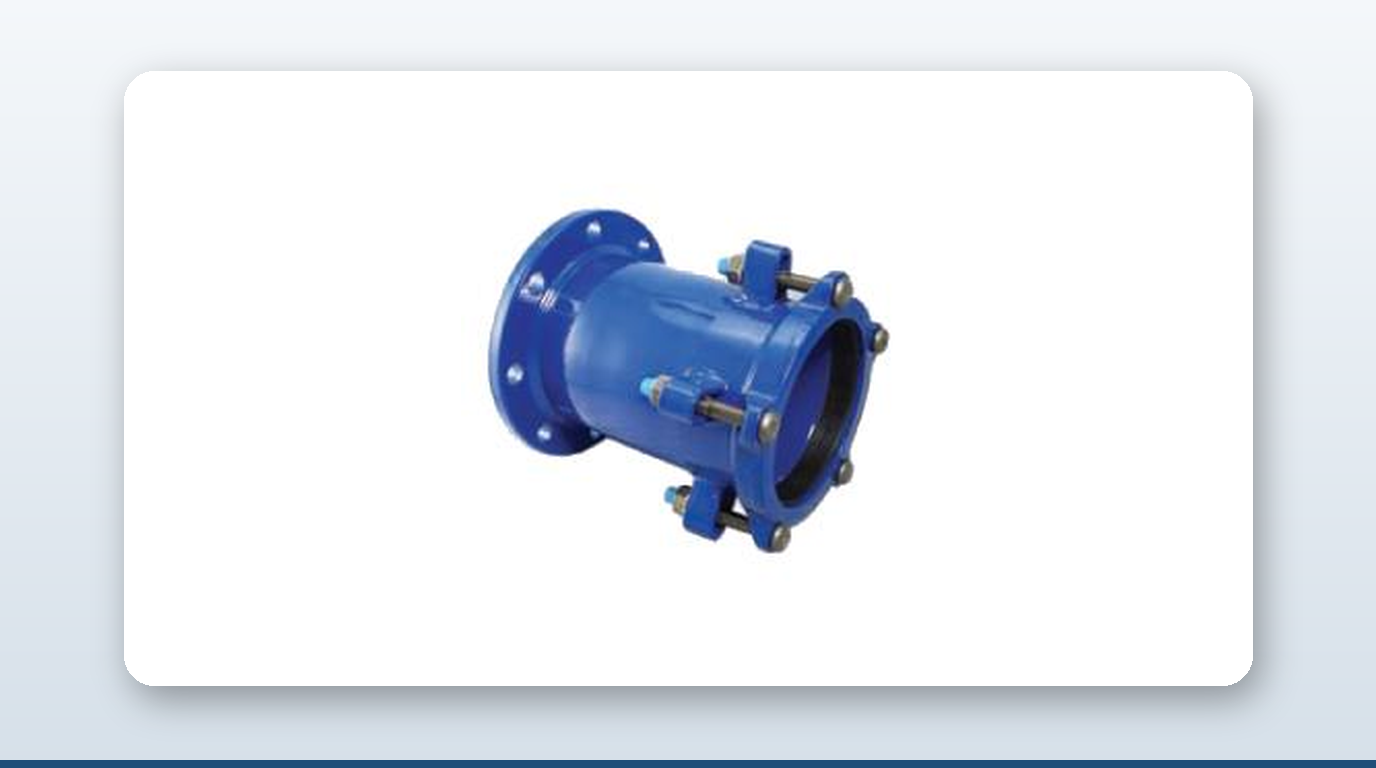
A pipe coupling’s torque value tells you how tight to make the joint. It doesn’t tell you what the coupling body and bolts are actually made of — that’s a separate question, governed by a different set of standards: ASTM A536 for the ductile-iron body, and ASTM A193 / A194 for the bolting. If you’ve read our bolt torque guide, this article is the companion piece — the material spec beneath the torque number, not a repeat of it.
These three standards are what a spec-conscious buyer’s QA team actually checks on a mill certificate before accepting a shipment. Knowing what they specify — and where the real differentiator sits — matters more than reciting the grade names.
ASTM A536: What the Coupling Body Is Made Of
ASTM A536 — Standard Specification for Ductile Iron Castings — covers the ductile (nodular) iron used for coupling bodies, middle-rings, sleeves, and followers. Each grade is named by three numbers: minimum tensile strength (ksi), minimum yield strength (ksi), and minimum elongation (%). The industry-default grade for coupling housings is 65-45-12 — 65 ksi tensile, 45 ksi yield, 12% elongation, supplied as-cast with no heat treatment.
Ductile iron earns its place in pressure-retaining parts because of how it’s made: a magnesium treatment during casting turns the iron’s graphite into round nodules instead of sharp flakes. Round nodules don’t concentrate stress or seed cracks the way flakes do, which gives ductile iron roughly twice the strength and dramatically more toughness than plain grey cast iron. That ductility matters directly for a bolted coupling body, which must hold internal pressure and absorb the bolts’ clamping load without cracking.
Why Ductile Iron Needs a Coating
Bare ductile iron is not corrosion-resistant on its own. For any buried, wet, or coastal application — which describes most of Singapore’s water-utility and industrial piping — the casting must carry a protective coating. The water-utility default is fusion-bonded epoxy (FBE), applied to standards like AWWA C116 or C213, which is tough, corrosion-resistant, and improves flow by smoothing the bore. Some brands use a nylon (Rilsan) coating instead as their standard finish.
This is worth stating plainly: an A536 65-45-12 body with no coating, or the wrong coating for the service, is a corrosion failure waiting to happen in Singapore’s humid, coastal ground. The base grade is table stakes — every reputable coupling maker meets it. The coating specification is where the real difference between suppliers shows up.
ASTM A193 and A194: The Bolting Standards
A mechanical coupling is clamped shut by bolts, and those bolts are governed by two companion standards: ASTM A193 for the studs/bolts and ASTM A194 for the nuts.
| Grade | Material | Typical use |
|---|---|---|
| A193 Grade B7 | Chromium-molybdenum alloy steel, quenched and tempered — 125 ksi min tensile / 105 ksi min yield | The default carbon-steel bolt for both flanged joints and mechanical couplings; used in the large majority of installations |
| A193 Grade B8 | Austenitic 304 stainless | Corrosive or high-temperature service |
| A193 Grade B8M | Austenitic 316 stainless (molybdenum-bearing) | Coastal, marine, or chloride-exposed service — the molybdenum content resists chloride pitting significantly better than 304 |
| A194 Grade 2H | Heavy-hex nut, deliberately stronger than a B7 stud | Standard companion to B7 — designed so the stud fails before the nut strips |
| A194 Grade 8 / 8M | Stainless nuts | Pair with B8 / B8M respectively |
The canonical fastener pairing worth memorising is A193 Grade B7 stud with two A194 Grade 2H heavy-hex nuts — the default bolting for the overwhelming majority of carbon-steel flanged joints and standard couplings alike.
Stepping Up for Coastal and Marine Service
Where full-stainless bolting isn’t specified, coated B7 is the cheaper corrosion path — and the bolt is often the first component to fail on a buried or coastal coupling, even when the body itself is properly FBE-coated. Options include:
- Hot-dip galvanizing (ASTM A153 / F2329) — a thick sacrificial zinc layer, suitable for general buried or outdoor service.
- PTFE / Xylan fluoropolymer coating — a petrochem and offshore favourite, rated for over 4,000 hours of salt-spray exposure and prized for being anti-galling, so bolts can still be removed years later.
- 316 stainless (B8M / 8M) — the strongest option for continuous chloride exposure, such as submerged or splash-zone service.
For Singapore’s coastal, humid, and buried conditions specifically, the practical rule is: default to 316 stainless or PTFE/Xylan-coated B7 for any seawater, coastal, or buried coupling, and treat bare uncoated B7 as a corrosion risk that should be flagged rather than accepted quietly.
What Each Brand Actually Uses (The Material Isn’t Uniform)
Because A536 65-45-12 and B7/2H bolting are the industry defaults, a “we meet A536” claim on its own doesn’t distinguish one supplier from another — every reputable maker does. What does vary, brand to brand, is the actual body material:
- Ductile-iron body brands typically cite ASTM A536 (or the equivalent BS EN 1563 grade used by European manufacturers) for the housing, paired with FBE or nylon coating.
- Stainless-body brands — including JWC, DPE’s hero product line — use stainless steel (grades in the 304/316 family) for the coupling casing itself rather than a coated ductile-iron body. This is a different corrosion strategy, not an inferior one: stainless doesn’t need an FBE coating because the corrosion resistance is inherent to the base metal, but it also means an A536 grade claim simply does not apply to a stainless-bodied coupling, and shouldn’t be quoted for one.
The lesson for buyers: ask for the material test report (mill certificate with heat number and actual mechanical values) and the coating specification, rather than accepting a grade name at face value. That documentation — not the grade itself — is what a QA inspector actually checks. See our stainless vs carbon steel comparison for how these two body-material families compare more broadly, and our corrosion material selection guide for the wider selection logic.
Key Takeaways
- ASTM A536 grade 65-45-12 is the industry-default ductile-iron body material for coupling housings — but bare ductile iron needs a corrosion coating (typically FBE) for any buried or coastal service.
- ASTM A193 Grade B7 studs with ASTM A194 Grade 2H nuts are the standard bolting pair for most flanged joints and couplings alike.
- Step up to 316 stainless (B8M/8M) or PTFE/Xylan-coated B7 for coastal, marine, or chloride-exposed bolting — bare B7 is a genuine failure mode in Singapore’s climate.
- Stainless-bodied couplings (including JWC) don’t use ASTM A536 at all — their corrosion resistance comes from the base metal, not a coating.
- The material test report and coating specification matter more than the base grade name — every reputable maker meets the base grade.
About David Phee Enterprise
David Phee Enterprise (DPE) is a Singapore-based pipe coupling specialist at Empire Technocentre, Kaki Bukit, and the exclusive Singapore distributor for JWC couplings, established in 1990. DPE can advise on the right bolt material and coating for coastal, marine, or buried service, and supplies documentation to support QA acceptance. Visit davidphee.com for the current product range.