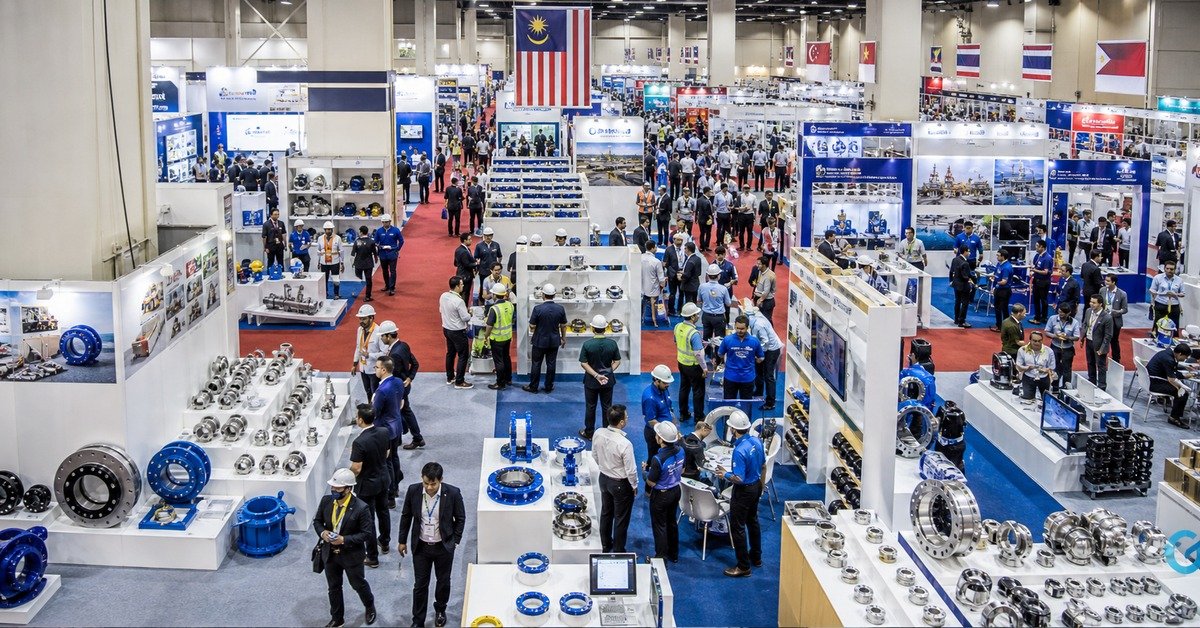
OGA — Oil & Gas Asia — is the largest oil and gas trade exhibition in Southeast Asia. It runs biennially in Kuala Lumpur and draws procurement teams, EPC contractors, and national oil companies from across the region. For pipe fitting suppliers eyeing Malaysia and Indonesia as growth markets, OGA KL is the most concentrated single opportunity to engage buyers, assess competition, and position stock.
This article covers what OGA is, who attends, what buyers at the show are looking for from pipe fitting suppliers, and how Singapore-based distributors fit into the ASEAN supply chain conversation.
What OGA KL Is
OGA (Oil & Gas Asia) is a biennial trade exhibition held at the Kuala Lumpur Convention Centre (KLCC). The show has run since 1981 and is co-located with other industrial events, making it one of the most concentrated procurement gatherings in the ASEAN O&G calendar.
Key facts:
| Feature | Detail |
|---|---|
| Frequency | Every two years (biennial) |
| Location | Kuala Lumpur Convention Centre (KLCC), Malaysia |
| Sectors | Upstream, midstream, downstream O&G; EPC; MRO |
| Attendance | Typically 30,000+ trade visitors across 3–4 days |
| Key buyers | Petronas, Pertamina, EPC contractors, MRO buyers, ship chandlers |
The show is not a consumer event. It is procurement-focused — buyers attend with specific material requisition lists, supplier evaluation checklists, and budget authority. If you are exhibiting, expect to spend more time on technical validation than on marketing collateral.
Who Attends — The Buyer Landscape
Understanding who walks the floor tells you how to position as a pipe fitting supplier.
National oil companies (NOCs) — Petronas (Malaysia) and Pertamina (Indonesia) procurement teams attend to survey suppliers, validate approved vendor lists (AVLs), and assess alternatives to existing contracts. Getting onto a NOC AVL at OGA typically requires a prior history of certified supply and a local entity or appointed distributor in-country.
EPC contractors — Companies like Technip Energies, McDermott, and local contractors attend for project-specific procurement. They move fast during active tender phases and are looking for verified stock, price competitiveness, and delivery capability.
MRO and maintenance buyers — Maintenance, Repair, and Operations buyers are looking for routine pipe fittings — couplings, flanges, repair clamps — available at short notice. These buyers often have the most flexibility to try a new supplier if the price and lead time are right.
Malaysian and Indonesian distributors — Regional distributors use OGA to find new product lines and assess Singapore-based principals. If you are a Singapore distributor seeking to appoint regional sub-agents, this is the floor where those conversations start.
What Buyers Want from Pipe Fitting Suppliers
Based on the profile of ASEAN O&G procurement, buyers at OGA KL are looking for three things from a pipe fitting supplier:
1. Certifications and Documentation
ASEAN O&G buyers — particularly those dealing with offshore platforms, process piping, and hazardous fluid systems — require certified product. The certifications that come up most often:
- Material Test Reports (MTRs) — confirming the chemical and mechanical properties of the base material
- EN / ASME standards compliance — especially for pressure-rated components
- ABS, BV, or DNV Type Approval — for marine and offshore applications
- Third-party inspection reports — some NOC procurement requires factory inspection evidence
If your products can’t be supported with documentation at the booth, the conversation ends. Prepare a documentation pack before the show — not after.
2. Regional Stock and Fast Delivery
Buyers in Malaysia and Indonesia have been burned by suppliers who promise delivery and fail. The question they ask at OGA is not “do you have it?” — it’s “where is the stock right now?”
Singapore-based distributors have a structural advantage here. Singapore’s position as a regional logistics hub means same-day or next-day dispatch to Johor Bahru, and two-to-three-day air freight to Jakarta or Surabaya, is realistic for stocked items. That speed is a genuine differentiator versus suppliers shipping direct from Korea, Europe, or the US.
3. Cross-Referencing Ability
ASEAN O&G projects frequently arrive with existing specifications — a Victaulic style number, a Dresser coupling reference, or a Straub part code — and a buyer needs to know whether you can supply an approved equivalent. The ability to cross-reference between brands on the spot, at the booth, with technical documentation to back it up, builds credibility immediately.
This is where carrying a multi-brand inventory — rather than a single-brand catalogue — matters. A supplier who can cross-reference JWC against Victaulic or confirm an EPDM gasket equivalent for a Straub Flex coupling is solving a real procurement problem, not just selling a product.
Singapore’s Position in the ASEAN Supply Chain
Singapore operates as the regional hub for industrial distribution across ASEAN. For pipe fitting suppliers, this means:
- Inventory is held in Singapore and dispatched to Malaysia, Indonesia, and beyond
- Export documentation — packing lists, Certificates of Origin, export permits — is handled at the Singapore end
- Technical support is centralised, with product knowledge and datasheet capability in one location
- Currency and payment — USD and SGD transactions, Letters of Credit for larger orders, and trade credit facilities are more straightforward from Singapore than from in-country distributors
Malaysian and Indonesian buyers who have experienced supply chain failures from in-country suppliers often find that a Singapore-based principal with confirmed regional stock is more reliable than a local entity that drops ships from overseas without holding inventory.
Trends Worth Watching at OGA KL
Certification requirements tightening — Petronas’s vendor qualification process has become more rigorous since 2020. AVL entry without third-party documentation is increasingly difficult. Expect this trend to continue across the NOC community.
Sustainability and material traceability — More ASEAN O&G projects are requiring full material traceability from mill cert to installation point. Suppliers who have this documentation chain in place are at an advantage in tender scoring.
Plain-end coupling demand in emerging markets — In markets where roll-grooving infrastructure is limited, plain-end coupling systems (JWC MJG, Straub, Dresser) have a practical advantage. Grooved systems require a grooving machine on site — a constraint that doesn’t apply to plain-end designs. This is relevant for Indonesia and Malaysia, where site infrastructure varies widely. See rigid vs flexible grooved coupling for context on where grooved systems are specified.
Practical Advice for First-Time Exhibitors and Visitors
For exhibitors:
- Pre-schedule meetings with key procurement contacts before the show opens. Walk-ins at the booth are valuable but not sufficient for NOC-level buyers.
- Bring physical samples in the most common sizes. Buyers in O&G trust what they can hold.
- Have your documentation ready: MTRs, product datasheets, certifications. Requesting these post-show adds friction at the worst moment.
- Consider sharing booth space with a complementary supplier (gaskets, flanges, expansion joints) to cover a wider procurement list.
For visitors:
- Identify two or three specific procurement problems you want to solve before attending. Without a focused brief, OGA’s scale can be overwhelming.
- Use the show to validate alternative suppliers — not to replace relationships, but to understand the market before your next tender.
- Bring your technical specs. On-the-spot cross-referencing conversations are more productive than follow-up email chains.
Key Takeaways
- OGA KL is the most concentrated single opportunity for pipe fitting suppliers to engage ASEAN O&G buyers — Petronas, Pertamina, EPC contractors, and MRO teams attend with active procurement needs
- Buyers prioritise certifications (MTRs, ABS/DNV), confirmed regional stock, and cross-referencing ability — none of these can be assembled after the show
- Singapore distributors hold a structural advantage in ASEAN supply: inventory depth, export documentation capability, and logistics speed to Malaysia and Indonesia
- Plain-end coupling systems have a practical edge in emerging-market O&G sites where roll-grooving infrastructure is limited
- First-time exhibitors should pre-schedule meetings, bring physical samples, and arrive with documentation packs — not marketing brochures
About David Phee Enterprise
David Phee Enterprise supplies pipe couplings, expansion joints, and repair clamps from Singapore to Malaysia, Indonesia, and broader ASEAN markets. For technical cross-referencing, regional stock availability, or export documentation, contact DPE for a same-day quotation.