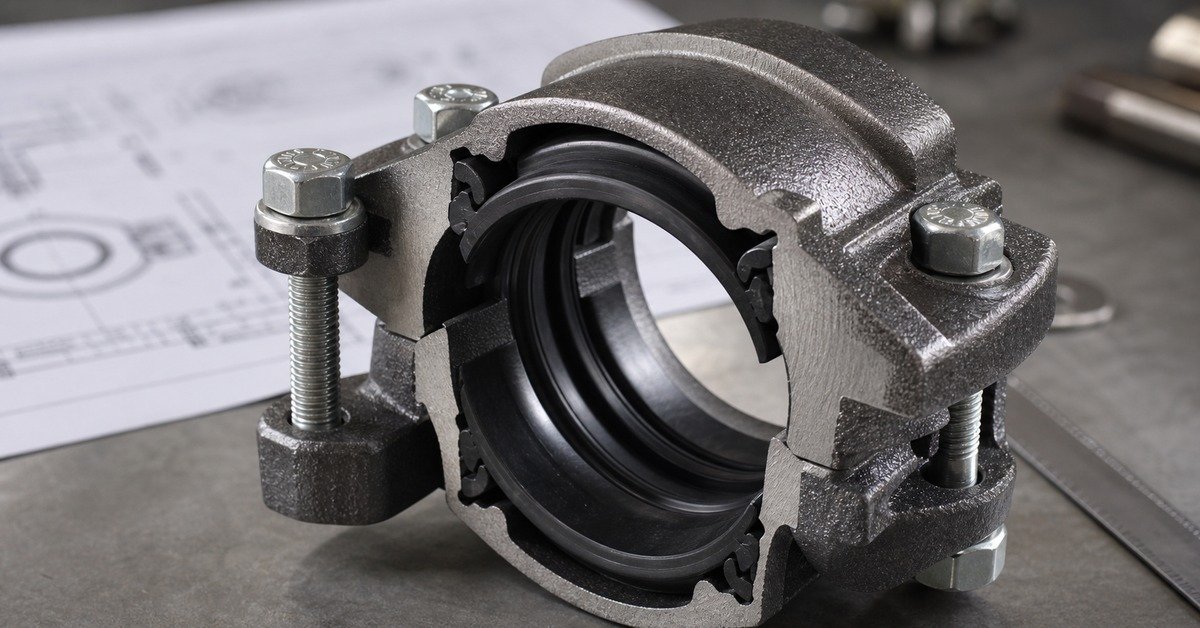
Pressure rating is one of the most misread specifications on a pipe coupling datasheet. Buyers sometimes treat PN16 as a ceiling and nothing more. In practice, it affects bolt torque, gasket selection, temperature limits, and whether the system will hold under test conditions. Getting it wrong doesn’t just fail inspection — it can mean a burst coupling in a live water or gas line.
This article covers how PN ratings work, what the difference is between working pressure and test pressure, how ratings change with temperature, and how to match JWC MJS and MJG couplings to the right pressure class for your project.
What PN Ratings Actually Mean
PN stands for Pressure Nominale — a European standard designating the maximum allowable working pressure at 20°C in bar.
The common classes are:
| PN Rating | Working Pressure (bar) | Working Pressure (psi) | Typical test pressure |
|---|---|---|---|
| PN6 | 6 bar | ~87 psi | 9 bar |
| PN10 | 10 bar | ~145 psi | 15 bar |
| PN16 | 16 bar | ~232 psi | 24 bar |
| PN25 | 25 bar | ~363 psi | 37.5 bar |
| PN40 | 40 bar | ~580 psi | 60 bar |
The conversion factor is 1 bar ≈ 14.5 psi. For most pipe coupling work in Singapore — building services, HVAC, water infrastructure — PN10 and PN16 cover the overwhelming majority of applications.
PN is a rating of the system, not just the housing. The weakest component in the assembly — gasket, bolts, pipe wall — determines the actual system pressure class.
Working Pressure vs Test Pressure
These two numbers appear on the same datasheet and are frequently confused.
Working pressure is the maximum pressure the coupling is designed to sustain continuously under normal operating conditions. This is the PN number.
Test pressure is the pressure applied during hydrostatic testing to verify integrity before installation. It is typically 1.5× the working pressure and is held for a defined duration (commonly 30 minutes for pipe system pressure tests).
Applying test pressure as though it were a working pressure rating will overload the system. A PN16 coupling has a test pressure of 24 bar — that 24 bar figure is not the ceiling for continuous operation.
For projects governed by SS EN standards or ASME B31 codes, the engineer of record will specify both figures in the system design. If a coupling datasheet only lists one number, confirm with the supplier whether it is working or test pressure before committing to the spec. See pipe coupling datasheets for what to look for when reading a manufacturer document.
JWC MJS vs MJG: Pressure Rating Comparison
JWC manufactures two primary plain-end coupling types relevant to Singapore industrial and marine work:
| Coupling | Type | Typical working pressure | Notes |
|---|---|---|---|
| JWC MJS | Flexible/slip | PN10 (10 bar) | Plain-end pipe, angular deflection allowed |
| JWC MJG | Grip-ring | PN16 (16 bar) | Internal grip rings resist axial pull-out |
| JWC MJGL | Long grip-ring | PN16 (16 bar) | Extended body for additional joint stability |
| JWC MJD | Reducing | PN10–PN16 | Depends on size configuration |
If a project requires PN16 at the coupling, the MJG or MJGL is the correct JWC choice — not the MJS. For a full breakdown of which model to select, see the MJG vs MJS vs MJD comparison.
The MJG also provides mechanical restraint against axial loads, which the MJS does not. In pressure applications where joint movement is not desirable, the grip-ring design is the right starting point.
How to Read a Pressure Rating on a Datasheet
A coupling datasheet will typically list:
- Maximum working pressure (MWP) — continuous operating limit, the PN figure
- Test pressure — hydrostatic test value, usually 1.5× MWP
- Temperature range — the range over which the rated pressure applies
- Gasket material — NBR, EPDM, or Viton, each with different upper temperature limits
Look for the temperature qualification alongside any pressure figure. A PN16 rating at 20°C is not the same as a PN16 rating at 80°C. At elevated temperatures, the rubber gasket softens and the effective pressure rating drops.
Temperature Derating and Gasket Effects
Rubber gaskets are the critical pressure-limiting element at elevated temperatures. As temperature increases, gasket hardness decreases, sealing performance degrades, and the effective pressure rating falls.
General derating guidelines by gasket material:
| Gasket material | Max continuous temperature | Notes |
|---|---|---|
| NBR (Nitrile) | ~80°C | Good for water and mild hydrocarbons; degrades in ozone |
| EPDM (Ethylene Propylene) | ~120°C | Good for hot water, steam lines, and UV exposure |
| Viton (FKM) | ~150°C | Chemical resistance, high-temperature O&G service |
If your system operates above 60°C, confirm the coupling’s rated pressure at operating temperature, not just at 20°C. The manufacturer’s derating curve (pressure vs temperature chart) should be in the datasheet. If it isn’t, request it.
For a full breakdown of gasket material selection, see NBR vs EPDM vs Viton gaskets.
What Happens When Pressure Rating Is Exceeded
Exceeding a coupling’s working pressure does not usually produce immediate catastrophic failure. What happens instead:
- Gasket extrusion — the rubber gasket is forced outward past the housing lips, initiating a leak.
- Bolt yielding — over-pressurised bolts stretch beyond their elastic limit, losing clamping force.
- Housing deformation — in extreme cases, the ductile iron housing cracks at stress concentration points near the bolt lugs.
The failure mode is usually a slow leak before a sudden burst, but this depends on whether the system was correctly hydrotested. A coupling that was never properly tested can fail suddenly under pressure surges — water hammer in particular can produce transient pressures two to three times the static working pressure. Always confirm that the coupling’s working pressure rating allows adequate margin above expected surge pressure.
Specifying the Right Pressure Rating
When writing a project specification or preparing an RFQ, include:
- Static working pressure — the continuous operating pressure in bar or psi
- Surge or test pressure — the maximum transient or test pressure expected
- Operating temperature — to confirm gasket material suitability
- Fluid type — water, oil, gas, or chemical — which determines gasket material
- Pipe OD and nominal bore — to confirm housing sizing. See the pipe coupling size chart for OD reference tables.
A well-written RFQ that includes these five parameters gets a faster, more accurate quotation and avoids the back-and-forth that delays orders.
FAQ
What is the difference between PN10 and PN16?
PN10 allows a maximum working pressure of 10 bar (approximately 145 psi) at 20°C. PN16 allows 16 bar (approximately 232 psi). PN16 components are rated for higher pressure service and are typically built with thicker housings and stronger bolt hardware.
Is the test pressure the same as the working pressure?
No. Test pressure is typically 1.5× the rated working pressure and is applied only during commissioning or periodic testing — not during normal operation.
Can I use a PN10 coupling on a PN16 system?
No. The coupling must meet or exceed the pressure class of the system. A PN10 coupling on a PN16 system is under-rated and may fail at test pressure or during a pressure surge.
Does gasket material affect pressure rating?
Not directly, but at elevated temperatures, softer or degraded gaskets reduce the effective sealing performance. Always confirm the coupling’s derating curve at operating temperature for high-temperature service.
Key Takeaways
- PN ratings denote maximum working pressure at 20°C in bar — PN10 = 10 bar, PN16 = 16 bar, PN25 = 25 bar
- Test pressure is 1.5× working pressure and applies only during hydrostatic testing, not continuous operation
- JWC MJS is rated to PN10; JWC MJG and MJGL are rated to PN16 — match the coupling to the system pressure class
- Rubber gasket material determines the temperature ceiling above which pressure ratings derate — EPDM handles up to ~120°C, Viton up to ~150°C
- Always include static pressure, surge pressure, temperature, and fluid type in your RFQ to get an accurate coupling specification
About David Phee Enterprise
David Phee Enterprise is the exclusive Singapore distributor for Jeong Woo Coupling (JWC). For pressure rating queries, datasheet requests, and coupling selection for specific system pressures, contact DPE directly for technical support and same-day quotations.