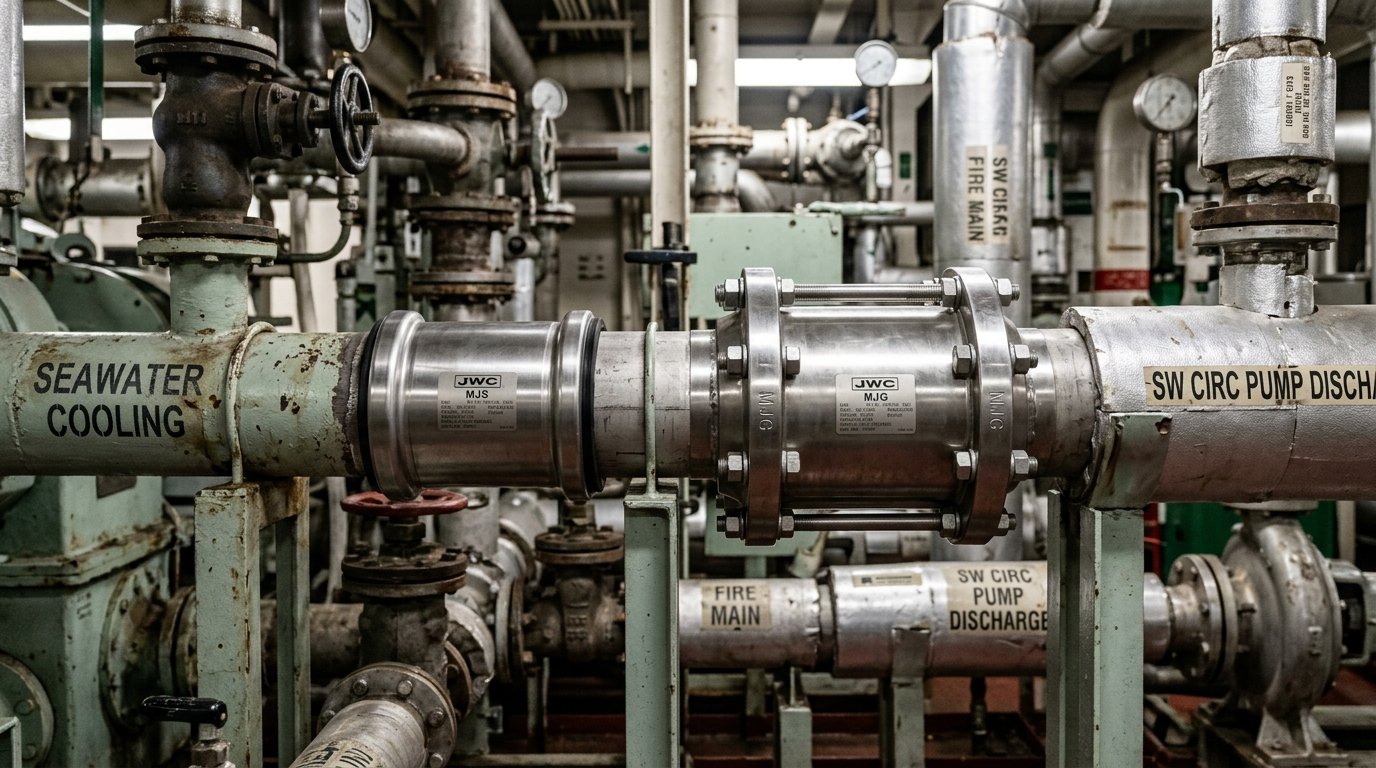
Flexible vs rigid pipe coupling selection in marine and oil & gas service comes down to more than a product catalogue — the wrong type on a pump discharge line will walk itself apart under thrust, while an axially restrained coupling on a long thermal run will buckle the pipe instead of absorbing it. The distinction reduces to one mechanical principle: a flexible (slip) coupling seals the joint and lets the pipe move axially; a rigid (grip) coupling seals and anchors against pull-out. Getting that call right is the entry point for every subsequent decision about gasket compound, pressure class, and class-society certification.
This guide covers the two main families — JWC’s slip series (MJS/MJL) and grip series (MJG/MJGL/MJGF/MJGFL) — and the hybrid MJSGL, and maps each to the shipboard systems where they belong. It draws on JWC’s type-approval certificates across seven IACS class societies (ABS, BV, DNV, KR, LR, NK, RINA), so the guidance reflects what the certificates actually say, not generic supplier claims.
The Core Difference: Axial Restraint
The JWC slip coupling (MJS/MJL) is axially non-restrained. A rubber gasket compressed inside a stainless casing seals against the pipe surface; there is no grip ring. The pipe end can slide axially within the coupling — up to 5 mm at 15A–175A, 10 mm at 200A–500A, and 15 mm at 550A and above. That movement is the feature: it absorbs thermal expansion, vibration, misalignment, and pump-induced noise (JWC data: over 60% noise reduction versus a welded joint). The trade-off is that the coupling cannot resist longitudinal force. If the pipe is under axial thrust from a pump, a pressure surge, or thermal contraction in an anchored run, a slip coupling must be accompanied by a pipe anchor or thrust block — the coupling will not hold the pipe.
The JWC grip coupling (MJG/MJGL/MJGF/MJGFL) adds a SUS 301H spring-steel grip ring inside the casing. As the bolts are tightened, the ring’s teeth engage the pipe outside diameter and lock it against pull-out. The joint is axially restrained: it seals and holds. This eliminates the need for a thrust block at the coupling itself, making it the correct choice wherever the pipe must not move — pump discharge flanges, branching tees, exposed deck runs, or any transition from a flexible section back to fixed pipe. The MJSGL is the slip-grip hybrid: grip on one end, slip on the other, used where a single joint must anchor one pipe while permitting movement in the other.
For a full model-by-model comparison, see MJG vs MJS vs MJD couplings.
Typical Shipboard Systems by Type
Flexible (Slip) Coupling Applications
Seawater cooling (Class III). Engine-room seawater circuits run long horizontal runs with pumps at each end. Thermal cycling between tropical port water (~30 °C) and deep-ocean intake can produce 3–8 mm of axial growth on a 10-metre carbon-steel run. MJS or MJL couplings at each pump connection absorb this without stressing the pump flanges. Gasket: NBR — seawater and oil-contaminated environments are NBR territory. Casing: SUS 316 recommended for seawater exposure; SUS 304 acceptable for sheltered runs.
Fresh water cooling (Class III). FW cooling circuits use inhibited water — typically MAN-specification nitrite/borate mix. EPDM is the correct gasket here; NBR is degraded by nitrite/borate inhibitor and should not be used on FW cooling lines.
Bilge and ballast (Class III). Both are Class III piping systems where the full JWC slip range applies. Ballast water post-BWTS treatment is chlorinated; specify SUS 316 housings and consider HNBR gaskets if chlorine exposure is sustained.
Engine-room vibration isolation. Fit a slip coupling at the pump suction and discharge, and locate the first rigid pipe support at least five pipe diameters downstream — the 5D rule that isolates structure-borne vibration (most yards get it wrong). A single MJS or MJL at each pump connection measurably reduces the noise and stress propagation along the pipe run. David Phee Enterprise holds stock across the common sizes for same-day supply to ship chandlers and shipyards.
Rigid (Grip) Coupling Applications
Pump discharge lines. Any line leaving a pump under sustained pressure carries axial thrust — especially on high-head centrifugal pumps. A slip coupling on a pump discharge will progressively walk off the pipe unless a thrust block is fitted. The MJG grip coupling eliminates that risk: the grip ring anchors against pull-out, and the coupling tolerates up to 4° angular deflection at 65A–175A for practical alignment.
Fuel oil and lube oil (Class I/II). Fuel and lube oil lines are Class I/II piping and require a fire-endurance-tested coupling for Category-A machinery spaces and pump rooms. The JWC MJG with FRC (fire-resistant cover) satisfies the ISO 19921/19922 requirement at 800 °C / 30 minutes — see the FRC section below. Gasket: FKM (Viton) for hot oil above ~80 °C; NBR for ambient-temperature lube and fuel oil lines.
Deck runs and exposed locations. Above-deck piping on merchant vessels and offshore installations is subject to wave loading, thermal swings, and occasional mechanical impact. Grip couplings, anchored at both ends of the span, prevent the pipe from telescoping under load.
O&G process piping. In offshore and FPSO process piping, unrestrained joints at flowline branches or instrument tapping points are a pull-out risk. Grip couplings with NBR or FKM gaskets provide a no-hot-work mechanical joint suitable for no-weld permit zones.
Gasket Selection by Media
Gasket compound is the most failure-prone variable in marine coupling selection. The coupling casing survives most environments; the wrong gasket degrades invisibly and fails in service.
| Fluid / media | Recommended gasket | Notes |
|---|---|---|
| Seawater | NBR | Standard seawater and salt-spray compatible |
| Fuel oil (diesel, IFO) | NBR | Petroleum-based; EPDM not compatible |
| Lube oil | NBR | As fuel oil |
| Fresh water (inhibited) | EPDM | NBR degraded by nitrite/borate inhibitor |
| Fresh water (uninhibited) | EPDM | Default clean-water gasket |
| Hot oil / high-temperature process > ~80 °C | FKM (Viton) | BV certifies FKM to −18 °C / +300 °C |
| Aggressive chemicals | FKM (Viton) | Widest chemical resistance |
| Ballast (post-BWTS, chlorinated) | HNBR or NBR | Confirm chlorine concentration |
The DNV type-approval certificate (TAP0000054 Rev.4) explicitly states that EPDM is NOT for hydrocarbon applications. This is not a caution note — it is a certification exclusion. A coupling with EPDM gaskets on a fuel oil or lube oil line is out of scope for the DNV type approval.
For a full chemical compatibility breakdown, see NBR vs EPDM vs Viton gasket guide.
Class-Society Approvals and the FRC Fire Cover
JWC grip and slip families hold current type-approval certificates from seven IACS class societies: ABS, Bureau Veritas, DNV, Korean Register, Lloyd’s Register, ClassNK, and RINA. Both the grip (MJG/MJGL/MJGF) and slip (MJS/MJL) ranges appear on most certificates for Class II and III piping systems.
The FRC fire-resistant cover extends the MJG and MJGF to 800 °C / 30-minute fire endurance, qualifying them for fire mains and flammable-media lines per IACS UR P2.11 / P2.7.4 and ISO 19921:2005 / 19922:2005. One important nuance: fire-rated scope is per society and per size — not a single blanket coverage.
| Society | MJG + FRC fire-rated sizes | MJGF + FRC fire-rated sizes | Pure slip (MJS/MJL) fire-rated? |
|---|---|---|---|
| ABS | 15A–300A | 65A–300A | No |
| BV | Per Pt C Ch 1 Sec 10 Table 17 | Same | No |
| DNV | 20A–300A | 65A–300A | Yes — specific sizes only (NBR gasket) |
| LR | 15A–500A | Not explicit (covered under MJG family) | No |
| NK | 15A–300A | 65A–300A | No |
| KR | 15A–300A | 65A–300A | No |
| RINA | 20A–100A (NBR) | Not in RINA scope | No |
DNV is the only society that fire-tests the pure slip family (MJS at specific sizes from 20A to 200A; MJL at selected sizes from 40A to 500A) with an NBR gasket. For all other societies, only the grip family with FRC qualifies for fire mains and Category-A fire exposure. Never specify MJS+FRC as fire-rated unless the vessel is DNV-classed and the size is on the DNV-listed set.
For a full breakdown of JWC grip model specifications, including pressure ratings and installation tolerances, see JWC grip-type couplings: MJG, MJGL, MJGF and MJGFL.
Choose Flexible When… / Choose Rigid When…
This is the selection decision reduced to its practical form:
| Condition | Flexible (Slip) MJS/MJL | Rigid (Grip) MJG/MJGL/MJGF |
|---|---|---|
| Thermal expansion or pipe growth expected | Yes — absorbs axial movement | No — rigid restraint will stress pipe |
| Pump connection — vibration and noise isolation | Yes — slip absorbs pump vibration | Not the primary choice |
| Fresh water / potable water with inhibitor | Yes — EPDM gasket | Yes — with EPDM gasket |
| Seawater cooling, ballast, bilge (Class III) | Yes — NBR gasket | Yes — NBR gasket |
| Pump discharge — axial thrust present | No — must be anchored separately | Yes — grip ring resists pull-out |
| Fuel oil / lube oil / O&G process lines | Yes (with NBR) — not fire-rated without FRC | Yes — MJG + FRC for fire-rated requirement |
| Fire main (ISO 19921/19922 required) | DNV-classed vessels only, specific sizes | Yes — MJG / MJGF + FRC, all 7 societies |
| Exposed deck run — mechanical loading | Only with anchors fitted | Yes — grip locks pipe in place |
| Emergency repair, no-hot-work zone | Yes (fast install) | Yes — both are plain-end, no welding |
| Pressure exceeds standard MJG at that size | n/a | Yes — step up to MJGF / MJGFL Force casing |
The slip-grip hybrid MJSGL fills a specific niche: one end grips a fixed pipe (pump flange side), the other end allows axial movement (the free run side). It carries fire-rated coverage on select societies and sizes in the same pattern as the grip family.
Pressure Ratings: Slip vs Grip Compared
Slip (MJS/MJL) and grip (MJG/MJGL) families carry identical ship working pressures at the same nominal diameter — the grip ring does not reduce pressure capacity. Both step up to the Force casing (MJSF/MJSFL and MJGF/MJGFL) for higher-pressure duties.
| ND | MJS / MJG — Ship | MJS / MJG — Industrial | MJSF / MJGF — Ship | MJSF / MJGF — Industrial |
|---|---|---|---|---|
| 65A–125A | 14 bar | 28 bar | 16 bar | 32 bar |
| 150A | 12 bar | 24 bar | 16 bar | 32 bar |
| 200A | 8 bar | 16 bar | 12 bar | 24 bar |
| 250A | 8 bar | 16 bar | 10 bar | 20 bar |
| 300A–350A | 7 bar | 14 bar | 10 bar | 20 bar |
| 400A | 6 bar | 12 bar | 8 bar | 16 bar |
Ship ratings carry a ≥4× burst safety factor; industrial ratings ≥2×. At large bores, the Force casing recovers 30–50% of the pressure capacity lost to diameter — at 200A, MJGF (ship) rates at 12 bar versus 8 bar for standard MJG.
Key Takeaways
- Flexible (slip) couplings absorb movement; rigid (grip) couplings resist it. The slip coupling (MJS/MJL) seals but lets the pipe move axially — correct for thermal expansion and vibration isolation. The grip coupling (MJG/MJGL/MJGF/MJGFL) seals and locks the pipe against pull-out — correct for pump discharge, thrust points, and fire-rated duty.
- The gasket compound is the most critical variable. NBR for seawater, fuel, and lube oil; EPDM for fresh water and inhibited cooling circuits (never on hydrocarbons — explicitly excluded by DNV certification); FKM/Viton for high-temperature oil and aggressive chemicals.
- FRC fire-resistant cover qualifies MJG/MJGF for fire mains across all seven IACS societies — but fire-rated scope is per society and per size. For DNV-classed vessels, the pure slip family (MJS/MJL) also qualifies at specific sizes with NBR. Check the certificate.
- Pressure ratings are equal for slip and grip at the same nominal size. Step to the Force casing (MJSF/MJGF) when the line pressure exceeds the standard rating at that diameter.
- Both coupling types are plain-end, no-hot-work fittings — they install with hand tools on a square-cut pipe end without welding, grooving, or threading.
About David Phee Enterprise
David Phee Enterprise is the exclusive Singapore distributor for Jeong Woo Coupling (JWC) and a long-established supplier of Aju, Romacon, and Smith-Blair couplings, repair clamps, and expansion joints. Operating from Empire Technocentre in Kaki Bukit, DPE supplies ship chandlers, MV vessels, and shipyards across Singapore, Malaysia, and Indonesia — holding the JWC flexible and rigid marine ranges in SUS 304 and SUS 316 for same-day delivery on stocked sizes, with gasket selection and class-society certificate support for marine and O&G procurement. Visit davidphee.com for datasheets, certificates, and stock checks.