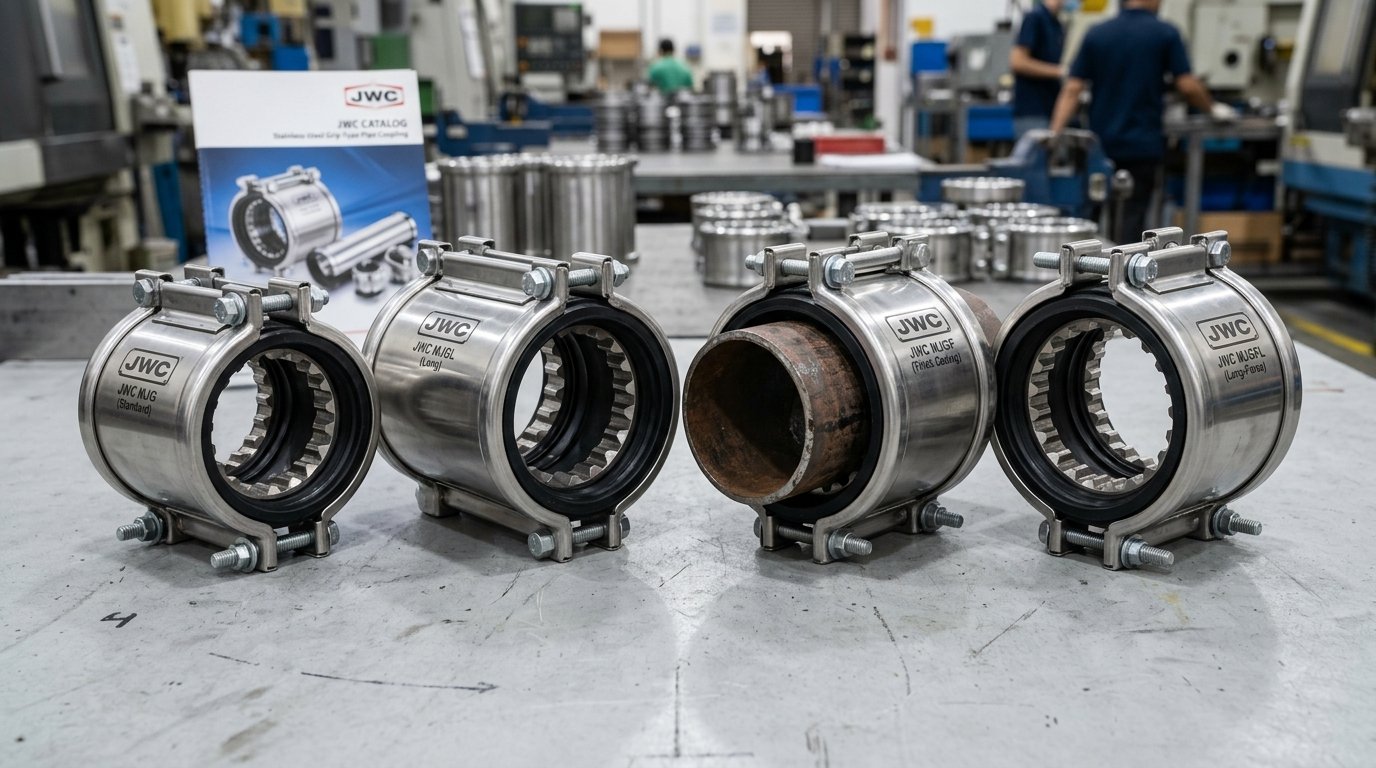
A JWC grip type coupling does one thing a standard flexible coupling cannot: it physically grips the pipe wall and resists axial pull-out. That single difference — a hardened stainless grip ring that bites into the pipe surface as the bolts are tightened — is why grip couplings are specified on pump discharge lines, thermal expansion runs, and any joint where the pipe is trying to pull itself apart under load. Choose the wrong model, though, and you either pay for pressure capacity you do not need or under-spec a joint that creeps apart in service.
Jeong Woo Coupling (JWC) — the Korean MP JOINT manufacturer David Phee Enterprise distributes in Singapore — builds its grip range in four variants: MJG, MJGL, MJGF, and MJGFL. They share the same grip-ring principle but differ in body length, casing thickness, and pressure rating. This guide breaks down the specifications of each — sizes, working pressures, materials, gaskets, tolerances, and approvals — so you can match the right grip coupling to the job the first time.
What Is a JWC Grip Type Coupling?
A JWC grip type coupling is a mechanical, plain-end pipe joint that is axially restrained — it locks the pipe ends against pull-out without welding, flanges, or grooving. Inside the stainless casing, a patented grip ring (SUS 301H spring steel) sits behind the rubber gasket. As the bolts draw the casing closed, the ring’s teeth grip the outside of the pipe while the gasket compresses to seal. The result is a joint that both seals against pressure and holds against the longitudinal thrust that would walk a standard slip coupling off the pipe.
This is the key distinction from JWC’s slip (flexible) range. A slip coupling seals but lets the pipe move axially — useful for absorbing thermal expansion. A grip coupling holds the pipe fast. Because the grip ring does the anchoring, no pipe-end processing is required — no threading, no grooving, no bevelling. The coupling installs on a clean, square-cut plain pipe end with hand tools, which is why it is favoured for no-hot-work sites and emergency repairs. For the full grip-versus-slip-versus-multi-lock breakdown, see our guide to MJG vs MJS vs MJD couplings.
The Four JWC Grip Type Coupling Models
All four models work on the same grip-ring principle. The difference is geometry and pressure class:
| Model | Size range | Body | Best for |
|---|---|---|---|
| MJG | 15A–400A | Standard length | General anti-pull-out joints, the parent series |
| MJGL | 20A–300A | Long body | Larger gaps, bridging short missing pipe sections |
| MJGF | 65A–400A | Standard, thick casing (“Force”) | Higher working pressures |
| MJGFL | 65A–300A | Long body, thick casing | Higher pressure and larger gap span |
The plain rule of thumb: MJG is the default grip coupling. Step up to MJGF when the line pressure exceeds what the standard casing carries at that size. Choose the “L” long-body versions (MJGL, MJGFL) when you need to span a wider installation gap or bridge a short cut-out section of pipe.
Note that catalogue size ranges are the maximum available; the certified size range for a given marine class society can be narrower (for example, several societies approve the grip family only to 300A). Always confirm the certificate against the size you are specifying for classed work.
JWC Grip Type Coupling Pressure Ratings
Working pressure depends on three things: the model (standard vs Force casing), the nominal diameter, and whether the rating is the marine/ship figure or the industrial figure. JWC publishes both — ship ratings carry a ≥4× burst safety factor, industrial ratings ≥2×.
| ND | MJG / MJGL — Ship | MJG / MJGL — Industrial | MJGF / MJGFL — Ship | MJGF / MJGFL — Industrial |
|---|---|---|---|---|
| 65A–125A | 14 bar | 28 bar | 16 bar | 32 bar |
| 150A | 12 bar | 24 bar | 16 bar | 32 bar |
| 200A | 8 bar | 16 bar | 12 bar | 24 bar |
| 250A | 8 bar | 16 bar | 10 bar | 20 bar |
| 300A–350A | 7 bar | 14 bar | 10 bar | 20 bar |
| 400A | 6 bar | 12 bar | 8 bar | 16 bar |
Two things stand out. First, pressure capacity falls as diameter rises — a 400A grip joint carries roughly half the pressure of a 65A one. Second, the MJGF/MJGFL “Force” casing buys back that capacity: at 200A, the Force version carries 50% more pressure than the standard grip (12 bar vs 8 bar, ship). When a large-bore line runs near the standard model’s limit, the Force casing is the fix — not a different brand.
Materials and Gasket Options
Every JWC grip type coupling uses a stainless casing — SUS 304 as standard, SUS 316 on request for chloride and marine exposure — with SUS 301H grip rings and stainless bolts. The variable that most affects suitability is the gasket, and JWC offers four rubber compounds:
- EPDM — water, hot water, dilute acids and alkalis. The default for potable and chilled water. Not for oil or hydrocarbons.
- NBR (Nitrile) — oils, fuels, hydrocarbons, and seawater. The marine and oil-and-gas default.
- Silicone — wide temperature range and food-grade duty.
- FKM (Viton) — high temperatures and aggressive chemical media.
Matching the gasket to the fluid matters more than the casing grade for most failures. A grip coupling with the wrong elastomer will seal on day one and degrade in months. For the full compatibility breakdown, see our NBR vs EPDM vs Viton gasket guide.
Installation, Gap and Angular Tolerance
Because the grip ring anchors the pipe, the JWC grip range tolerates real-world site conditions that defeat rigid joints:
- Gap setting: 0–8 mm for 15A–65A; 0–15 mm for 80A and above. This is the end-to-end pipe gap the coupling will bridge and still seal.
- Angular deflection: up to 5° at 15A–50A, 4° at 65A–175A, and 2° at 200A and up. Useful where pipe runs are not perfectly aligned.
Installation is plain-end and tool-light: square-cut the pipe, mark the insertion depth, seat the coupling, and tighten the bolts to the rated torque in an even cross-pattern. No welding permit, no cooling time. For the step-by-step method and torque practice, see our pipe coupling installation guide, and confirm you are sizing to the pipe’s true outside diameter — not its DN label — using our explainer on pipe OD vs nominal bore.
Certifications and Approvals
For marine and classed work, the JWC grip family carries broad type approval. The grip models (MJG, MJGL, MJGF) appear on current type-approval certificates from ABS, Bureau Veritas, DNV, Korean Register, Lloyd’s Register, ClassNK, and RINA, for Class II and III piping systems, alongside ISO 9001:2015 manufacturing certification. An optional FRC fire-resistant cover extends MJG and MJGF to 800 °C / 30-minute fire endurance on flammable and seawater fire-main lines — though the exact fire-rated size range is set per class society, so check the specific certificate for the vessel’s flag.
One honest limitation: JWC couplings do not hold FM Approval or UL listing. For FM- or UL-mandated fire-protection systems — large commercial sprinkler mains, data-centre fire lines — a grooved system such as Victaulic or Gruvlok is usually the specified choice. For everything else in marine, industrial, and general water service, the grip family competes hard on cost and lead time. We cover that trade-off in detail in JWC vs Victaulic for Singapore buyers.
Key Takeaways
- A JWC grip type coupling resists pull-out. A stainless grip ring anchors the pipe against axial thrust — the core difference from a slip/flexible coupling, which seals but lets the pipe move.
- Four models, one principle: MJG (standard), MJGL (long), MJGF (Force/higher-pressure), MJGFL (long Force). MJG is the default; step up to the Force casing when pressure exceeds the standard rating at that size.
- Pressure falls with diameter, and the Force casing buys it back — up to 50% more at large bores. Always read the ship vs industrial column for your application.
- The gasket decides fluid compatibility — EPDM for water, NBR for oil and seawater, FKM for heat and chemicals. Get this wrong and the joint fails in service, not on test.
- Broad marine class approval, but no FM/UL. Excellent for marine, industrial, and water service; specify a grooved alternative where FM/UL fire-protection listing is mandatory.
About David Phee Enterprise
David Phee Enterprise is the exclusive Singapore distributor for Jeong Woo Coupling (JWC) and a long-standing supplier of Aju, Romacon, and Smith-Blair couplings, repair clamps, and expansion joints. Operating from Empire Technocentre in Kaki Bukit, DPE supplies ship chandlers, shipyards, and industrial contractors across Singapore, Malaysia, and Indonesia — holding the JWC grip range (MJG, MJGL, MJGF, MJGFL) in SUS 304 and SUS 316 for same-day delivery on stocked sizes, with gasket selection and pressure-class support for marine and high-thrust lines. Visit davidphee.com for datasheets, certificates, and stock checks.