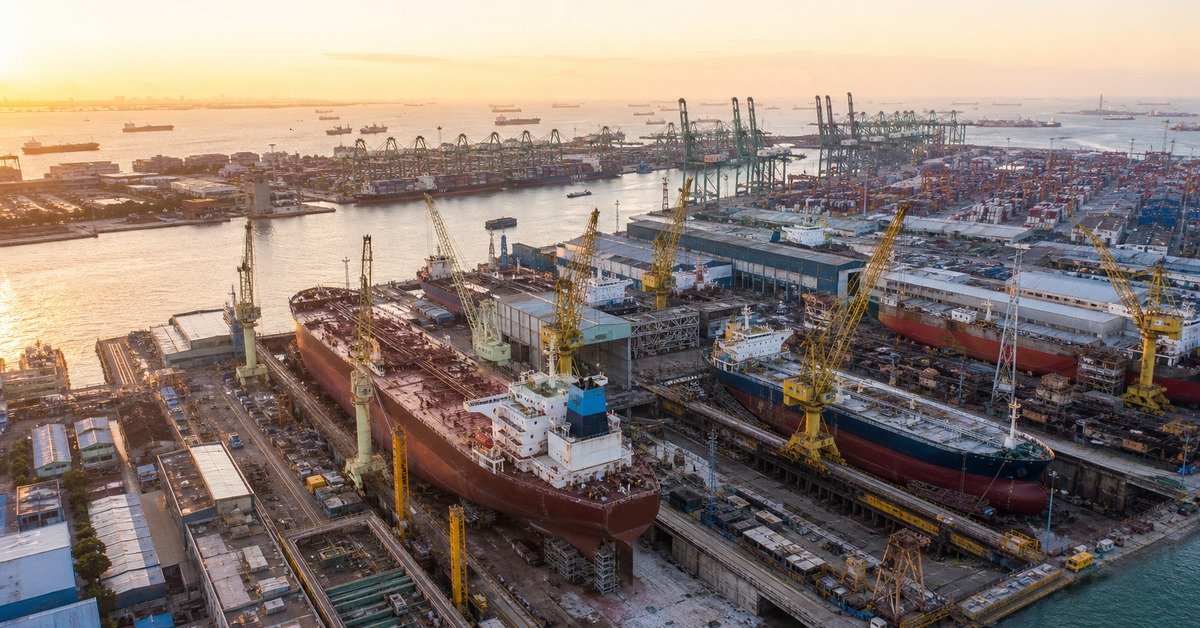
Singapore handles approximately 40% of the world’s ship repair and bunkering volume. That scale creates a dense, fast-moving supply chain for industrial consumables — pipe fittings, couplings, valves, gaskets — that flows from manufacturers in Korea, Europe, and the US through Singapore distributors, into ship chandlers’ hands, and onto vessels within hours.
Understanding how this supply chain works tells you what each participant needs from a pipe coupling supplier, and where failures happen.
Singapore’s Role as a Maritime Hub
Singapore’s maritime cluster is one of the largest in the world, built around three interlocking strengths:
Port infrastructure — The Port of Singapore Authority (PSA) handles over 37 million TEUs annually, making it one of the world’s busiest container ports. Vessel traffic means constant demand for maintenance, repair, and outfitting (MRO) supply.
Shipyard capacity — Seatrium (the 2023 merger of Sembcorp Marine and Keppel O&M) operates dry docks, fabrication yards, and rig-building facilities that require industrial pipe fittings in volume. Outfitting projects for new builds and repair schedules for drydocked vessels generate recurring demand for coupling products.
Ship chandler concentration — Singapore has one of the world’s highest concentrations of ship chandlers per port. Companies like Sinwa Global, Fuji Trading, and others supply vessels on extremely tight timelines — often within hours of a ship’s arrival.
For pipe coupling suppliers, this concentration is both an opportunity and a performance test. The chandlers know exactly what they need, and they know whether you can deliver it.
How Pipe Fittings Move Through the Supply Chain
The typical flow for pipe couplings in Singapore’s maritime sector:
Manufacturer (Korea / Europe / USA)
        ↓
Singapore distributor (holds inventory, handles certification)
        ↓
Ship chandler (aggregates orders, provides vessel delivery)
        ↓
Vessel (installation by ship's engineers or yard crew)
Each step in this chain has different performance requirements.
Manufacturer to distributor — This leg involves regular replenishment shipments, typically by sea freight from Korea (2–3 weeks lead time for JWC), with air freight used for urgent restocking. The distributor’s job is to hold enough depth in common sizes to decouple delivery speed from manufacturing lead time.
Distributor to ship chandler — This is the high-velocity segment. Chandlers place orders for multiple vessels simultaneously, often with same-day delivery requirements. A distributor who cannot fill a multi-line order from stock within a few hours is not viable as a chandler supplier. See same-day pipe coupling delivery in Singapore for what the operational standard looks like.
Ship chandler to vessel — The chandler consolidates multiple supplier orders into a single provision run to the vessel at berth. Timing is governed by the vessel’s port call schedule — if the ship sails at 14:00, the provision must arrive before 12:00. There is no flexibility on this deadline.
What Ship Chandlers Need from a Pipe Coupling Supplier
Ship chandlers operate differently from typical industrial buyers. Their core requirement is speed and reliability on a narrow product range.
Same-Day Stock
A chandler cannot hold large pipe coupling inventory themselves — they are logistics aggregators, not warehouses. They depend on their suppliers having stock depth and delivering the same day. The critical window is before noon for afternoon vessel departure.
Common sizes that ship chandlers order most frequently:
| Size | Application |
|---|---|
| DN25 (1″) | Auxiliary piping, instrumentation |
| DN40 (1½”) | Fuel and lubricant lines |
| DN50 (2″) | General service, bilge, ballast |
| DN80 (3″) | Cooling water, sea water systems |
| DN100 (4″) | Main coolant circuits |
| DN150 (6″) | Large bore sea water intakes |
Depth in these sizes — not breadth across the full DN range — is what a chandler actually needs.
ABS and Class Certifications
Vessels operated by major shipping companies often require ABS (American Bureau of Shipping), DNV (Det Norske Veritas), BV (Bureau Veritas), or LR (Lloyd’s Register) approved components for classification-critical systems. A chandler ordering for a DNV-classed vessel needs the coupling supplier to confirm whether the product is type-approved by that class society.
This is not a universal requirement for every supply. Deck hardware and auxiliary systems often don’t require class approval — only pressure-bearing components in classification-critical systems do. But the supplier needs to know the difference and respond accurately when asked.
Cross-Referencing from Vessel Drawings
A ship’s engineer will often present a part reference from the vessel’s original specification — a Victaulic style number, a Dresser coupling reference, or a drawing OD specification — and ask for a supply equivalent. The chandler passes this to the supplier, who needs to resolve it to a physical part quickly.
This is a technical task, not a catalogue search. For plain-end coupling cross-referencing, the JWC buyers guide covers the key model variants and their dimensional equivalents.
Key Sectors in Singapore’s Maritime Supply
Commercial Shipping
General cargo, container, and tanker vessels calling at PSA terminals. Supply is largely MRO — replacement couplings, repair clamps, expansion joints for damaged or worn systems. Volume is consistent but order sizes are small-to-medium.
Offshore Oil and Gas
Offshore supply vessels (OSVs), FPSOs, and jack-up rigs undergoing maintenance in Singapore’s yards. Coupling specifications for offshore service typically require higher material grades — SUS316 hardware, Viton gaskets for chemical resistance — and certification to ASME or offshore standards.
Naval and Defence
Republic of Singapore Navy vessels undergo refit at Sembcorp Defence & Engineering facilities. Naval supply is government-tendered and requires approved vendor status, but the underlying product needs — pipe couplings and repair fittings — are similar to commercial maritime.
Planned Maintenance vs Emergency Repair: How the Supply Chain Differs
The distinction between planned maintenance and emergency repair drives completely different supply chain behaviour.
Planned maintenance — Docking schedules are known weeks or months in advance. The ship chandler and their suppliers receive a material requisition list early. There is time to source non-stock items, confirm certifications, and aggregate the full provision. Price sensitivity is higher because there is time to compare quotes.
Emergency repair — A pipe fails at sea or during a port call. The ship needs a coupling within two to four hours. Price is secondary. The question is whether the supplier has the right part in stock right now. For these situations, stock depth in the right sizes, and a supplier who answers the phone at 6am, determines whether the vessel sails on schedule.
For reference, the pipe coupling installation guide covers the field installation steps that ship engineers and yard technicians follow once the part arrives.
What Separates a Viable Maritime Supplier from a General Industrial One
The maritime supply chain is more demanding than general industrial supply on three dimensions:
- Speed — hours, not days, for emergency orders
- Documentation — class certs, MTRs, and packing lists must accompany the goods
- Cross-referencing — vessel specs don’t always match stock part numbers cleanly
A supplier who can meet all three consistently earns chandler loyalty. One who fails on any of them — even once on a time-critical job — loses the account.
Key Takeaways
- Singapore’s maritime supply chain flows from manufacturer to distributor to ship chandler to vessel — and can move from order to delivery in under four hours for stocked items
- Ship chandlers need same-day stock depth in the high-frequency DN25–DN150 range, not breadth across the full size catalogue
- ABS, DNV, and class society certifications matter for classification-critical systems — the supplier must know the difference between what needs a cert and what doesn’t
- Emergency repair orders are price-insensitive — availability and speed determine the outcome
- Cross-referencing from vessel drawings and original equipment specs is a core technical service, not a secondary task
About David Phee Enterprise
David Phee Enterprise supplies JWC, Aju, and other pipe coupling brands to ship chandlers and shipyards across Singapore with same-day delivery on stocked items. For vessel-specific cross-referencing, class society documentation, and emergency supply, contact DPE directly.