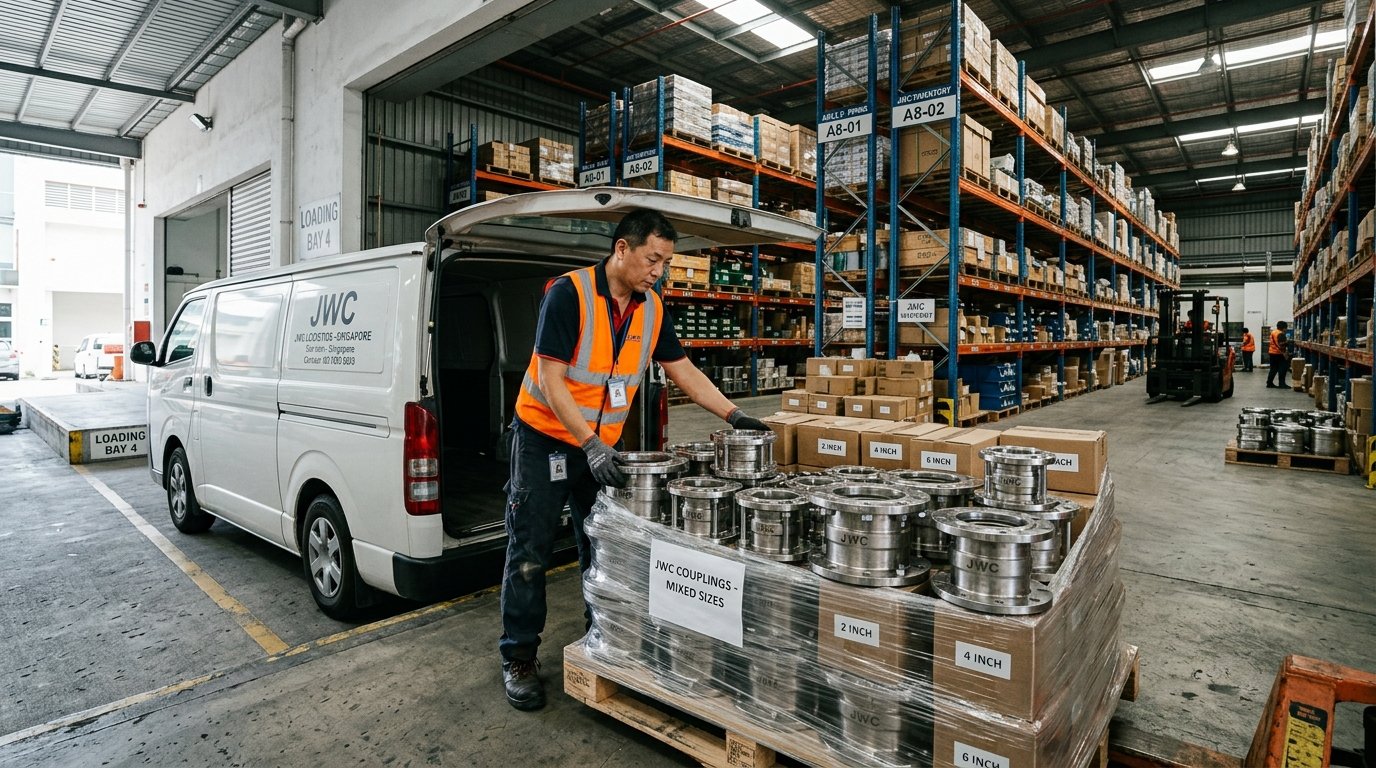
Same day pipe coupling delivery Singapore is not a convenience feature — for ship chandlers, Masters of merchant vessels, and shipyard maintenance teams, it is the line between a vessel sailing on schedule and one sitting idle in port. A single missing or incorrect pipe coupling on a fire-main, sea-water cooling line, or fuel-oil system can hold up a repair sign-off, which means no departure. The cost of that delay falls entirely on the vessel’s operator, and it accumulates by the hour.
This guide explains why overseas lead time is structurally unsuited to the maritime and industrial maintenance market in Singapore, what same-day local stock actually requires of a supplier, and what questions to ask before you commit to a sourcing relationship — especially if you are also moving orders into Malaysia or Indonesia.
Why Lead Time Is a Real Operating Cost
Every procurement team has a mental model of price as the primary variable in coupling sourcing. That model holds when the job is planned, the pipe system is offline, and there is time to consolidate orders across a shipping cycle. It breaks entirely under emergency or port-call conditions.
A merchant vessel calling at Singapore, Jurong, or Tuas typically has a narrow port window. Maintenance teams work against that window to complete hull inspections, clean exchangers, and repair or replace worn piping components. If a replacement coupling — one line item among dozens on the ship’s stores list — is not delivered before the vessel clears port, the repair is deferred, the defect log stays open, and the class surveyor may flag it at the next inspection.
For shipyards executing drydock repairs, the constraint is tighter still. A drydock slot has a fixed cost whether the ship is moving through the repair schedule or waiting for parts. When a coupling is specified, ordered from an overseas supplier, and then delayed in transit or customs, the cost of the wait is borne by the shipyard schedule — not the supplier’s invoice.
The same logic applies to industrial and process facilities. A pump isolation failing on a live cooling line, or a pinhole developing on a pressurised bilge header, cannot wait two to four weeks for an import order to clear. Facilities that stock no local buffer and rely entirely on overseas supply are, in effect, one repair event away from an unplanned shutdown.
What “Same-Day” Actually Requires of a Supplier
The phrase appears on many supplier websites. The operational reality is narrower. A supplier genuinely capable of same-day pipe coupling delivery in Singapore needs four things in place:
Permanent local stock, not a display catalogue. A website that lists every size from DN15 to DN400 is not evidence of inventory. The relevant question is which sizes are held in depth — enough quantity to fill a multi-line order without waiting for a top-up shipment from Korea, Europe, or the United States. For the most common marine and industrial sizes (roughly DN50 to DN150 in flexible, grip, and repair-clamp formats), a professional supplier holds enough to fill the average order from the shelf, same morning.
A defined order cutoff time. Most industrial suppliers in Singapore operate on a midday or early-afternoon cutoff for same-day dispatch. Orders placed after that threshold go out the following morning. Ask for the cutoff time explicitly — a vague answer usually means the supplier has no formal same-day capability, only best-effort dispatch.
Priority dispatch for emergencies. For vessel emergencies — a sailing window in three to four hours, a live-system repair with the ship alongside — some suppliers offer priority delivery on a short-lead basis. This is separate from standard same-day delivery and should be confirmed as an available option, not assumed.
Export-ready capability for regional orders. If you are sourcing from Singapore for a vessel in Indonesian waters, or a facility in Malaysia, same-day collection in Singapore is only half the answer. The supplier must be able to produce the export documentation — packing list, commercial invoice, correct HS codes — as part of the standard quotation, not as an afterthought that adds a day of administrative lead time.
For a broader assessment of what distinguishes a professional supplier from an order-taker, see our guide to choosing a pipe coupling supplier in Singapore.
The Hub-and-Spoke Advantage for Malaysia and Indonesia
Singapore’s position as the regional logistics hub is not incidental to the marine supply market — it is structural. The port handles among the highest container throughput in the world, bonded warehouse regulations are well-established, and the customs process for export to Malaysia and Indonesia is a known, documented workflow.
For regional buyers, this matters. A Singapore-based supplier with a hub-and-spoke model — holding inventory in Singapore and fulfilling Malaysia and Indonesia orders from that central stock — delivers consistency that a locally-based supplier in each market cannot replicate at the same stock depth.
The alternative, ordering directly from a manufacturer in Korea, Europe, or the United States for delivery to Batam, Johor Bahru, or Port Klang, introduces two lead-time risks: the manufacturing or dispatch cycle, and the import clearance at the destination. Both are variable. A Singapore hub order, by contrast, moves on a known timeline with export documentation the supplier has prepared many times before.
David Phee Enterprise operates exactly this model — Singapore-stocked inventory at Empire Technocentre in Kaki Bukit, with standard export processes for Malaysia and Indonesia orders. Regional buyers including ship chandlers and industrial contractors use this as a consistent sourcing pipeline for JWC grip-type couplings and related fittings without managing import complexity at the destination end.
Questions to Ask a Supplier Before You Commit
Before placing a time-sensitive order with any supplier, these five questions will tell you quickly whether their delivery capability matches their marketing:
| Question | Why it matters |
|---|---|
| Which sizes and types do you permanently hold in stock in Singapore? | Separates shelf inventory from catalogue listings |
| What is your same-day dispatch cutoff? | A clear time means real operational capability |
| How many pieces of DN50/DN80/DN100 flexible coupling do you have today? | Tests depth, not just breadth |
| Can you handle export to Malaysia or Indonesia on the same quotation? | Confirms regional capability |
| What is your lead time for non-stocked sizes? | Sets expectations for less common specifications |
A supplier who cannot answer the third question specifically — “around X pieces, lead time for top-up is Y weeks” — is almost certainly sourcing on demand rather than holding genuine inventory. That distinction becomes the entire problem when a vessel is sailing in twelve hours.
For sizing confirmation before placing an order, use our pipe coupling size chart to verify OD, DN, and coupling model against your pipe specification.
What to Expect on a Same-Day Order
For context, a standard same-day order process with a well-stocked Singapore supplier runs roughly as follows:
- RFQ sent by email or phone, covering item, size, quantity, and any material or certification requirements
- Quotation returned within four to eight hours on stocked items — often faster for straightforward lines
- Purchase order placed, delivery confirmed with an estimated window
- Delivery to site or vessel, with delivery order documentation
For marine orders, confirm early whether a class society certificate or material test certificate (MTC) is required. Most professional suppliers hold certificates for stocked items and can include them with the delivery. Requesting them after the delivery has been dispatched adds a paperwork step that the buyer then has to chase.
For installation once the fitting arrives, the pipe coupling installation guide covers the step-by-step process for plain-end mechanical couplings — including torque sequence and gap setting — which is relevant for any team installing JWC couplings in a vessel’s piping system for the first time.
FAQ
How fast is same-day delivery for pipe couplings in Singapore?
For orders placed before midday on stocked items, dispatch is the same day with delivery typically within four to six hours in Singapore. Priority delivery within two to three hours is available from some suppliers for vessel emergencies, usually on a surcharge basis.
Can a Singapore supplier deliver pipe couplings to Malaysia and Indonesia?
Yes, suppliers with export capability handle packing lists, commercial invoices, and HS code documentation as part of the standard quotation. Confirm this explicitly — suppliers focused only on domestic retail may not have these processes in place.
What coupling sizes does a good Singapore supplier hold in depth?
DN15 to DN150 in flexible and grip formats are the highest-turnover sizes and should be held in sufficient depth for same-day multi-line orders. DN200 and above are typically held in lower quantities or supplied on short import lead time.
What if I need a coupling with a class society certificate?
Reputable suppliers hold manufacturer certificates (ABS, DNV, LR, BV, ClassNK, and others) for stocked marine-grade products. Request the certificate requirement on the RFQ, not after delivery — most suppliers can include the document with the goods on the same day.
Does same-day delivery work for emergency repairs on a live system?
For live-pressure repairs, the coupling type matters first — a Romacon Snap Clamp, for example, can be applied without draining the line. Same-day delivery is the logistics answer; the right product for the application is the engineering one. Most professional suppliers can advise on both.
Key Takeaways
- A vessel or facility waiting on a missing pipe coupling is not experiencing a logistics inconvenience — it is incurring a real and measurable cost that accumulates until the part arrives and the repair is completed.
- Same-day delivery requires permanent local stock in depth, not just a catalogue listing. Test this by asking for a specific size count, not a lead-time promise.
- The hub-and-spoke model — Singapore-held inventory fulfilling regional orders to Malaysia and Indonesia — provides consistent lead times and export documentation that direct overseas sourcing cannot match.
- Order cutoff times, priority dispatch options, and export documentation capability are the three operational details that separate genuine same-day suppliers from aspirational ones.
- Confirm certificate requirements on the RFQ. For marine and classed work, material certificates and type-approval documents should travel with the delivery, not arrive separately later.
About David Phee Enterprise
David Phee Enterprise is the exclusive Singapore distributor for Jeong Woo Coupling (JWC) and a long-established supplier of Aju, Romacon, and Smith-Blair couplings, repair clamps, and expansion joints. Operating from Empire Technocentre in Kaki Bukit, DPE holds the JWC range in SUS 304 and SUS 316 for same-day delivery on stocked sizes, with export documentation as standard for Malaysia and Indonesia orders. Ship chandlers, shipyards, and industrial contractors across the region rely on DPE’s hub-and-spoke model when lead time matters. Visit davidphee.com for stock checks, quotations, and datasheets.