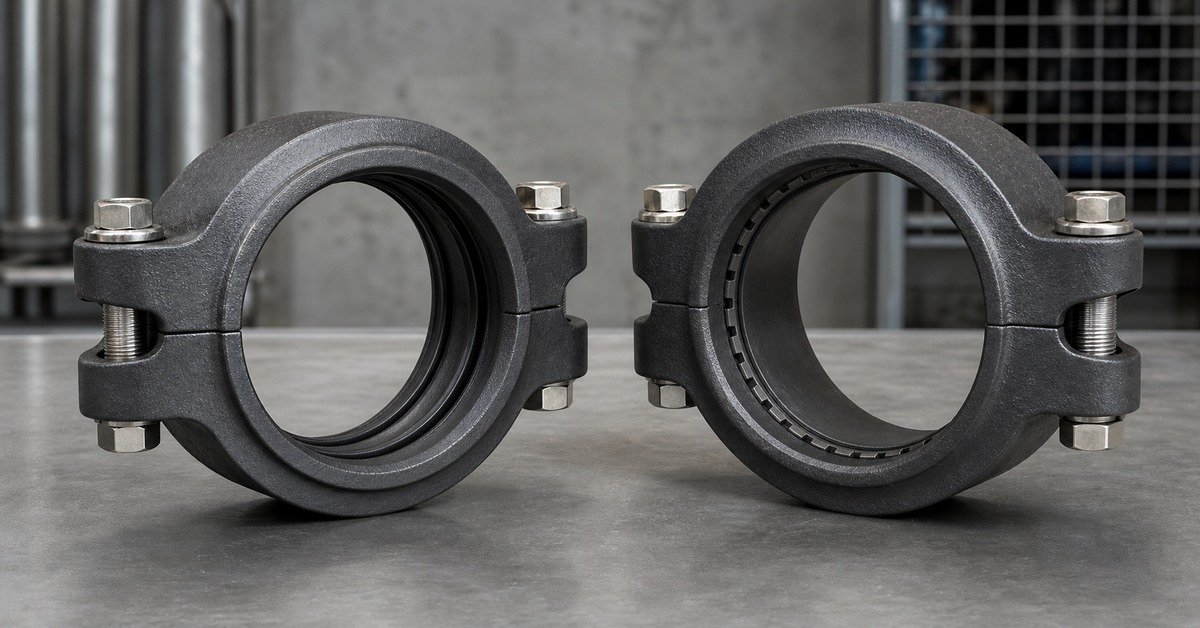
The introductory comparison between Victaulic and JWC covers the basics — brand origins, pricing tiers, and general use cases. This article goes further, covering dimensional compatibility, the grooved-end vs plain-end system distinction, project specification scenarios, and where each coupling type actually wins on technical grounds.
For the foundational comparison, see JWC vs Victaulic Singapore first.
The Critical System Distinction: Grooved-End vs Plain-End
This is the most important point in any Victaulic vs JWC comparison. Getting it wrong leads to mismatched orders that cannot be installed.
Victaulic Style 07 and Style 77 require roll-grooved pipe ends. The coupling housing captures a machined groove in the pipe OD, and the rubber gasket seals within that groove. Without a rolled groove, Victaulic couplings cannot seal. Installing a Victaulic coupling on plain-end pipe is not possible.
JWC MJG (grip-ring coupling) works on plain-end pipe. The internal grip rings bite into the pipe OD under bolt load. There is no groove required. The MJG is not interchangeable with Victaulic Style 07 or Style 77 — it is a different pipe preparation system entirely.
This means:
- You cannot substitute JWC MJG onto a Victaulic-grooved system without re-piping
- You cannot substitute Victaulic onto a JWC plain-end system without adding roll-grooving
- The two systems are parallel design choices, not drop-in alternatives
The only situation where direct substitution is possible is on JWC MJS (slip coupling) vs other plain-end systems — but that comparison is limited by pressure class differences.
Victaulic System Overview
Victaulic is an American manufacturer with over a century of history in grooved coupling systems. Its dominant position in Singapore’s HVAC and fire protection sector comes from UL and FM listing, which is mandatory for many fire suppression systems.
Key product families:
| Model | Type | Pressure rating | Notes |
|---|---|---|---|
| Style 07 Zero-Flex | Rigid | Up to 400 psi | For no-movement joints |
| Style 77 | Flexible | Up to 300 psi | Angular deflection permitted |
| Style 009 | Vic-Press | Up to 200 psi | Press-fit, no bolt hardware |
Victaulic requires:
– Roll-grooved pipe ends (machine required on site or pre-grooved pipe supplied)
– Victaulic-specific gaskets (70A or CompoSeal grade)
– Victaulic-certified installers for warranty-governed fire protection work
Where Victaulic wins:
– Fire protection systems (NFPA 13 / SS 575 compliance) requiring UL/FM listing
– Large commercial HVAC projects where the grooved system is already specified
– Projects where the engineering consultant has hard-specified Victaulic by brand
JWC System Overview
JWC (Jeong Woo Coupling) is a Korean manufacturer. The product range covers multiple plain-end coupling types, manufactured in ductile iron with SUS304 stainless hardware as standard.
Key product families:
| Model | Type | Working pressure | Pipe end |
|---|---|---|---|
| MJS | Flexible/slip | PN10 (10 bar) | Plain-end |
| MJG | Grip-ring | PN16 (16 bar) | Plain-end |
| MJGL | Long grip-ring | PN16 (16 bar) | Plain-end |
| MJGF | Grip-ring with flange | PN16 (16 bar) | Plain-end to flange transition |
| MJD | Reducing | PN10–PN16 | Plain-end |
JWC requires:
– Plain-end pipe (no grooving required, no special tooling)
– Standard bolt torque as per manufacturer specification (see bolt torque guide)
– No specialist installer certification — standard trade installation
Where JWC wins:
– Marine and shipboard service, where plain-end pipe is standard and grooving is impractical
– Industrial applications on plain-end pipe where grooved infrastructure doesn’t exist
– Projects where cost is a primary constraint and UL/FM is not required
– Replacement and repair work on existing plain-end pipe systems
Dimensional Comparison: Where Both Have Coverage
Both systems cover a similar nominal size range, but the pipe OD requirements differ because one system needs a groove and the other does not.
For the same nominal pipe size, a Victaulic coupling and a JWC coupling will have different housing internal diameters — the Victaulic housing is dimensioned to the groove OD, while the JWC housing is dimensioned to the pipe OD.
Common nominal sizes with both Victaulic and JWC coverage:
| DN (Nominal) | Pipe OD (mm) | Victaulic model available | JWC MJG available |
|---|---|---|---|
| DN50 (2″) | 60.3 | Style 07 / 77 | Yes |
| DN65 (2½”) | 73.0 | Style 07 / 77 | Yes |
| DN80 (3″) | 88.9 | Style 07 / 77 | Yes |
| DN100 (4″) | 114.3 | Style 07 / 77 | Yes |
| DN150 (6″) | 168.3 | Style 07 / 77 | Yes |
| DN200 (8″) | 219.1 | Style 07 / 77 | Yes |
| DN250 (10″) | 273.0 | Style 07 / 77 | Yes |
| DN300 (12″) | 323.9 | Style 07 / 77 | Yes |
For pipe OD reference across nominal bore and DN designations, see the pipe coupling size chart.
Project Specification Scenarios
Scenario 1: Fire Protection Sprinkler System — Specify Victaulic
A commercial building sprinkler system designed to NFPA 13 or Singapore’s SS 575 requires UL/FM listed components. Victaulic Style 07 and Style 77 are UL/FM listed; JWC MJG is not. There is no engineering workaround for this — if the spec requires UL/FM listing, JWC is not an option here.
Scenario 2: Marine Auxiliary Piping — Specify JWC
A vessel’s auxiliary seawater cooling system runs plain-end pipe. Roll-grooving requires specialised equipment that is not practical on a shipboard installation or during a short port call. JWC MJG installs directly onto plain-end pipe with standard tools, making it the correct system for marine applications. See flexible vs rigid pipe coupling for marine for the deflection and vibration considerations.
Scenario 3: Industrial Plant with Plain-End Pipe — Specify JWC
A manufacturing plant or process facility built on plain-end pipe schedule — common in Southeast Asian industrial construction — uses JWC throughout. Introducing Victaulic would require purchasing or renting a roll-grooving machine and re-ending the pipe.
Scenario 4: Retrofit onto Existing Grooved System — Victaulic Stays
Replacing a failed coupling on an existing grooved system means the groove is already there. In this case, Victaulic (or another grooved-end system) is required. Fitting JWC onto a pre-grooved pipe is not possible.
Scenario 5: New-Build where Specification Is Open — Evaluate Both
If the engineering spec allows either system, the decision comes down to pressure class, budget, and whether roll-grooving capability is available. JWC MJG at PN16 covers most building services and industrial pressure requirements. The price advantage of JWC over Victaulic is typically 30–50% on equivalent sizes for standard industrial service.
When to Call a Supplier for Cross-Referencing
The above scenarios cover the straightforward cases. In practice, procurement arrives with:
- A Victaulic style number but plain-end pipe already on site
- A JWC model number from a previous project but a grooved system in the new build
- A drawing reference that predates both brands
In these cases, cross-referencing requires knowing the pipe OD, the pressure class, the fluid type, and whether the existing pipe ends are grooved or plain. A supplier who holds both Victaulic-compatible products and JWC can resolve this quickly. One who carries only a single brand will push you toward their product regardless of fit.
David Phee Enterprise supplies JWC couplings and can cross-reference against Victaulic specifications for Singapore buyers.
Key Takeaways
- Victaulic Style 07 and Style 77 require roll-grooved pipe ends — JWC MJG does not; the two are not interchangeable and operate on different pipe preparation systems
- Victaulic is the correct choice when UL/FM listing is required, primarily for fire protection systems
- JWC MJG is the correct choice for plain-end pipe in marine, industrial, and general building services where grooved infrastructure does not exist
- Both brands cover DN50–DN300 in core sizes, but dimensional differences mean direct substitution requires re-piping the pipe ends
- When the specification is open, JWC MJG typically offers a 30–50% price advantage over Victaulic for equivalent pressure-class plain-end applications