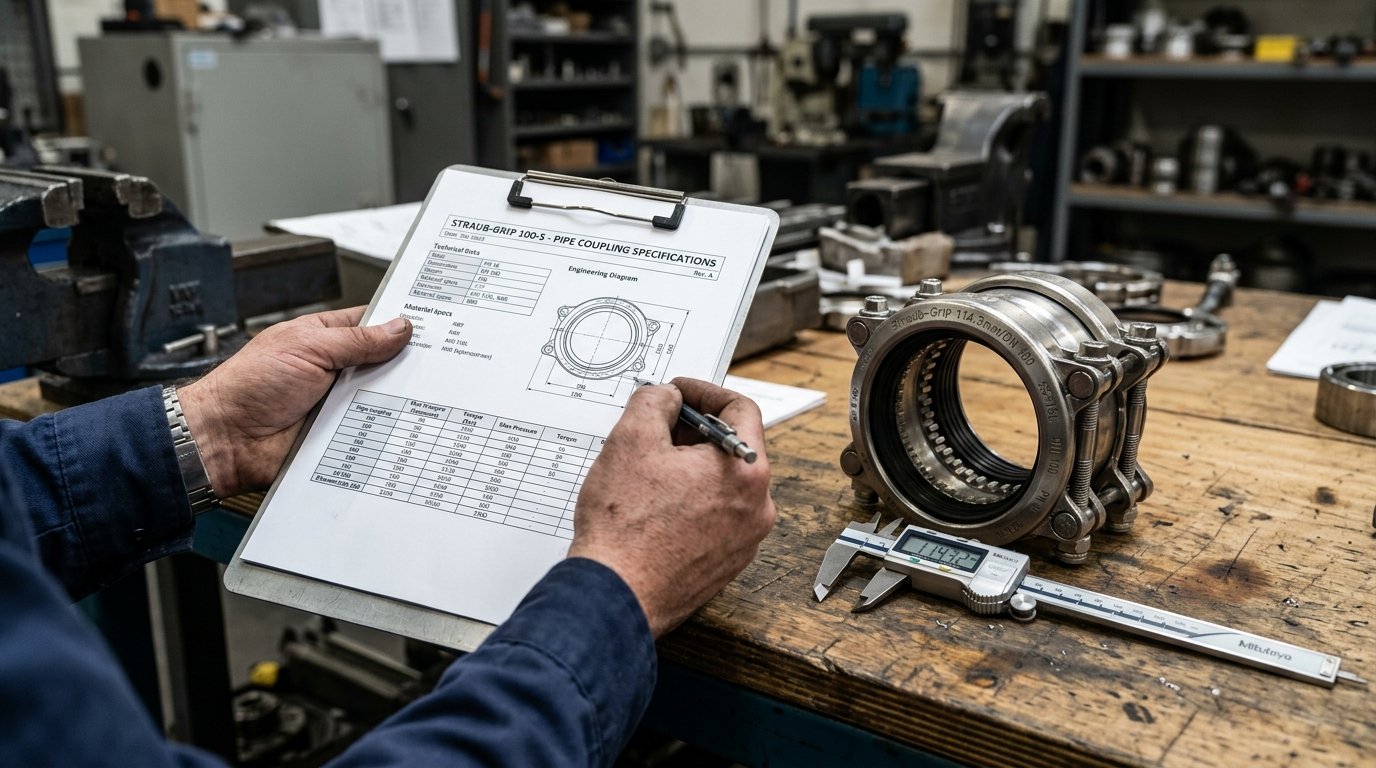
A pipe coupling datasheet specification tells you everything the part will and will not do — but only if you know which rows to read. Most procurement errors on mechanical coupling jobs are not sourcing mistakes; they are reading mistakes. The buyer ordered by size, the supplier shipped a valid catalogue item, and the coupling sat on the pipe without sealing because a pressure column, gasket code, or angular tolerance was not checked against the actual site conditions.
This walkthrough takes seven fields from a real mechanical-coupling datasheet and explains what each number means and what the selection mistake looks like in practice. The worked example throughout is the JWC grip-type coupling range — the Korean MP JOINT product that David Phee Enterprise distributes in Singapore — because it publishes separate ship and industrial ratings, multiple gasket variants, and seven class-society approvals. That breadth makes it a representative specimen for any buyer learning to read a coupling datasheet.
1. Nominal Size and OD Range — What the Coupling Actually Grips
Every datasheet opens with a size column. What matters is not the nominal designation (15A, DN50, NPS 2) but the OD range beside it — the minimum and maximum outside diameters the coupling will seal on. A mechanical coupling grips the outside of the pipe; it has no view of the bore.
The selection mistake: ordering by DN label alone without confirming pipe material. DN50 carbon steel to ASTM A53 is 60.3 mm OD. DN50 HDPE to ISO 4427 is approximately 50 mm OD. A steel-pipe coupling will not close on the HDPE pipe of the same DN label. Always confirm the pipe material and standard first, then cross-reference the coupling’s published OD range. Full DN-to-OD mapping is in our pipe OD vs nominal bore explainer.
2. Working Pressure — Ship vs Industrial, and What PN Means
Working pressure is the maximum continuous operating pressure the coupling is rated to sustain. Datasheets often publish two columns: ship (or marine) and industrial. These are not interchangeable marketing labels — they reflect different burst safety factors. JWC publishes a ≥4× burst safety factor for ship ratings and ≥2× for industrial. That means a coupling rated 8 bar ship has been tested to at least 32 bar burst; the same physical coupling rated 16 bar industrial has also been tested to at least 32 bar burst. The part is identical — the rating differences reflect what classification society rules require as the minimum safety margin for the application.
PN (Pressure Nominal) is the ISO/EN rating class — PN10, PN16, PN25 — expressed as the maximum allowable pressure in bar at 20 °C. PN is a system classification, not a coupling-specific test result. The coupling’s tabulated working pressure is the governing figure; if the datasheet shows 14 bar ship for a 300A MJG, that is what ABS, DNV, and LR have certified for Class II/III piping — PN is not a substitute.
The selection mistake: using the industrial figure on a classed vessel because it is the higher number. Class society surveyors work from the ship column. Using the higher industrial rating on a classed system can result in a non-conformance at survey.
3. Burst Pressure and Safety Factor — The Number Behind the Number
Working pressure is the operating limit. Burst pressure is the point at which the coupling fails under hydrostatic test. The ratio between them is the safety factor — and the datasheet should state it explicitly or allow it to be derived.
For context: a JWC 65A–125A standard grip coupling rated 14 bar ship carries a burst safety factor of ≥4×, meaning the coupling must survive at least 56 bar during type testing. The same coupling at 28 bar industrial carries a ≥2× factor, meaning the minimum burst threshold is also at least 56 bar — the two rating columns converge at the same tested strength, with the ship column reserving more headroom for dynamic loads, vibration, and water hammer typical of marine piping systems.
The selection mistake: treating working pressure as a hard ceiling. Working pressure already includes the safety factor. Running a system at 90% of working pressure on a ship is not “leaving headroom” — the 4× safety factor is the headroom. Design the system to stay comfortably within the working pressure figure, not above it.
4. Gasket Material — Fluid Compatibility and the Most Common Failure Mode
The gasket row on a coupling datasheet is typically a short code: EPDM, NBR, Silicone, FKM (Viton). Each code describes the rubber compound and, by extension, what the coupling will seal against long-term. Getting this wrong produces a coupling that seals on hydrostatic test and degrades within months in service.
JWC grip couplings ship with the following gasket options:
| Code | Compound | Compatible with | Not suitable for |
|---|---|---|---|
| EPDM | Ethylene Propylene | Water, hot water, dilute acids, alkalis | Oil, hydrocarbons, fuels |
| NBR | Nitrile | Oils, fuels, hydrocarbons, seawater | Hot water above ~100 °C |
| Silicone | Silicone rubber | Wide temperature range, food-grade | Strong solvents |
| FKM | Fluorocarbon (Viton) | High temperatures, aggressive chemicals | Low-pressure cryogenic |
The default gasket shipped from stock is typically EPDM. On a shipboard seawater cooling line or fuel-oil system, EPDM will swell and fail. The right selection is NBR. The gasket code on the datasheet is a one-word entry that changes the coupling’s service life by years. A full compatibility breakdown is in our NBR vs EPDM vs Viton gasket guide.
The selection mistake: not specifying gasket material on the purchase order. Many suppliers default to EPDM unless told otherwise. If the fluid is a hydrocarbon, seawater, or chemical service, specify NBR or FKM explicitly in writing.
5. Casing and Grip-Ring Material — Corrosion and Mechanical Load
Material rows on a datasheet define the casing and internal components. For stainless mechanical couplings, the standard entries are:
- Casing: SUS 304 (standard) or SUS 316 (chloride and marine environments, available on request)
- Grip rings: SUS 301H spring steel — the hardened alloy that gives grip couplings their pull-out resistance
- Bolts: Stainless steel (grade specified in the full datasheet)
SUS 304 and SUS 316 refer to the Japanese Industrial Standard equivalents of AISI 304 and AISI 316 respectively. The difference matters in salt-air and submerged marine environments: SUS 316 adds molybdenum, which significantly improves pitting and crevice corrosion resistance in chloride exposure. For a coupling in an engine room seawater system, the SUS 316 casing is the right answer; for a freshwater line in a controlled industrial building, SUS 304 is sufficient.
The grip ring material — SUS 301H — is separate from the casing. The H temper designation means the steel has been work-hardened to increase spring force and tooth bite. The grip ring is not interchangeable with a standard SUS 301 component; if a field repair uses the wrong internal ring, the pull-out resistance is compromised even though the coupling looks identical on the outside.
The selection mistake: specifying SUS 304 across the board without reviewing the service environment. On coastal installations or shipboard systems with regular saltwater spray, SUS 316 is not an upgrade — it is the correct specification.
6. Angular Deflection and Axial Gap — Tolerance for Real-World Installation
Two datasheet fields that are frequently ignored until installation day are angular deflection and axial gap. Both describe the coupling’s mechanical tolerance — what it will forgive if the pipe run is not perfectly aligned or the pipe ends are not perfectly flush.
Angular deflection is the maximum angle the coupling will seal across. JWC grip couplings publish size-dependent values:
| Nominal size | Max angular deflection |
|---|---|
| 15A–50A | 5° |
| 65A–175A | 4° |
| 200A and above | 2° |
Axial gap is the end-to-end distance between pipe faces that the coupling will bridge and still compress the gasket correctly. JWC values are:
| Nominal size | Gap range |
|---|---|
| 15A–65A | 0–8 mm |
| 80A and above | 0–15 mm |
Together these figures define how much misalignment and pipe-end variation the coupling tolerates. A 5° deflection at small bores is generous — it allows use on short curved runs and repair joints where the replacement pipe does not sit perfectly in line. A 2° tolerance at 200A is tight — large-bore installations require better pipe alignment before the coupling is fitted.
The selection mistake: ignoring angular deflection on large-bore installations. A 200A run with 3° of misalignment will exceed the coupling’s tolerance regardless of how well it is bolted. The pipe must be supported and aligned first, then the coupling installed.
For size-specific data on JWC grip-type couplings including the long-body MJGL (which accommodates a wider gap range for bridging cut-out sections), see the model guide.
7. Class-Society Approvals and Fire Rating — What the Stamp Actually Covers
The approvals row is the most misread row on a coupling datasheet. Seeing “ABS, BV, DNV, KR, LR, NK, RINA” does not mean the coupling is approved for every pipe system on any vessel classed by those societies. Each certificate specifies the models covered, the size range covered, the piping class (Class II, Class III), and whether fire-resistance applies.
JWC grip couplings carry current type approvals from ABS, Bureau Veritas, DNV, Korean Register, Lloyd’s Register, ClassNK, and RINA. The approvals cover Class II and III piping for marine and offshore work. However, the approved size range varies by society — for example, Korean Register’s current certificate covers MJG only to 300A, not the full 400A production range. A 350A MJG on a KR-classed vessel would require a separate confirmation.
Fire rating: JWC’s FRC (Fire-Resistant Cover) accessory has been tested to 800 °C / 30 minutes wet, meeting IACS UR P2.11 and ISO 19921/19922 requirements. However, fire-resistance scope is per-society and per-size — it is not a blanket extension. For most class societies (ABS, BV, LR, NK, KR, RINA), only MJG and MJGF with the FRC accessory qualify as fire-rated at the certified sizes. DNV additionally recognises specific sizes of the slip family (MJS, MJL, MJSF) as fire-resistant with NBR gasket — a unique provision that does not apply on other-society vessels.
The coupling datasheets and type-approval certificates do not carry FM Approval or UL listing. For FM- or UL-mandated fire-protection systems — commercial sprinkler mains, data-centre fire lines — a grooved mechanical system is the standard specified choice.
The selection mistake: assuming “DNV-approved” on the cover page means the coupling is approved for the specific system and size under survey. Always pull the current certificate, check the model and size entry, and confirm with the flag-state surveyor for systems that require fire rating.
For a full size and working-pressure reference, see our pipe coupling size chart.
Key Takeaways
- OD range, not DN label, governs coupling fit. Confirm the pipe material and standard; different materials give different ODs at the same nominal size.
- Read the ship and industrial pressure columns separately. They carry different burst safety factors — 4× and 2× respectively for JWC — and class surveyors expect the ship figure on classed work.
- The gasket code is a fluid-compatibility declaration, not a default. EPDM for water; NBR for oil and seawater; FKM for high heat and chemicals. Specify it on the purchase order.
- SUS 304 vs SUS 316 matters in marine and coastal environments. The grip ring — SUS 301H — is a hardened component that is not field-substitutable with standard SUS 301.
- Angular deflection and axial gap limits apply at the specified nominal size. Large-bore couplings (200A+) carry tighter tolerances — pipe alignment is a prerequisite, not a post-installation adjustment.
- Class-society type approval is model-specific, size-specific, and system-specific. Always read the certificate entry for your model, your size, and your piping class — not the cover page.
About David Phee Enterprise
David Phee Enterprise is the exclusive Singapore distributor for Jeong Woo Coupling (JWC) and a long-established supplier of Aju, Romacon, and Smith-Blair pipe couplings, repair clamps, and expansion joints. Operating from Empire Technocentre in Kaki Bukit, DPE supplies ship chandlers, shipyards, and industrial contractors across Singapore, Malaysia, and Indonesia — providing technical support on datasheet interpretation, class-society certificate retrieval, and gasket selection for marine and industrial applications, with same-day delivery on stocked sizes. Visit davidphee.com for datasheets, certificates, and sizing enquiries.